
Executive Assistant vs Virtual Assistant: Full Comparison
Key Takeaways
- EAs handle judgment-intensive, high-trust work; VAs handle defined, process-driven tasks.
- VAs cost $15-50/hr vs EA at $60,000-$100,000+/yr - but comparing cost without scope is misleading.
- Hire an EA when you lead at C-suite/VP level and your calendar directly affects company outcomes.
- Hire a VA when work is task-bounded, well-documented, and does not require confidential access.
- A fractional EA occupies the hybrid space - dedicated and experienced but remote and flexible.
- In 2026, AI tools shift the productivity ceiling for VAs but not the judgment ceiling - EAs still own the decisions a VA cannot be trusted to make independently.
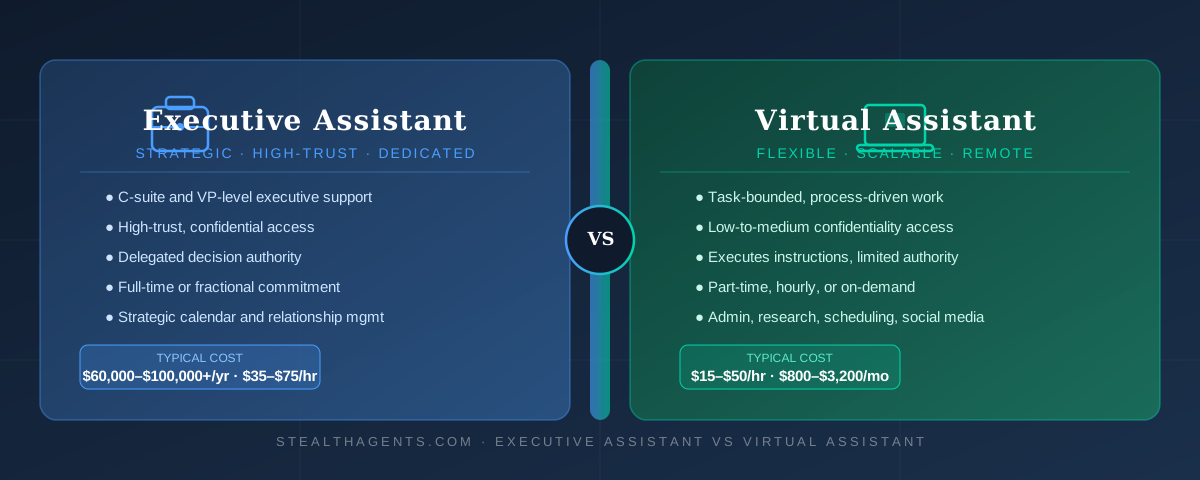
When your schedule is overflowing and your to-do list keeps growing, the instinct is to hire help. But the type of help matters. Choosing between an executive assistant (EA) and a virtual assistant (VA) is not just a cost decision - it is a strategic one that affects how closely supported your leadership function will be.
Return to the virtual assistant docs hub for more guides.
Executive Assistant vs Virtual Assistant: Comparison Table
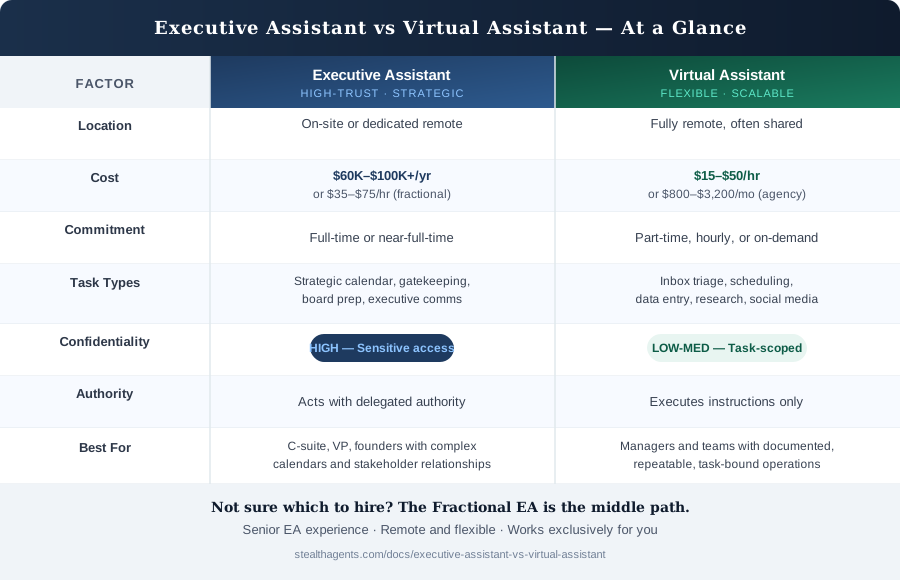
| Factor | Executive Assistant | Virtual Assistant |
|---|---|---|
| Location | Typically on-site or dedicated remote | Fully remote, often shared across clients |
| Cost | $60,000–$100,000+/yr (FTE) or $35–$75/hr | $15–$50/hr; project or package-based |
| Commitment level | Full-time or near-full-time | Part-time, hourly, or on-demand |
| Task types | Strategic calendar management, gatekeeping, board prep, executive comms, relationship management | Admin tasks, inbox triage, scheduling, data entry, research, social media |
| Confidentiality | High - privy to sensitive business decisions | Low-to-medium - task-scoped access |
| Upskilling | High - significant onboarding and context-building | Low - typically plug-and-play for defined tasks |
| Availability | Aligned to executive schedule (often extended hours) | Bounded to contracted hours/scope |
| Decision authority | Often acts with delegated authority | Executes instructions, rarely given authority |
When to Hire an Executive Assistant
An EA is the right hire when your leadership function has become a bottleneck. If you are spending hours each week on calendar juggling, missing follow-ups on key relationships, or losing context between meetings, a dedicated EA restores your ability to operate at the level your role demands.
Hire an EA when:
- You lead at the C-suite or VP level and your calendar directly affects company outcomes
- You need someone to manage cross-functional coordination, ensuring the right people are in the room with the right context
- You require someone who understands organizational politics and can act as a proxy in your name
- You are dealing with board-level reporting, investor relations, or high-stakes stakeholder communications
- You have a documented ADHD executive assistant need - an EA experienced in executive dysfunction support can be transformative for attention-regulation challenges at the leadership level
- Your calendar, inbox, and travel coordination are so intertwined that a shared resource creates more friction than it solves
A C-suite executive assistant at this level is not an admin. They are an extension of your operating system, with the context and trust to make decisions in real time.
Signals you are ready for an EA:
- You are regularly double-booked or missing strategic meetings
- Key relationships are slipping because no one is managing follow-ups
- You spend more than 5 hours per week on calendar and logistics alone
- You have tried a VA and found the task-based model insufficient for your complexity of work
When to Hire a Virtual Assistant
A VA is the right hire when the work is bounded, documentable, and does not require confidential access or organizational judgment. Most administrative and operational work falls into this category.
Hire a VA when:
- Tasks are process-driven and can be documented in an SOP
- Work does not require access to sensitive business decisions or confidential communications
- You need flexible, scalable support - hours that grow with your needs without a full-time commitment
- Your budget does not support a full-time hire, but the work volume justifies dedicated help
- You need support across multiple domains - admin, marketing, customer service, research - without specialized depth in each
The VA model works best for:
- Inbox triage and email management
- Calendar scheduling for non-executive functions
- Research, data entry, and reporting
- Social media management and content scheduling
- Customer service and CRM updates
- Travel coordination for standard itineraries
Explore what a virtual assistant can do for a full breakdown by function.
Cost: EA vs VA
The cost comparison between EAs and VAs is frequently cited but often misleading because the roles do not overlap as much as people assume.
Executive assistant cost:
- In-house full-time EA: $55,000–$95,000/year in base salary plus benefits (30–40% overhead)
- Fractional or contract EA: $35–$75/hour depending on experience and specialization
- Total cost of employment for an in-house EA: $75,000–$130,000+/year
Virtual assistant cost:
- Part-time VA (10–20 hrs/week): $600–$2,000/month
- Full-time VA (40 hrs/week): $1,600–$3,200/month through a staffing agency
- Offshore VA: $800–$1,600/month
The 60–75% cost difference is real - but only relevant if a VA can actually perform the work. For executive-level support requiring judgment and confidentiality, a VA is not a substitute regardless of cost.
See the virtual assistant cost guide for a detailed cost breakdown by role type.
The Fractional EA: A Middle Path
For leaders who need more than a standard VA but cannot justify a full-time EA, a fractional executive assistant bridges the gap. A fractional EA:
- Works exclusively for you (not shared across clients)
- Brings senior-level experience with executive support
- Operates remotely on a part-time or project basis
- Costs significantly less than a full-time in-house hire
This model is increasingly common for early-stage founders and VP-level operators who need EA-caliber support without a full-time seat.
Stealth Agents provides senior virtual and executive assistants matched to your specific workflow and complexity level.
Decision Guide: Which Should You Hire?
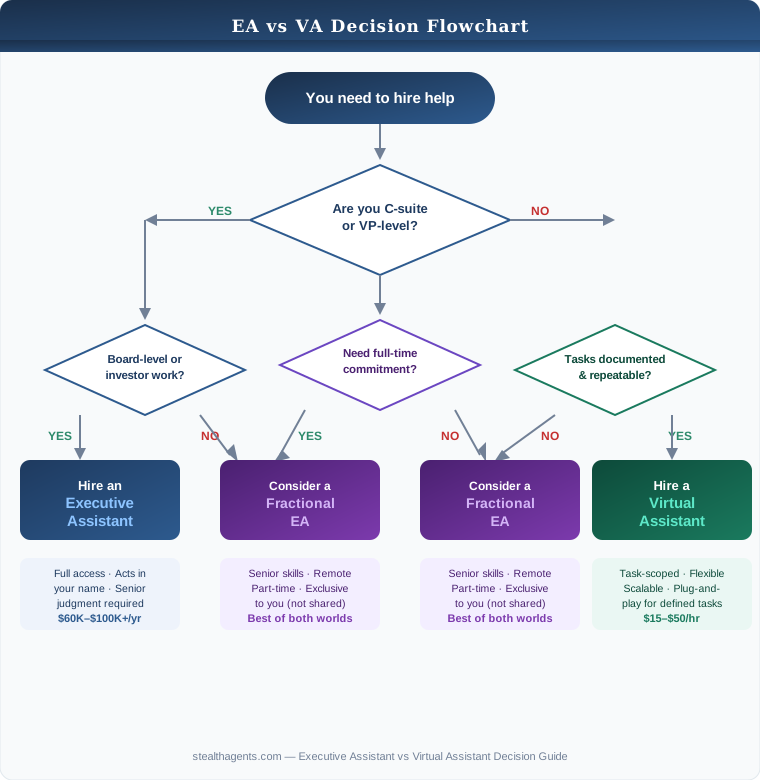
Summary: Which Should You Hire?
| Situation | Right hire |
|---|---|
| C-suite leader with complex calendar and stakeholder relationships | Executive Assistant |
| Founder or manager with high task volume and clear processes | Virtual Assistant |
| VP-level leader needing senior support without full-time commitment | Fractional EA |
| Team needing scalable admin, marketing, or research support | Virtual Assistant team |
| Leader needing someone to act in their name with investors or board | Executive Assistant |
AI Tools in 2026: Does This Change the EA vs VA Decision?
AI tools (ChatGPT, Claude, Perplexity) have increased the productivity ceiling for VAs - a VA using AI for research and drafting now completes those tasks 2-3x faster. This changes the cost equation somewhat: a skilled VA with AI tools can produce more output per hour than a comparable VA from three years ago.
What AI tools do not change is the judgment ceiling. The distinction between an EA and a VA was never about how fast they complete tasks - it was about what decisions they can be trusted to make. AI-augmented VAs are faster and more productive, but they still operate within defined task scope. They do not manage stakeholder relationships, prepare strategic briefings, or act as organizational proxies.
How AI shifts the EA vs VA calculation:
| Dimension | Before AI tools | With AI-augmented VA |
|---|---|---|
| Research output | 1-2 hours per topic | 20-40 minutes per topic |
| Email drafting speed | 30-45 min/batch | 10-15 min/batch |
| Task volume capacity | ~30 hrs/week of output | ~50-60 hrs/week equivalent |
| Judgment and decision authority | Task-scoped | Still task-scoped |
| Executive-level communications | Not appropriate | Still not appropriate |
| Cost | $15-$40/hr | Same rate, higher output |
The practical implication: If you were previously on the fence between a VA and an EA because you needed faster turnaround on research and admin tasks, an AI-savvy VA may now close that gap. If the reason you needed an EA was judgment, confidentiality, and delegated authority - those requirements are unchanged.
When evaluating VAs in 2026, ask specifically about AI tool use: which tools they use, how they verify AI output before delivery, and what data they protect from AI platforms. A VA who uses AI tools well and verifies output rigorously is a meaningfully stronger hire than one who does not.
Related Resources
- C-Suite Executive Assistant - dedicated support for C-suite leaders with board-level responsibilities
- Executive Assistant for ADHD Executives - structured EA support designed for executives with ADHD
- Fractional Executive Assistant - experienced remote EA support without a full-time commitment
Frequently Asked Questions
Do AI tools make a VA as capable as an executive assistant?
No. AI tools increase a VA's output speed - research, drafting, and data tasks complete 2-3x faster with tools like ChatGPT or Claude. But they do not change the judgment ceiling. An EA is distinguished by delegated authority, stakeholder trust, and organizational judgment - not by how fast they complete tasks. AI-augmented VAs produce more per hour; they still operate within task-scoped boundaries that an EA does not.
Is a virtual assistant cheaper than an executive assistant?
Yes, in most cases. VAs typically charge $15-$50/hr. A full-time EA at the senior level can cost $70,000-$100,000+/year. The comparison is misleading if task scope differs: a VA cannot perform the judgment-intensive, high-trust work of an EA.
Can a VA replace an executive assistant?
For task-bound administrative work, yes. For executive-level support, no. An EA operates with access to sensitive business decisions, acts with delegated authority, and manages relationships on behalf of the executive.
What tasks can an executive assistant do that a VA cannot?
An EA can manage complex calendar negotiations, draft confidential communications in your voice, represent you with board members or investors, prepare strategic briefing documents, and triage decisions with organizational judgment.
When should I hire an EA instead of a VA?
Hire an EA when you lead at the C-suite or VP level, when your calendar directly affects company outcomes, or when you need someone to act as a proxy with board members, investors, or senior stakeholders. Hire a VA when work is task-bounded and well-documented.
Ready to hire a virtual assistant?
Stealth Agents matches you with pre-vetted VAs in 24 to 48 hours.
Talk to a Staffing Expert