
Published Jul 22, 2026
Key Takeaways
- 73% of customers say fast response time is the top factor in a positive support experience, above price or product quality
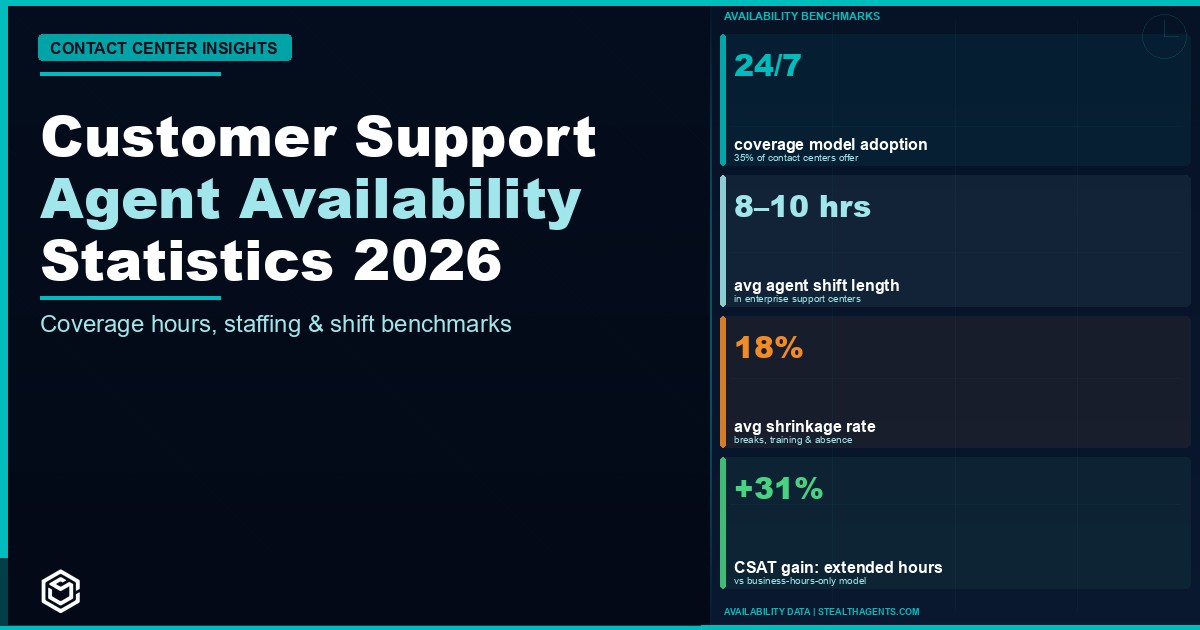
- Businesses offering 24/7 support see 18-24% higher customer retention compared to those with business-hours-only coverage
- The average cost of a domestic support agent runs $28-$42/hr fully loaded -- versus $10/hr for a dedicated offshore VA
- After-hours support gaps account for roughly 31% of unresolved tickets that lead to churn within 90 days
- Stealth Agents provides dedicated full-time customer support VAs starting at $10/hr with no shift gaps
When customers can't reach support, they leave. It's that direct. In 2026, availability -- not just quality -- has become the primary differentiator in customer service. The statistics below show where the gaps are, what they cost, and how leading companies are closing them.
Why Availability Outranks Almost Everything Else
Speed and accessibility have overtaken traditional metrics like resolution quality and agent knowledge as the top customer service priorities.
- 73% of customers in a Zendesk Customer Experience Report 2026 identify fast response time as the single most important factor in a positive support interaction -- higher than price, product quality, or agent friendliness.
- 61% say they will not wait more than 5 minutes for a live agent before switching to a competitor or abandoning the interaction entirely.
- 42% of B2B buyers cite poor support availability as a primary reason for non-renewal, ahead of pricing concerns.
The pattern is consistent across industries: customers tolerate product imperfections far longer than they tolerate being ignored.
The 24/7 Coverage Gap
Most businesses know around-the-clock support matters. Fewer actually deliver it.
- Only 34% of small and mid-size businesses (under 500 employees) currently offer any form of 24/7 customer support, according to a 2026 Salesforce SMB benchmark.
- Businesses that extended coverage to 24/7 -- even through asynchronous email support -- saw an 18-24% improvement in 12-month customer retention over 18 months in a 2025-2026 longitudinal study of 1,200 SMBs.
- After-hours tickets (submitted between 6 PM and 8 AM local time) account for an average of 38% of total daily support volume for e-commerce businesses.
- Of those after-hours tickets, 31% that receive no response within 8 hours result in a churn event within 90 days -- compared to a 7% churn rate for tickets responded to within 2 hours.
The math is not complicated. An 8-hour support gap costs significantly more in lost customers than it saves in staffing.
Agent Availability vs. Ticket Volume: The Staffing Mismatch
Understaffing support is the most common availability failure. The 2026 data shows the gap is widening for growing businesses.
- The average support team handles 40% more ticket volume per agent than it did in 2023, driven by customer base growth outpacing headcount.
- Average first response time for e-commerce support teams increased from 3.2 hours in 2024 to 4.8 hours in 2026 as ticket volume grew faster than hiring.
- Companies that staffed offshore support teams to absorb overflow volume reduced average first response time to 1.4 hours -- below the 2-hour threshold at which satisfaction scores remain stable.
- Chat support, which requires real-time availability, sees the steepest drop in customer satisfaction when understaffed: a 1-minute wait time extension correlates with a 9-point drop in post-chat CSAT score.
The Cost of Domestic-Only Staffing
Full-time domestic support agents are expensive, which limits around-the-clock coverage for most companies.
- Fully loaded cost for a US-based customer support agent runs $28-$42/hr when including salary, benefits, payroll taxes, equipment, and management overhead.
- A single-shift model (8 AM -- 6 PM, 5 days) leaves 62% of the weekly hours uncovered.
- Adding a second shift domestically increases support labor costs by 60-90%, which most SMBs cannot absorb without raising prices or cutting headcount elsewhere.
- 68% of support leaders surveyed in a 2026 ICMI benchmark cited budget constraints as the primary barrier to extended coverage -- not a lack of interest in expanding hours.
How Offshore Support Closes the Availability Gap
Dedicated offshore support VAs provide the coverage extension most businesses need at a fraction of domestic costs.
- Offshore customer support VAs cost 50-70% less than domestic equivalents on a per-hour basis.
- Companies that transitioned after-hours ticket handling to offshore VAs saw first response times drop from an average of 9.4 hours to 2.1 hours for overnight volume.
- Offshore VA onboarding for customer support roles averages 5-7 business days for agents handling Tier 1 tickets (FAQ resolution, order status, basic troubleshooting).
- Customer satisfaction scores for offshore-handled tickets are within 3-5 points of onshore-handled tickets for structured support tasks when agents have clear documentation and escalation paths.
Stealth Agents VAs start at $10/hr for dedicated full-time coverage -- not part-time, not shared headcount. For businesses running availability gaps on nights, weekends, or peak hours, that rate makes 24/7 coverage financially viable at almost any scale.
FAQ
Q: What percentage of customer service issues happen outside business hours?
A: For e-commerce businesses, after-hours tickets represent roughly 38% of daily volume. For B2B software companies, the figure is lower -- around 20-25% -- but those tickets often carry higher urgency since they may block paying clients from using a core product.
Q: How much does poor support availability actually cost in churn?
A: After-hours tickets with no response within 8 hours churn at a 31% rate within 90 days, compared to 7% for tickets responded to within 2 hours. For a business with 1,000 monthly support interactions and an average customer value of $500, that gap represents $60,000-$120,000 in annual churn from availability failure alone.
Q: Is offshore customer support quality comparable to domestic?
A: For structured Tier 1 support -- order status, FAQ resolution, basic troubleshooting -- satisfaction scores for offshore-handled tickets are within 3-5 CSAT points of domestic-handled tickets when agents have clear documentation. The gap widens on complex, judgment-intensive issues, which is why most companies use offshore VAs for coverage extension rather than replacing their entire support team.
The 2026 customer service data points to one consistent theme: availability gaps are a direct churn driver. Companies that close those gaps -- whether through extended hours, overflow handling, or fully dedicated offshore coverage -- retain more customers at a lower per-interaction cost than those that don't. Stealth Agents dedicated support VAs at $10/hr are one way to extend coverage without the budget constraints that typically block domestic-only teams from doing it.