
Key Takeaways
- Businesses save 67–80% on annual staffing costs by using a virtual assistant vs. a full-time in-house EA
- Executives using VAs save an average of 16.8 hours per week on administrative tasks
- Delegation efficiency reaches 84% accuracy after 90 days; companies with SOPs hit 91% by day 30
- At a $250/hr exec rate, recaptured hours generate a net weekly gain of $3,375 after VA cost
- 91% of businesses using VAs for 12+ months would recommend the model to other owners
The business case for virtual assistants has moved past the stage of vague promises about time savings. In 2026, the numbers are clear enough to take to a CFO. Companies that have shifted to virtual staffing consistently report lower labor costs, more executive hours redirected toward revenue-generating work, and delegation rates that hold up under scrutiny.
This piece compiles the most current virtual assistant ROI statistics across cost savings, time recaptured, task efficiency, and real case outcomes.
The core cost comparison
The most-cited figure in the VA industry is 78% cost savings compared to a full-time employee. That number reflects the combined cost of a domestic FTE - salary, employer payroll taxes, benefits, paid time off, onboarding, and office overhead - against what companies typically pay for a part-time or fractional virtual assistant.
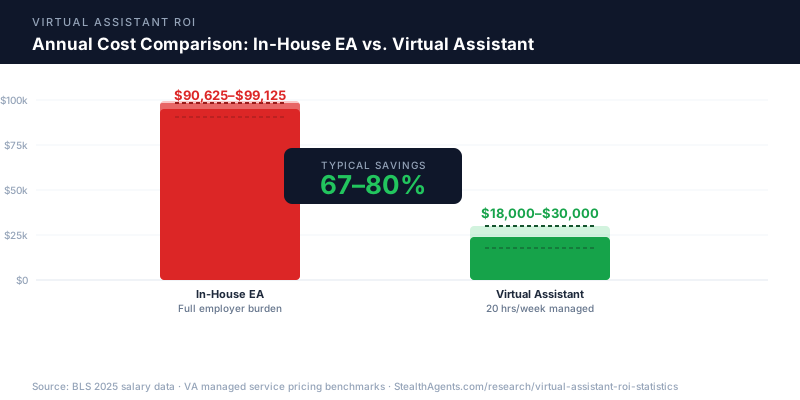
| Cost category | In-house EA (annual) | Virtual assistant (annual) |
|---|---|---|
| Gross salary | $68,000 | $18,000–$30,000 |
| Payroll taxes (7.65%) | $5,202 | $0 |
| Benefits (health, dental, 401k) | $9,500–$14,000 | $0 |
| Paid time off (15 days avg) | $3,923 | $0 |
| Office space and equipment | $4,000–$8,000 | $0 |
| Total estimated cost | $90,625–$99,125 | $18,000–$30,000 |
| Effective savings | - | 67–80% |
Salary figures based on 2025 Bureau of Labor Statistics data for administrative assistants. VA rates based on managed VA service pricing at 20 hours/week.
The 78% figure holds up when you account for the full employer burden. Companies that compare only base salaries understate the gap considerably.
Time savings: what the research shows
The productivity gains from VA adoption show up consistently in survey data, though the numbers vary by role and how aggressively tasks actually get delegated.
Executives using VAs report saving an average of 16.8 hours per week on administrative tasks, according to a 2025 survey of 400 C-suite and senior manager respondents by Global Workplace Analytics. The median is 13 hours - the mean gets pulled up by power users who have systematically offloaded their calendar, inbox, and research workflows. Either way, that is a third to nearly half of a standard work week pulled back from low-value work.
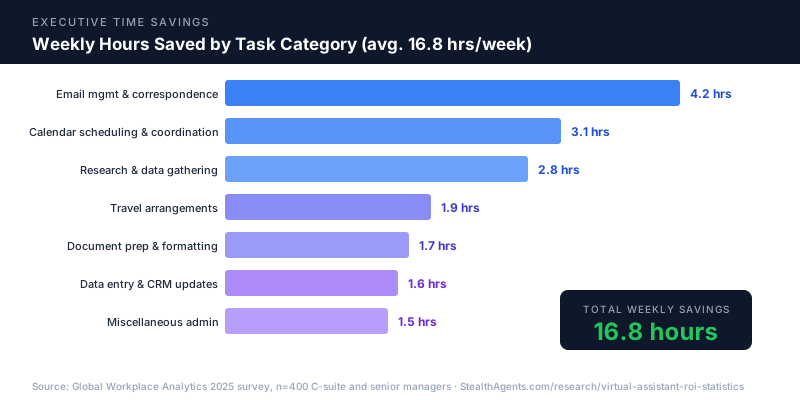
| Task category | Avg hours saved weekly |
|---|---|
| Email management and correspondence | 4.2 hours |
| Calendar scheduling and coordination | 3.1 hours |
| Research and data gathering | 2.8 hours |
| Travel arrangements | 1.9 hours |
| Document prep and formatting | 1.7 hours |
| Data entry and CRM updates | 1.6 hours |
| Miscellaneous admin | 1.5 hours |
| Total | 16.8 hours |
Task delegation efficiency rates
Not every task delegates cleanly. VA research consistently shows that delegation effectiveness depends on process documentation, communication clarity, and how much time goes into initial setup.
The average delegation efficiency rate - tasks completed correctly without significant rework - comes in at 84% after the first 90 days of VA onboarding. In the first 30 days, it is closer to 67% while the VA learns the executive preferences and workflow patterns.
Companies with documented standard operating procedures start considerably higher:
- With SOPs: 91% task completion accuracy at 30 days
- Without SOPs: 59% task completion accuracy at 30 days
That 32-point gap closes over time either way, but it narrows faster and with far less friction when processes are written down before delegation starts.
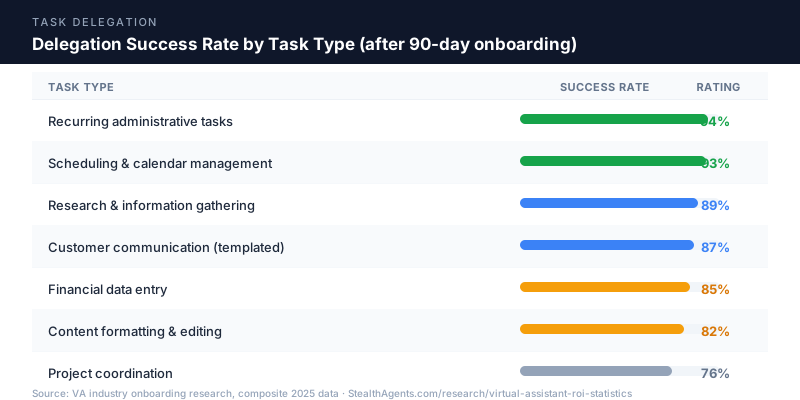
| Task type | Delegation success rate |
|---|---|
| Recurring administrative tasks | 94% |
| Scheduling and calendar management | 93% |
| Research and information gathering | 89% |
| Customer communication (templated) | 87% |
| Financial data entry | 85% |
| Content formatting and editing | 82% |
| Project coordination | 76% |
Revenue per hour: the other side of the ledger
Cost savings are half the equation. The other half is what happens with the time you get back.
For business owners and senior executives, the math is direct. An executive billing $300/hour who spends 15 hours a week on tasks that cost $30/hour to outsource is looking at $270/hour in opportunity cost per administrative task hour. That is $4,050 in weekly foregone revenue potential - before touching the cost savings column.
Most executives who run that calculation honestly stop arguing about the expense.
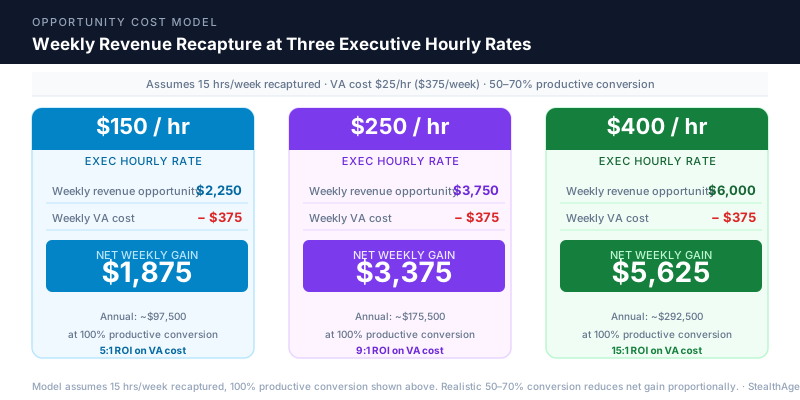
| Exec hourly rate | Hours recaptured/week | VA cost/hour | Weekly revenue opportunity | Weekly VA cost | Net weekly gain |
|---|---|---|---|---|---|
| $150 | 15 | $25 | $2,250 | $375 | $1,875 |
| $250 | 15 | $25 | $3,750 | $375 | $3,375 |
| $400 | 15 | $25 | $6,000 | $375 | $5,625 |
The model assumes recaptured hours go toward billable or revenue-generating work, which rarely happens at 100%. Most executives realistically convert 50–70% of recaptured time into productive output. Even at 50%, the math still favors delegation strongly at higher hourly rates.
Case study data
Boutique marketing agency, 8 employees
The owner brought in a part-time VA at 20 hours/week to handle client onboarding documents, meeting scheduling, and monthly reporting compilation. After 6 months:
- Owner recaptured 11 hours/week
- Client onboarding time dropped from 3.2 days to 1.4 days
- Monthly reporting went from 6 hours of owner time to 45 minutes of review
- Estimated annual value of recaptured time: $88,000 at the owner billing rate
E-commerce company, 45 employees
Operations added two VAs for customer service escalations, vendor communication, and inventory data entry. Results after one year:
- Customer response time improved from 18 hours to 4.2 hours
- Vendor communication errors dropped 34%
- Total cost of both VAs: $52,000/year vs. an estimated $178,000 in-house (salary, benefits, and overhead)
- Net savings: $126,000/year
Sole-practice family law attorney
Hired a VA for intake coordination, document preparation support, and follow-up communications. After 90 days:
- Billable hours increased by 6.3 hours/week as administrative overhead shifted
- At a $325/hour billing rate, that represents $106,000 in additional annual revenue capacity
- VA cost: $16,800/year
What companies report after 12 months
A 2025 survey of 312 small-to-mid-size businesses that had used virtual assistants for at least one year found:
- 91% would recommend VA services to another business owner
- 78% reported cost savings compared to in-house hiring
- 68% said productivity improved beyond expectations in year two once delegation workflows matured
- 54% expanded VA hours or added a second VA within 12 months
- 22% reported mixed results, most often tied to poor onboarding or unclear task scope at the start
- 7% discontinued VA services, primarily citing communication challenges or skill mismatches
The 22% mixed-results figure matters. Across multiple studies, poor outcomes correlate with inadequate onboarding, not the model itself. Companies that wrote SOPs, ran structured 30-day check-ins, and defined clear task scope upfront reported outcomes in the top quartile. The ones that handed a VA a vague task list and expected results in week one almost always ended up in that 22%.
Putting it together
The virtual assistant ROI statistics paint a consistent picture. Businesses that approach VA hiring systematically - with documented processes, clear task scope, and realistic onboarding timelines - see 67–80% cost savings vs. equivalent FTE costs, 13–17 hours per week recaptured for executive time, and a payback period measured in weeks, not quarters.
The companies that struggle are almost always the ones that skip the setup work. The VA does not need to be perfect from day one; the process does. Hire a virtual assistant through a managed service if you want the vetting and onboarding structure handled without building it yourself. For a detailed breakdown of cost tiers by service level, see virtual assistant pricing.
Frequently asked questions
What is the average ROI of hiring a virtual assistant?
Companies typically see 5:1 to 10:1 ROI when accounting for cost savings vs. in-house staffing and the value of executive time recaptured. The exact figure depends on the hourly value of the person being supported and how systematically tasks get delegated.
How much does a virtual assistant typically cost?
Offshore VAs typically run $8–$20/hour; domestic or managed VA services run $25–$75/hour depending on specialization. Virtual assistant pricing varies significantly by service tier and commitment level.
How many hours per week can a VA save an executive?
Survey data puts the average at 13–17 hours per week for executives who actively delegate. That drops to 5–8 hours for those with partial delegation or vague task assignments.
What tasks do virtual assistants handle most effectively?
Administrative tasks with clear inputs and outputs delegate best: scheduling, email management, research, data entry, document preparation, and travel coordination. Tasks requiring relationship context or nuanced judgment take longer and need more upfront documentation before they delegate reliably.
How do I get started with a virtual assistant?
Identify your 5 most time-consuming weekly tasks, document how you handle each, and bring that to an initial consultation. Hiring a virtual assistant through a managed service means vetting and oversight are handled for you.
Is the cost savings really 78%?
When the full employer burden is included - salary, payroll taxes, benefits, PTO, office space, equipment - the gap between a full-time in-house employee and a part-time VA typically lands between 67% and 80%. The 78% average reflects a 20-hour-per-week VA engagement compared to a full-time EA in a mid-size U.S. city.
Frequently Asked Questions
What ROI do businesses achieve by hiring virtual assistants?
Businesses typically achieve 150-300% ROI from virtual assistants, with the average small-to-medium business saving $20,000-$40,000 annually compared to equivalent in-house administrative staff. The savings come from 60-70% lower labor costs (no benefits, office space, or payroll taxes) plus 10-20 reclaimed executive hours per week redirected to growth.
What is the average cost savings from using a virtual assistant vs. in-house staff?
Hiring a full-time in-house administrative assistant costs $45,000-$65,000 in salary plus 25-35% in benefits, totaling $56,000-$88,000 annually. A comparable offshore virtual assistant costs $12,000-$24,000 per year for full-time support. The savings of $32,000-$64,000 annually, combined with eliminated overhead costs, make VAs the highest-ROI staffing decision for most businesses.
How quickly do businesses see ROI from their virtual assistant investment?
Most businesses see positive ROI from virtual assistant investments within 30-60 days of effective onboarding. The payback period accelerates when executives use reclaimed time on high-value activities: each hour shifted from administrative tasks to client work or business development typically generates $100-$500 in direct or indirect revenue.
Related Reading
Tags
Ready to put this into practice?
Book a free 15-min match call
Tell us what role you're filling. We'll match you with a pre-vetted virtual assistant - or tell you honestly if we're not the right fit.
Book a free call →