
Updated Jul 18, 2026
Remote work standing desk statistics in 2026 reveal a sharp gap between what the research recommends and what most home offices actually contain.
Only 22% of remote workers own a height-adjustable sit-stand desk for their home office. Yet the health and productivity data supporting these desks is among the most consistent in occupational health research. This article covers the key numbers, what they mean for remote workers and employers, and why the adoption gap persists.
How Many Remote Workers Actually Use a Standing Desk?
About 22% of remote workers own a height-adjustable sit-stand desk at home. In contrast, roughly 53% of on-site office employees have access to one at their employer's facility.
The gap is largely a procurement problem. Corporate facilities teams buy in bulk and spread costs over years. An individual remote worker buying out of pocket faces retail prices starting around $300 for entry-level electric models and exceeding $1,500 for commercial-grade frames. Even with an employer stipend, the typical $500 to $1,000 allowance covers only part of a mid-tier desk.
Among remote workers who don't own a standing desk, Owl Labs' State of Remote Work (2025) found:
- 61% said cost was the primary barrier
- 29% cited limited home office space
- 18% didn't know their employer would help cover the cost
For employers managing remote teams, this creates a practical support gap. A virtual assistant can handle the administrative side of ergonomic equipment programs — vendor research, stipend tracking, and procurement coordination — so your HR team isn't buried in logistics.
Remote Workers Sit Far More Than Office Employees
Remote workers average 10.4 hours of sitting per day, compared to 7.7 hours for in-office employees. The difference is incidental movement. Office workers walk to meeting rooms, visit a cafeteria, and move between floors throughout the day. Home offices don't generate that activity.
The World Health Organization classifies anyone sitting more than 8 hours daily as highly sedentary. Most remote workers hit that threshold routinely.
| Sitting Behavior | Remote Workers | In-Office Workers |
|---|---|---|
| Average daily sitting time | 10.4 hours | 7.7 hours |
| Exceed WHO 8-hour threshold daily | ~70%+ | ~40% |
| Have access to a standing desk | 22% | 53% |
Research in the American Journal of Epidemiology linked sitting more than 6 hours per day to a 37% higher mortality risk for women and 17% for men, compared to sitting under 3 hours.
Health Benefits: What Standing Desks Actually Change
The clinical case for sit-stand workstations is consistent across multiple independent studies.
Back and neck pain: A CDC-funded study found 4 weeks of sit-stand desk use produced a54% reduction in upper back and neck pain compared to a seated control group. When participants returned to standard seated desks, pain levels climbed back toward baseline within 2 weeks — confirming the desk change was the active variable.
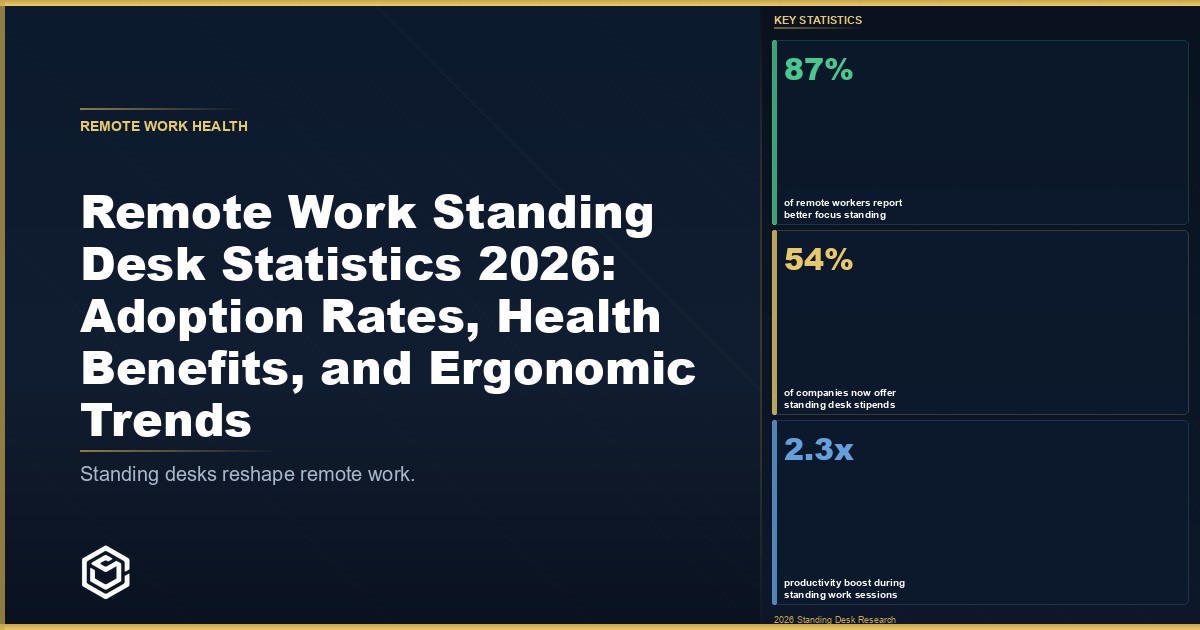
Fatigue: The same CDC-funded study recorded an87% reduction in fatigue scores from baseline among sit-stand desk users.
Daily sitting time: A BMJ Open randomized controlled trial (the SMART Work and Life study, 2019) tracked 146 workers with sit-stand desks for 12 months. They reduced daily sitting time by83 minutes per workday compared to the control group and held that reduction at the 12-month mark.
Blood glucose: A Diabetes Care (2013) study found alternating sitting and standing every 30 minutes reduced post-meal glucose spikes by11.1%. This matters for remote workers who eat most meals at their desks.
| Health Outcome | Change Observed |
|---|---|
| Upper back and neck pain | 54% reduction after 4 weeks |
| Fatigue scores | 87% reduction from baseline |
| Daily sitting time | 83 minutes less per workday |
| Post-meal blood glucose | 11.1% lower when alternating sit/stand |
| Musculoskeletal discomfort | 32% lower across shift |
Sources: CDC; BMJ Open SMART trial 2019; Diabetes Care 2013; Ergonomics meta-analysis 2021.
Productivity: The Numbers and Their Limits
The most-cited productivity data comes from the Texas A&M Health Science Center, which tracked call center workers over 6 months. Workers with standing desks were 45% more productive in month one, rising to53% by months two and three. Researchers linked the gains to sustained alertness, lower afternoon fatigue, and reduced discomfort pulling attention from call handling.
Call center metrics are unusually clean to measure, which makes the study legible — but also limits how far it generalizes to knowledge work.
A 2022 Ergotron survey of workers who had used a sit-stand desk for at least 6 months found:
- 87% reported productivity that improved or held steady
- 65% said focus improved noticeably
- 33% said they finished tasks faster when standing for part of the day
One practical note: typing speed and accuracy drop about 8% when workers stand continuously for more than 2 hours, per the International Journal of Environmental Research and Public Health. This is why occupational health guidelines recommend posture alternation (30 minutes sitting, 30 minutes standing) rather than replacing one static position with another.
Market Growth and Pricing in 2026
The global standing desk market was valued at approximately $11.8 billion in 2023 and is forecast to reach $16.9 billion by 2030 at a 5.3% annual growth rate (Grand View Research).
Before 2020, demand was concentrated in corporate procurement. Since 2021, the consumer-direct and small-business channels have outpaced the corporate segment in growth rate. The permanent shift of knowledge workers to home offices is what drove that change.
Current pricing by tier:
| Tier | Price Range | Lift Mechanism |
|---|---|---|
| Entry-level | $300 – $600 | Single-motor electric |
| Mid-tier | $600 – $1,200 | Dual-motor electric |
| Commercial-grade | $1,200 – $2,000 | Dual-motor, higher duty cycle |
| Premium/executive | $2,000 – $4,000+ | Heavy-duty, wider range |
Manual crank desks start around $150 to $250, but the effort to adjust height means workers change positions less often — which undermines the health benefits. Occupational therapists generally recommend electric models for this reason.
Employer Stipends and the Coverage Gap
52% of U.S. employers offered some form of home office stipend or equipment reimbursement in 2024, with a median amount of $750 (WorldatWork).
Standing desks are typically the most expensive item in a home office setup and the most likely to exceed stipend limits. A WorldatWork analysis found 58% of remote workers who used employer stipends to buy a standing desk still paid out of pocket to cover the difference.
Some larger technology companies have set standing desk or ergonomic furniture allotments of $1,000 to $1,500 as separate budget lines from general home office stipends.
The financial case for broader employer provision is straightforward: a single musculoskeletal injury claim costs $13,000 to $40,000 in direct expenses per OSHA data. One prevented claim funds standing desks for a 20-person remote team.
Managing an ergonomic equipment program across a distributed team — vendor vetting, reimbursement workflows, receipt tracking — is exactly the kind of administrative load that virtual assistant services can absorb, freeing HR and operations staff for higher-value work.
Why Standing Desk Owners Still Don't Stand Enough
Among remote workers who own height-adjustable desks, actual standing time averages just 1.8 hours per workday — well under the 2 to 4 hours occupational health guidelines recommend.
A 2024 Ergotron survey found:
- 44% said they forget to change positions during focused work
- 31% said foot and leg discomfort limits standing time
- 27% said inconvenient monitor arms or cable management make switching positions annoying
Anti-fatigue mats address the foot and leg issue: University of Waterloo research found mat use reduced lower limb discomfort by 50% among workers standing 90 to 120 minutes at a time. Fewer than 40% of standing desk owners use one.
Automated reminder prompts are the most reliable behavioral fix. A Preventive Medicine study found automated posture-change prompts every 30 minutes increased actual standing time by 64% compared to controls, with the effect holding at 6-month follow-up.
The Ownership Gap Comes Down to Cost and Who Pays
22% remote worker ownership against a backdrop of consistent health and productivity evidence means most home office workers are sitting 10-plus hours a day in setups that occupational health research has repeatedly flagged for long-term injury risk.
For individual workers, the entry-level price point ($300 to $600) is the most accessible it has ever been, and controlled trial data shows meaningful health improvements within 4 weeks. For employers, the math is simple: the cost of one prevented musculoskeletal injury claim funds a full team's ergonomic setup.
The gap is narrowing — the market growth data shows that clearly. But 78% of remote workers are still sitting through workdays that could be meaningfully healthier.
For deeper statistics on this topic, see our full remote work standing desk statistics research page. For the broader context on how home office setups affect remote worker health, see remote work ergonomics statistics and remote work wellness programs statistics.
Sources: SHRM Benefits Survey 2023; Owl Labs State of Remote Work 2025; International Facility Management Association 2024; Texas A&M Health Science Center School of Public Health (Benden et al.); CDC sit-stand desk study; BMJ Open SMART Work and Life trial 2019; Diabetes Care 2013; Ergotron Standing Desk Survey 2024; WorldatWork 2024; Grand View Research 2024; OSHA ergonomics data; Preventive Medicine; University of Waterloo.