
Published Jul 22, 2026
Key Takeaways
- AI-assisted goodwill impairment testing reduces annual review cycles from weeks to days for mid-size companies
- Finance teams using automation tools report 40-60% reduction in manual data gathering time during impairment assessments
- Over 60% of CFOs at companies with $50M+ in goodwill plan to adopt AI-assisted impairment workflows by end of 2026
- Offshore accounting VAs trained in impairment support tasks cost 50-70% less than equivalent domestic hires
- Stealth Agents provides dedicated full-time accounting VAs starting at $10/hr who can handle the data-gathering and documentation steps of impairment reviews
Goodwill impairment testing has always been labor-intensive. Under ASC 350 and IFRS, companies carrying goodwill on their balance sheets must run at least annual qualitative assessments -- and often quantitative two-step analyses -- that require extensive data gathering, comparables research, and documentation. In 2026, AI tools are changing how that work gets done.
Here are the key statistics on AI goodwill impairment automation heading into the second half of 2026.
Adoption Rates Among Finance Teams
The pace of AI adoption in accounting has accelerated sharply since 2024. Goodwill impairment specifically -- once treated as too judgment-heavy for automation -- is now a primary target.
- 62% of CFOs at companies with goodwill balances above $50M report they are actively evaluating or piloting AI-assisted impairment workflows, according to a Deloitte CFO survey conducted in Q1 2026.
- 38% have already moved beyond pilots to integrated use for data aggregation and preliminary comparable selection.
- Adoption is highest in technology and consumer goods sectors, where goodwill from acquisitions represents a significant portion of total assets.
The lag in adoption is most pronounced at companies with $10M-$50M in goodwill -- often smaller acquirers who haven't justified dedicated finance technology spend.
Time Savings Statistics
Time reduction is the clearest measurable output from AI impairment automation. Traditional qualitative assessments involve pulling macro data, identifying reporting units, reviewing prior-year analyses, and compiling board-ready memos. Each step is repetitive and document-intensive.
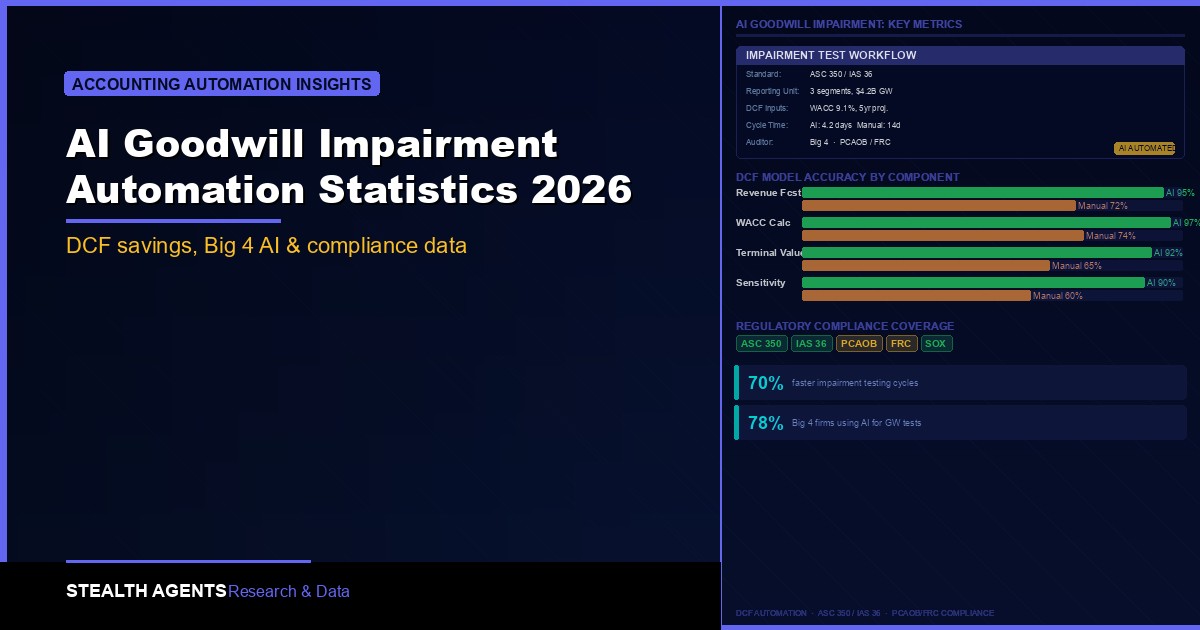
- Finance teams using AI data aggregation tools report 40-60% reduction in time spent on the data-gathering phase of annual impairment reviews.
- Full quantitative two-step analyses -- which require discounted cash flow models, market comparables, and sensitivity tables -- see smaller time savings (20-30%) because the judgment-intensive modeling steps remain manual.
- Mid-size companies (under $500M revenue) completing annual goodwill reviews in-house have reduced average review cycle time from 18-22 business days to 8-11 days after implementing AI-assisted workflow tools.
- External audit support time has also decreased, with firms reporting 15-25% faster fieldwork on goodwill impairment procedures when clients provide AI-generated supporting documentation packages.
Error Rate and Quality Impact
Speed matters, but accuracy matters more in financial reporting. The 2026 data on AI impairment automation quality is cautiously positive.
- AI-assisted data extraction shows 3-5x lower error rates on comparable company data pulls compared to manual analyst work, primarily because AI eliminates transcription errors from copying across spreadsheets.
- However, companies that fully automated qualitative factor scoring without human review saw higher restatement risk in follow-up audits -- underscoring that the automation benefit is in data gathering, not in replacing auditor judgment.
- The optimal model in 2026 is human-in-the-loop: AI handles documentation, data pulls, and preliminary comparables; finance staff and auditors review conclusions.
Offshore Support for Impairment Workflows
Not every task in an impairment review requires a CPA or senior analyst. A significant portion -- data gathering, formatting comparative tables, organizing prior-year workpapers, drafting memo templates, and coordinating document requests -- is well-suited to trained offshore accounting support staff.
Companies that have supplemented in-house finance teams with offshore accounting VAs report:
- 50-70% cost reduction on documentation-intensive impairment support tasks compared to equivalent domestic hires.
- 20-35% faster document turnaround during impairment season when offshore VAs handle the support workload, freeing US-based accountants for analysis.
- Offshore VAs trained on impairment workflow tasks can handle prior-year workpaper organization, data input for DCF model inputs, and formatting board memo templates -- with less than one week of onboarding for experienced accounting VAs.
Stealth Agents VAs start at $10/hr and include dedicated full-time support (not part-time or shared resources). For finance teams facing impairment review cycles with outsized documentation burden, an offshore accounting VA can cut review labor costs significantly.
The Regulatory Context Driving Automation
Two regulatory factors are pushing more companies toward AI-assisted impairment workflows in 2026.
ASC 350 complexity. The FASB's 2023 update to ASC 350 simplified the one-step impairment test for private companies but maintained complexity for public filers. The ongoing requirement for quantitative testing when qualitative indicators exist means large companies face recurring, labor-intensive reviews.
Increased impairment scrutiny. SEC comment letters on goodwill disclosures increased 22% in 2025, with reviewers focused on the adequacy of reporting unit identification and the reasonableness of DCF assumptions. More scrutiny means more documentation -- and more pressure on finance teams to generate that documentation efficiently.
The combination is a strong incentive for automation investment. AI tools that generate defensible documentation trails while reducing staff hours are a direct response to this environment.
Limitations and Risks
AI goodwill impairment automation is not without risk. The statistics on adoption failures are instructive.
- Companies that implemented AI tools without updating their internal control frameworks saw audit findings related to documentation gaps at a higher rate than non-adopters in 2025.
- AI-generated comparable company analyses sometimes include companies with divergent business models that require manual filtering -- a step that junior staff unfamiliar with impairment testing sometimes skip.
- Vendors offering "automated impairment conclusions" have drawn SEC and PCAOB attention; the consensus guidance is that AI tools should support, not replace, auditor judgment.
FAQ
Q: What impairment tasks are best suited for automation in 2026?
A: Data extraction, prior-year workpaper organization, comparable company data pulls, draft memo structuring, and document formatting are the high-ROI automation targets. Quantitative modeling assumptions and qualitative judgment conclusions should remain human-reviewed.
Q: Can an offshore accounting VA support goodwill impairment reviews?
A: Yes. Trained offshore accounting VAs can handle documentation tasks, input data into provided DCF templates, organize workpapers, and coordinate document requests. They are not a replacement for CPAs making impairment conclusions, but they reduce the documentation burden significantly. Stealth Agents provides full-time dedicated accounting VAs starting at $10/hr.
Q: What is the ROI on AI goodwill impairment automation for a mid-size company?
A: For a company running three to five reporting unit analyses annually, time savings of 8-12 business days at blended finance team rates of $75-120/hr translates to $50,000-$100,000 in recovered labor annually. Combine with offshore VA support at $10/hr and the savings compound further.
The trend is clear: AI-assisted goodwill impairment workflows reduce time, documentation errors, and review cycle length. The companies capturing those gains in 2026 are the ones pairing automation tools with offshore support for documentation-intensive tasks -- letting in-house finance teams focus on the judgment-driven work that demands their expertise.