
Updated May 12, 2026
Key Takeaways
- Offshore VAs in the Philippines naturally cover U.S. overnight hours without night-shift premiums.
- Two main 24/7 models: shift-based coverage with multiple VAs, or a single overnight dedicated VA.
- E-commerce, customer support, and lead response are the highest-value use cases for after-hours coverage.
- Stealth Agents VAs start at $10/hr and can be placed for overnight or extended-hours schedules.
- 24/7 coverage does not require 24/7 management - the right setup runs autonomously with clear SOPs.
A customer submits a support ticket at 11 PM. A lead fills out your contact form at 2 AM. An e-commerce order comes in with an incorrect address and needs immediate correction before your 6 AM fulfillment run. In each case, the business that responds first - or catches the problem before it becomes a complaint - wins.
24/7 virtual assistant support is not a luxury for enterprise companies. It is a practical operational decision for any business with customers in multiple time zones, after-hours lead flow, or e-commerce operations that do not pause when your office closes.
The good news is that building after-hours VA coverage is more straightforward than most business owners expect - and far less expensive than hiring overnight staff domestically.
Why Offshore Time Zones Make 24/7 Coverage Natural
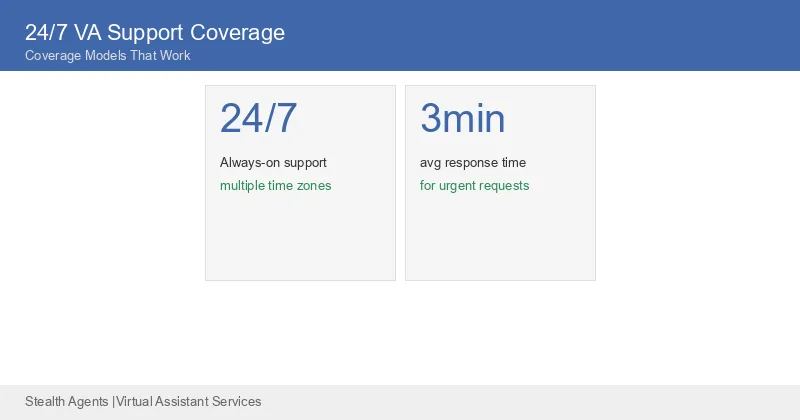
The Philippines sits 12-15 hours ahead of U.S. Eastern Time, depending on daylight saving. A VA in Manila working a standard daytime shift (8 AM - 5 PM local) is working 7 PM - 4 AM EST. No night-shift premium, no disrupted sleep schedule for your team member - they are working normal hours in their time zone while your office sleeps.
This time zone alignment is one of the primary reasons Philippines-based VAs have become the default choice for businesses that need after-hours coverage. You get a VA who is alert, working in their regular hours, without the cost or health implications of asking someone to work overnight.
For businesses on the West Coast (PST), the overlap is even more favorable. A Philippines VA working 8 AM - 5 PM local is covering 4 PM - 1 AM PST - catching the entire late-evening customer window before your team logs back on the next morning.
Two Coverage Models Worth Understanding
There are two primary approaches to building 24/7 VA support. Which one fits your business depends on volume and task type.
Shift-based coverage with multiple VAs is the right model when you have consistent, high-volume tasks across a 24-hour window. You assign different VAs to morning, afternoon, and overnight blocks, each covering a defined slice of the day. Handoff protocols - updated task logs, CRM notes, escalation paths - keep continuity between shifts.
This model works well for customer support teams, e-commerce operations with global order flow, and businesses handling inbound inquiries around the clock. The tradeoff is coordination overhead: more VAs means more onboarding, more SOPs, and more management structure required.
A single overnight dedicated VA is simpler and often enough for businesses that have moderate after-hours activity but do not need a full second shift. One VA working your overnight window handles the tasks that pile up while your team is offline: email triage, ticket responses, order flagging, social media monitoring, and lead qualification.
This is the most common starting point. Most businesses discover that one well-placed overnight VA resolves the majority of after-hours operational friction - and then scale the coverage model if demand grows.
High-Value Use Cases for After-Hours VA Coverage
Not every function benefits equally from 24/7 coverage. The highest-return use cases share one characteristic: delay costs you money or goodwill.
Customer support response time. Customers who contact support after hours and receive a response within the hour have significantly higher satisfaction scores than those who wait until the next business day. A VA handling tickets overnight can resolve common issues, escalate anything requiring a specialist, and ensure no inquiry goes unacknowledged.
E-commerce order management. See our full order assistant job description for a breakdown of this role. Address errors, payment flags, and inventory discrepancies need to be caught before fulfillment runs. An overnight VA monitoring your Shopify or Amazon Seller Central dashboard catches problems in real time rather than letting them surface as complaints or chargebacks after the fact.
Lead response speed. Response time is one of the strongest predictors of lead conversion. Studies consistently show that contacting a lead within five minutes of inquiry produces dramatically higher conversion rates than waiting even 30 minutes. An overnight VA handling your contact form responses and CRM intake keeps that window tight around the clock.
Social media monitoring. Brand mentions, negative reviews, and customer messages do not stop at 5 PM. A VA monitoring your social channels after hours can flag urgent issues and handle routine replies without waiting for your team to log in the next morning.
What You Need in Place Before Going 24/7
24/7 coverage only works if your VA has clear guardrails for operating autonomously. Before placing an overnight VA, build out:
SOPs for common scenarios. What does your VA do when a customer requests a refund? When an order cannot be fulfilled? When a lead asks for pricing? Document the decision tree so your VA can handle the majority of cases without escalating.
Escalation paths. Define what requires a human decision and how the VA reaches the right person. A phone call for critical issues, a Slack message for urgent non-critical items, and an email summary for anything that can wait until morning.
Logging and handoff protocols. Your daytime team needs to walk in with full context on what happened overnight. A standardized end-of-shift report - tickets handled, issues flagged, leads added to CRM - keeps the morning handoff clean.
Stealth Agents VAs start at $10/hr and can be placed for overnight or extended-hours schedules, with dedicated full-time commitment to your business. Account management is included, which means you have support in place as you build out the coverage model rather than configuring it entirely on your own.
Scaling from One Overnight VA to Full Coverage
Many businesses start with a single overnight VA and expand as they understand their actual after-hours volume. The progression typically looks like this:
- Month 1-2: Single overnight VA handles email triage, ticket responses, and basic order monitoring.
- Month 3-6: VA scope expands as they learn the business. Coverage window may extend.
- 6+ months: Businesses with growing after-hours volume add a second VA or shift to a full shift-based model.
The key is starting with the scope that solves the most acute problem - not trying to architect a perfect 24/7 system from day one.
FAQ
Q: How does 24/7 virtual assistant coverage work if I only have one VA?
A: A single VA working an overnight shift (their local daytime hours) can cover 8-10 hours of your off-hours window. Paired with your existing daytime coverage, that closes most of the gap. For true 24/7 coverage, a shift-based model with 2-3 VAs covering overlapping windows is more reliable.
Q: Do overnight VAs cost more than day-shift VAs?
A: With offshore VAs in the Philippines, typically no. A VA working 8 AM - 5 PM Manila time is working overnight U.S. hours at their standard rate - no night-shift premium. Stealth Agents VAs start at $10/hr regardless of shift schedule.
Q: What tasks can an overnight VA handle autonomously?
A: Common autonomous tasks include email triage and basic responses, customer support ticket handling (using documented SOPs), order monitoring and flagging, social media monitoring and replies, lead qualification and CRM data entry, and scheduled content publishing. Tasks requiring judgment calls or sensitive decisions should have clear escalation paths defined before the VA starts.
Q: What time zone does a Philippines VA work in?
A: Philippines Standard Time (PST) is UTC+8, which is 12-13 hours ahead of U.S. Eastern Time and 15-16 hours ahead of Pacific Time. A Manila VA working 8 AM - 5 PM local covers roughly 7 PM - 4 AM EST or 4 PM - 1 AM PST - ideal for U.S. overnight coverage.