
Updated May 9, 2026
Global outsourcing has moved from a cost-cutting tactic to standard operating practice. According to Deloitte's 2022 Global Outsourcing Survey, 76% of executives said their organizations were actively outsourcing at least one business function - up from 70% in 2020. The global outsourcing market (IT services + business process outsourcing combined) exceeded $700 billion in 2023, according to Statista, and is projected to grow at roughly 8% annually through 2028 as remote infrastructure matures and offshore talent pools deepen.
The question is no longer whether to outsource - it's which functions to start with, which regions offer the right trade-offs, and how to structure the relationship for quality and accountability.
What Is Global Outsourcing?
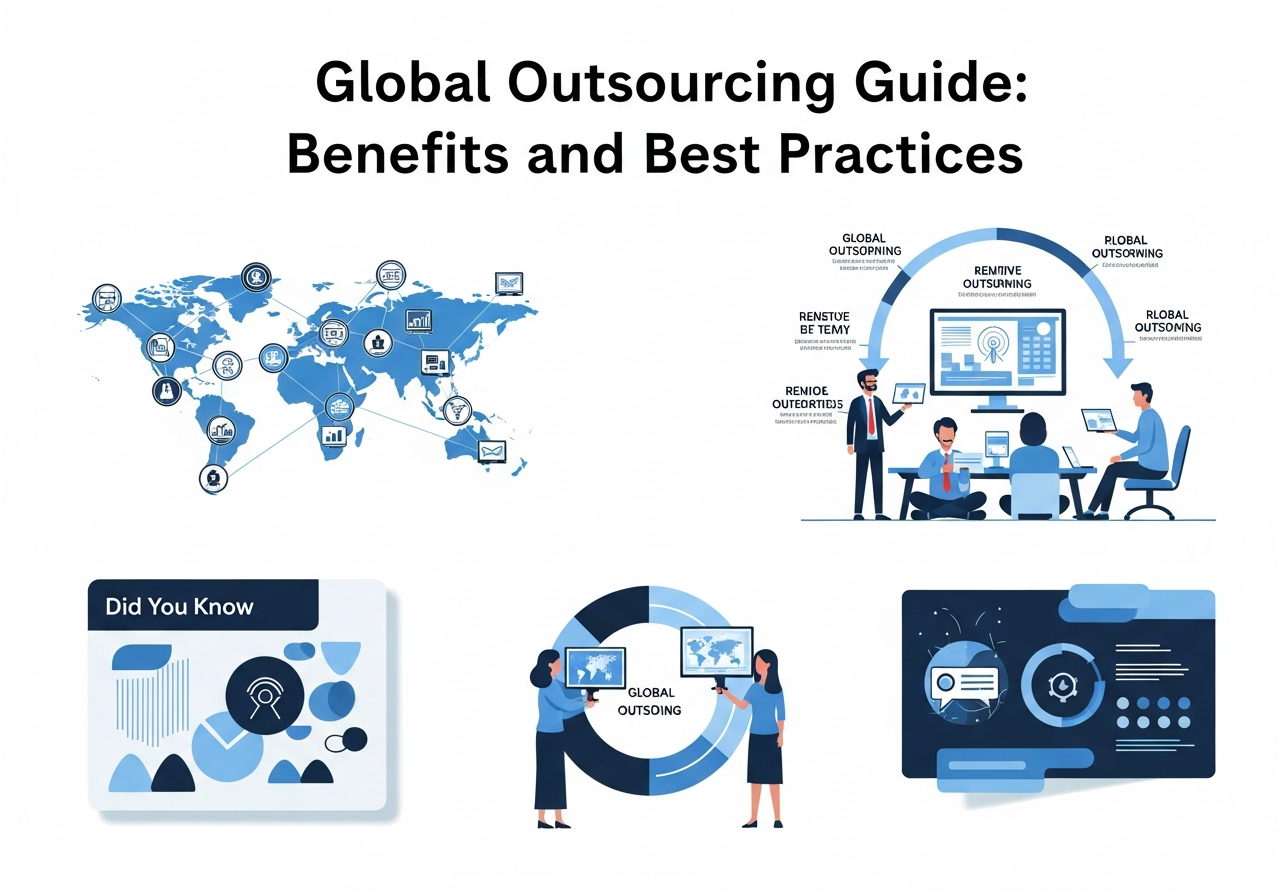
Global outsourcing means contracting business functions or tasks to third-party providers or workers in other countries, rather than staffing them in-house. It spans a spectrum from individual freelancers on Upwork to dedicated offshore development teams at a managed BPO firm.
Three common models:
- Staff augmentation - You hire remote workers directly and integrate them into your team. You retain management control but bear full responsibility for workflow and performance.
- Business process outsourcing (BPO) - You contract an entire function (e.g., customer support, accounting, data processing) to an external provider who manages staffing, training, and quality internally.
- Project-based outsourcing - A defined deliverable (app build, content batch, market research report) is scoped and contracted to an outside team for a fixed timeline.
Each model suits different risk profiles, management capacity, and task complexity.
Global Outsourcing At a Glance
| Attribute | Typical Range |
|---|---|
| Common outsourced tasks | Customer service, data entry, software development, accounting, content, HR admin |
| Hourly cost range (by region) | $4–$75/hour depending on role and location |
| Labor cost savings vs. US/UK hire | 40–70% for comparable roles (ISG Global Outsourcing Report, 2023) |
| Most popular outsourcing destinations | Philippines, India, Poland, Romania, Colombia, Mexico |
| Engagement models | Staff augmentation, BPO, project-based, hybrid |
| Common platforms | Upwork, Toptal, Onlinejobs.ph, Remote.com, Deel |
Major Outsourcing Regions: Strengths, Costs & Trade-offs
No single region dominates every use case. The right fit depends on the role, required overlap hours, language needs, and your budget.
Philippines
The Philippines is the leading destination for voice-based customer support and general virtual assistant work. English fluency is high (it's an official language), the cultural affinity with North American clients is strong, and labor costs are among the most competitive globally.
- Typical roles: customer support, VA/admin, content moderation, back-office
- Hourly cost range: $4–$12/hour for non-technical roles; $10–$20/hour for specialized work
- Time zone: UTC+8 (workable overnight shifts for US/EU clients)
- Key talent platforms: Onlinejobs.ph, Upwork
India
India is the dominant destination for software development, IT services, finance & accounting, and data analytics. It produces approximately 1.5 million engineering graduates annually (NASSCOM, 2023) and has a deep bench for technical roles at lower cost than Eastern Europe.
- Typical roles: software development, QA/testing, data science, finance & accounting, digital marketing
- Hourly cost range: $15–$45/hour for mid-level developers; $8–$20/hour for finance and back-office
- Key clusters: Bangalore, Hyderabad, Pune, Chennai
- Key platforms: Toptal, Upwork, dedicated Indian BPO firms
Eastern Europe (Poland, Romania, Ukraine, Bulgaria)
Eastern Europe commands a premium over Asia but offers strong engineering depth, EU timezone alignment, and European data-protection compliance (GDPR familiarity). Poland and Romania in particular have grown as nearshore destinations for Western European companies.
- Typical roles: software development, cybersecurity, DevOps, UX/UI, fintech
- Hourly cost range: $25–$65/hour for senior developers; $15–$35/hour for mid-level
- Key advantage: EU timezone overlap; GDPR-compliant by default; strong technical education systems
- Key platforms: Toptal, Remote.com, regional dev shops
Latin America (Colombia, Mexico, Argentina, Brazil)
Latin America has grown rapidly as a nearshore option for US companies seeking real-time timezone overlap. Spanish-speaking talent is abundant for US-market customer service, and tech hubs in Medellín, Buenos Aires, and Mexico City have attracted significant investment.
- Typical roles: software development, customer support (bilingual), marketing, sales support
- Hourly cost range: $15–$40/hour for technical roles; $8–$18/hour for BPO work
- Key advantage: Same-day working hours with US East and West Coast
What Functions Businesses Outsource
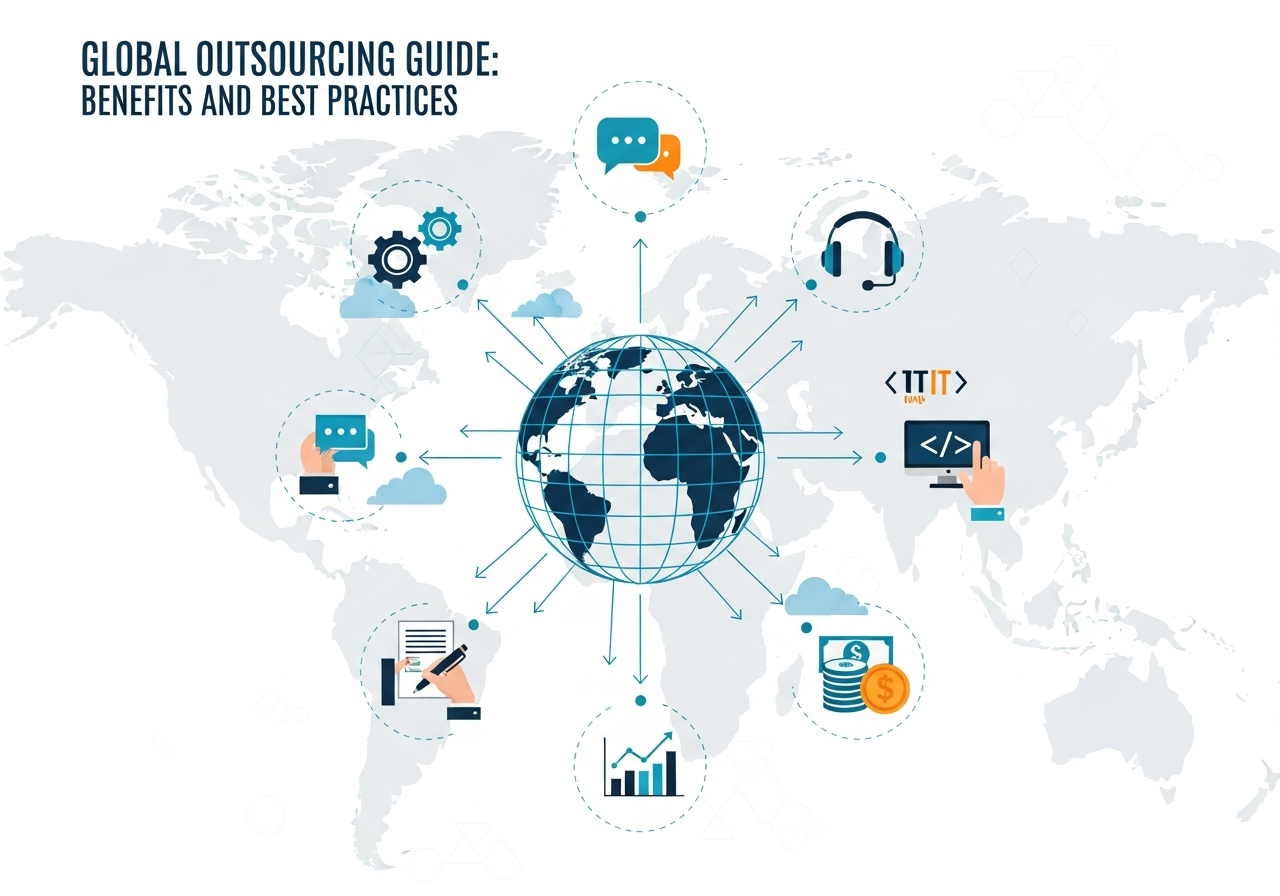
The ISG Global Outsourcing Report (2023) found that IT services remain the most outsourced function, followed by finance & accounting, customer operations, and HR. The breakdown by role type shifts significantly by company size.
Most commonly outsourced functions:
- Administrative support - calendar management, inbox, travel booking, document formatting
- Customer service - inbound support via phone, chat, and email; ticketing; escalation management
- Software development - front-end, back-end, mobile, QA/testing, DevOps
- Finance & accounting - bookkeeping, accounts payable/receivable, payroll processing, financial reporting
- Content & marketing - copywriting, SEO, social media management, graphic design, video editing
- Data services - data entry, data cleansing, research, CRM hygiene
- IT infrastructure - help desk, network monitoring, cloud management
Cost Comparison: Outsourcing vs. In-House Hiring
Labor cost savings are the most cited driver of outsourcing decisions. The differential varies significantly by role and region. The table below reflects market-rate estimates for common roles in 2025–2026.
| Role | US In-House (fully loaded) | Philippines | India | Eastern Europe | Latin America |
|---|---|---|---|---|---|
| Customer support agent | $45,000–$65,000/yr | $6,000–$14,000/yr | $5,000–$12,000/yr | $15,000–$28,000/yr | $10,000–$20,000/yr |
| VA / admin assistant | $40,000–$55,000/yr | $5,000–$12,000/yr | $5,000–$10,000/yr | $12,000–$22,000/yr | $9,000–$18,000/yr |
| Mid-level developer | $110,000–$160,000/yr | $18,000–$36,000/yr | $20,000–$50,000/yr | $40,000–$80,000/yr | $30,000–$65,000/yr |
| Bookkeeper / accountant | $55,000–$75,000/yr | $8,000–$18,000/yr | $7,000–$16,000/yr | $18,000–$35,000/yr | $14,000–$28,000/yr |
Note: "fully loaded" US costs include employer taxes, benefits, office space, and recruiting - typically 1.25–1.4× base salary. Offshore costs shown are all-in contractor or employment costs.
Savings of 40–70% on comparable roles are achievable and well-documented (ISG, 2023). Claims of "80% savings" are possible in narrow scenarios (e.g., replacing a high-cost US specialist with a junior offshore generalist) but are not representative of like-for-like comparisons.
Choosing an Outsourcing Model: Staff Aug vs. BPO vs. Freelance
| Factor | Freelance (e.g., Upwork) | Staff Augmentation | BPO |
|---|---|---|---|
| Management overhead | High - you recruit and manage directly | Medium - you manage individuals, provider handles HR/payroll | Low - provider manages the team and SLAs |
| Cost | Lowest upfront | Mid-range | Higher, includes overhead and management |
| Speed to hire | Fast (days) | 1–3 weeks typical | 2–6 weeks for BPO onboarding |
| Best for | Defined, short-term tasks | Growing a remote team you want to control | Mature functions needing SLA accountability |
| Risk | No continuity; dependent on one person | Some HR/compliance risk depending on country | Provider-managed risk, but less direct control |

Key Platforms for Finding Global Outsourcing Talent
Several platforms have become the primary sourcing layer for companies building global teams.
- Upwork - Largest freelance marketplace. Good for one-off projects and testing talent before committing to longer engagements. Hourly rates range from $4 to $150+ depending on role and experience.
- Toptal - Curated network claiming the top 3% of applicants. Best for senior technical roles and finance professionals. Higher cost than Upwork but pre-vetted.
- Onlinejobs.ph - Philippines-specific job board. Direct hire model, no platform fees on the worker side, but you manage all vetting and onboarding yourself.
- Remote.com - Employer-of-record (EOR) platform that handles local employment contracts, payroll, and compliance in 180+ countries. Best when you want to hire offshore workers as legal employees with benefits.
- Deel - Similar EOR and contractor payment platform with strong coverage across Latin America and Eastern Europe. Popular with tech startups building distributed teams.
Each platform has different cost structures, vetting standards, and compliance implications. For regulated industries (financial services, healthcare), EOR platforms typically offer stronger compliance infrastructure.
How to Get Started With Global Outsourcing
Successful outsourcing engagements share a common starting framework regardless of the provider or region.
Step 1 - Audit your task inventory. List all recurring tasks your team handles weekly. Mark each as: (a) high-judgment / must stay in-house, (b) trainable / rule-based, or (c) already documented with standard outputs. Category (b) and (c) tasks are your first candidates.
Step 2 - Document the process before you hire. Write a standard operating procedure (SOP) for each task you plan to outsource. If you can't describe the task clearly enough for someone unfamiliar with your business to complete it, you're not ready to hand it off. Loom videos and step-by-step checklists are both effective formats.
Step 3 - Define success metrics up front. Agree on output quality, turnaround time, and communication expectations before work begins. Ambiguous expectations are the most common cause of failed outsourcing relationships.
Step 4 - Start narrow and expand. The most durable outsourcing relationships start with one well-defined function and expand as trust develops. Handing over 10 tasks to a new team on day one is the fastest way to create quality problems.
Step 5 - Choose the right model for your management capacity. If you have bandwidth to recruit, onboard, and manage individuals directly, staff augmentation or freelance platforms offer the most control. If you need SLA accountability without the management overhead, a BPO or managed service is a better fit.
Step 6 - Plan for onboarding time. Offshore team members - even experienced ones - typically need 2–4 weeks to reach full productivity on your specific workflows and tools. Build that ramp time into your timeline and budget.
If you're evaluating a staffing partner for outsourcing support, Stealth Agents offers dedicated virtual assistant services with coverage across administrative, customer support, and content tasks. Explore VA services to see available roles and pricing tiers.
Getting the Best Results From Your Outsourcing Team
Quality drift is the most common complaint from companies with established outsourcing relationships - not initial setup. These practices reduce it.
- Communicate in writing. Verbal instructions via Zoom calls don't scale. Document recurring task notes in a shared tool (Notion, ClickUp, Asana) so instructions are searchable and don't live in someone's memory.
- Use async video for complex walkthroughs. Loom or similar tools let you record a task once and reference it indefinitely - far more scalable than live training sessions.
- Run structured weekly check-ins. A 15–30 minute weekly call that covers: what was completed, what's blocked, what's upcoming. This catches issues before they compound.
- Give structured feedback early. Correct quality issues in the first two weeks, not after two months. Offshore workers adjust quickly when feedback is specific and timely.
- Track output, not hours. Output-based accountability (tasks completed, tickets resolved, content pieces delivered) is more meaningful than monitoring clock time.
Common Pitfalls to Avoid
- Outsourcing undefined tasks. If the task doesn't have a clear output and acceptance criteria, you'll get inconsistent results regardless of the worker's skill.
- Underestimating time zone gaps. A 10–12 hour gap (US to Philippines) means async communication is the default. Expect same-day turnaround on some tasks but not real-time back-and-forth.
- Hiring on price alone. The lowest-cost option is rarely the best value. Vet for relevant experience, communication quality, and references - not just hourly rate.
- Skipping trial tasks. Always run a paid trial task or short engagement before committing to a long-term contract. This applies even when using vetted platforms like Toptal.
- No backup plan for key-person dependency. If your entire outsourced function depends on one person, build in a knowledge-transfer process and consider a primary/backup staffing model.
Frequently Asked Questions About Global Outsourcing
What tasks are best suited for global outsourcing?
Rule-based, repeatable tasks with clear outputs are the best fit: data entry, customer support, bookkeeping, content formatting, social media scheduling, and administrative coordination. High-judgment work that requires deep company context - strategy, leadership decisions, culture-sensitive communication - is generally kept in-house.
How much can I realistically save by outsourcing?
On a like-for-like role comparison, most companies achieve 40–70% savings on labor costs when moving from US/UK in-house staff to offshore equivalents (ISG, 2023). Savings vary by role complexity, region, and whether you're comparing to a contractor or a fully loaded employee.
How do I protect confidential data when working with an outsourced team?
Use role-based access controls so team members only see what they need. Require NDAs before sharing sensitive information. For high-sensitivity functions (finance, HR, customer data), verify that your provider or platform has relevant compliance certifications (SOC 2, ISO 27001, GDPR compliance for EU-adjacent regions). EOR platforms like Remote.com and Deel include data processing agreements (DPAs) as part of their standard contracts.
What is the difference between offshore and nearshore outsourcing?
Offshore refers to outsourcing to a distant region with a large time zone gap (e.g., US company working with a team in the Philippines or India).Nearshore refers to outsourcing to a geographically closer country with minimal time zone difference (e.g., US company working with a team in Colombia or Mexico). Nearshore is typically more expensive but allows real-time collaboration.
How long does it take to onboard an outsourced team?
Onboarding timelines vary by function complexity. A straightforward VA or customer support role typically reaches full productivity within 2–4 weeks if SOPs are in place. A software development team may need 4–8 weeks to fully understand your codebase, architecture, and release processes. Investing in SOPs before hiring significantly compresses ramp time.
What should I include in an outsourcing contract?
At minimum: scope of work, deliverables and acceptance criteria, communication expectations, data handling and confidentiality terms, payment terms, notice period for termination, and a dispute resolution clause. For BPO engagements, add service level agreements (SLAs) with defined remedies for non-performance.

Ready to Build Your Global Team?
Global outsourcing is one of the highest-leverage operational decisions available to growing businesses - but the results depend on choosing the right model, region, and partner for your specific needs.
Stealth Agents provides dedicated virtual assistant and outsourcing support across administrative, customer service, and content functions. Compare plans and pricing to find the right fit for your team size and budget.