
Updated Jan 21, 2026
Offshoring vs Outsourcing the Key Differences has become a go-to move for companies that want results without bloated payroll.
Offshoring vs. outsourcing is about choosing the smartest way to grow your business. You can either move tasks overseas or hire external experts.Stealth Agents makes this decision easy. They help you reduce costs, boost speed, and scale fast with the right team.
Offshoring vs. outsourcing are two strategies that have gained key attention of late.
While these terms are often used in place of each other, it's key to know their gap. You should also know the best practices for each approach.
Stealth Agents can support your efforts with their expert virtual assistants, helping your business connect with and keep customers.
Grab a spot now, and we'll talk about your preferences and the offshoring vs outsourcing rate options.
In this full comparison, we will look at offshoring and outsourcing. We'll cover their perks and drawbacks. We'll highlight key gaps. And we'll offer insights on how to choose between them.
Outsourcing Offshoring vs Outsourcing the Key Differences
Remember when "remote work" mainly meant working from home on a snow day? And when "offshoring" and "outsourcing" sounded like big-business buzzwords? Fast-forward to the world post-COVID, and the game has changed.
The global shift to remote work tore down the walls. Both literally and figuratively. It split teams, time zones, and old work models.
Now, the physical location of your staff seems almost irrelevant. Your marketing guru could be a few subway stops away in Brooklyn. Or they could be dialing in from Cebu. Online tools like Slack, Zoom, and Asana make it easy to run projects from anywhere.
As a result, the lines have blurred. Outsourcing means hiring third-party providers. Offshoring means moving services to another country. Simply hiring remote employees is now a third option. All three now overlap.
What's truly interesting is how platforms like Upwork, Fiverr, and Toptal have changed things. Experts from San Francisco to São Paulo can now offer their skills on demand. Hiring a virtual assistant san francisco is part of this free approach. It gives local businesses access to skilled support when they need it.
This new freedom lets businesses tap into a larger talent pool. It also lets workers tailor their schedules and projects. It's a win-win marketplace that's here to stay.
Understanding Offshoring
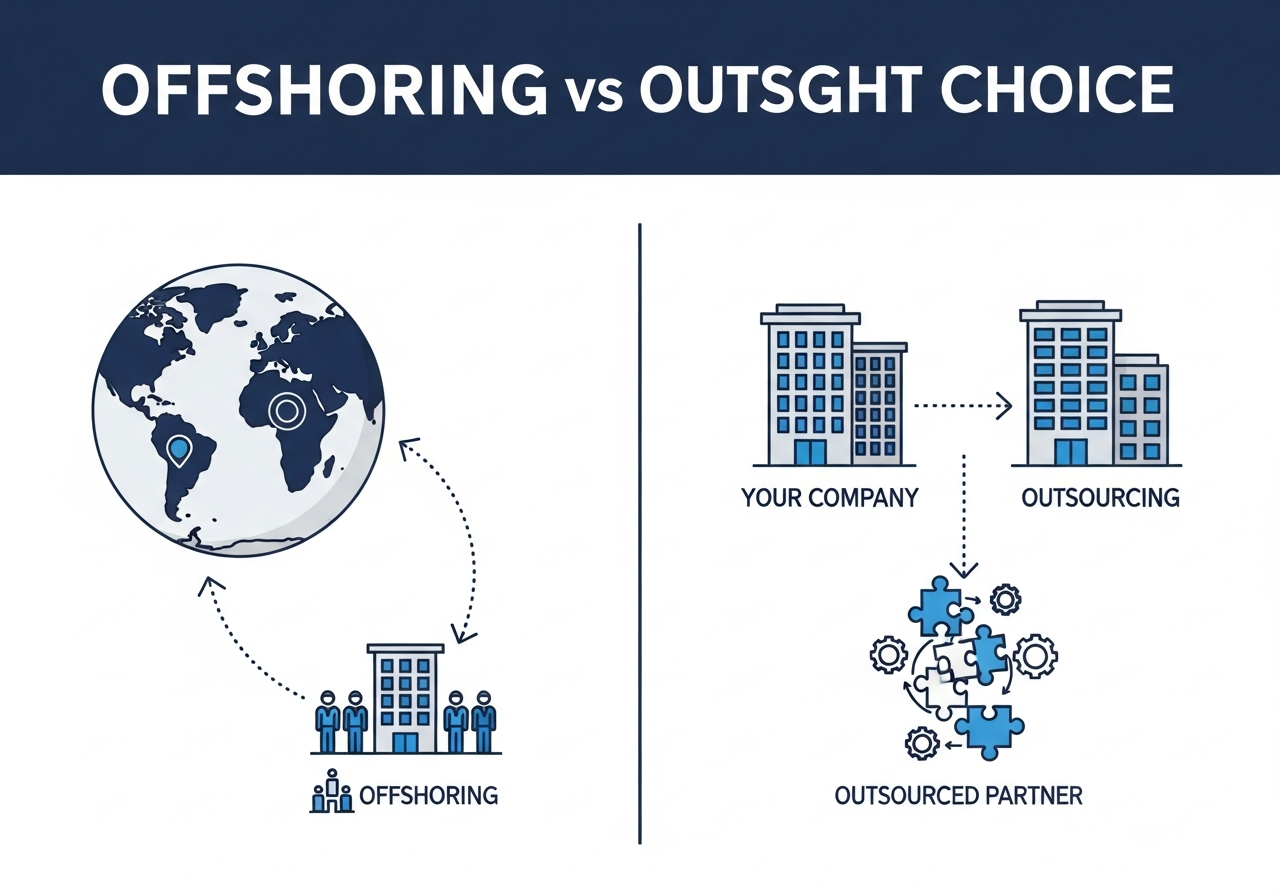
Offshoring means moving business activities or services to another country. Companies do this to take gain of lower labor costs or clear skills in that location.
It involves setting up or contracting with a foreign entity to handle certain tasks. Offshoring has grown very popular. Companies use it to reduce expenses and tap into global talent.
Key perks of offshoring
Offshoring has several key gains:
- Lower costs: Moving work to countries with lower wages cuts expenses a lot. Perks and overhead go down too.
- Access to skilled talent: You reach a larger pool of experts with clear skills. This is great for IT, software development, and engineering.
- Global presence: Setting up offices in many countries helps you diversify. You reduce dependence on one market. You also lower risks from economic or political changes.
You don't need to worry about handling. There are skilled managers who have received practical chain-of-command training.
Possible drawbacks of offshoring
Offshoring has perks but also problems. Cultural gaps and data safety risks are typical ones.
Companies can overcome these problems. They can set up strong communication strategies. They can provide cultural training. They can also set up strong legal contract agreements.
Companies need to address concerns openly. Engaging in honest dialogue with stakeholders builds trust. Careful planning and good handling help companies boost the perks. They also help reduce possible drawbacks.
Understanding outsourcing
Outsourcing means handing clear business tasks to an external entity. It typically involves contracting with a third-party provider. This can be done locally or globally. Many companies use an outsourcing company Philippines to access skilled experts and reduce costs. Outsourcing has proven valuable for companies that want to focus on their core strengths.
Gains of outsourcing
Outsourcing is a great money saver for companies. This is very true for smaller ones that are tight on cash. Digital marketing service providers can help businesses save money. They eliminate the need for extra staff. They also help businesses work more well. Outsourcing also gives businesses access to new technology. It boosts their output.
Drawbacks of outsourcing
The perks of outsourcing are clear, but there are also drawbacks. One of the central issues is losing control over outsourced work. There are ways to handle this. There are tips on how to hand off work as a leader.
Companies may find it hard to keep value standards. Making sure deadlines are met can also be tough. Handling an external provider's performance takes effort. A lack of right control can limit business speed and response time. Also, outsourcing raises concerns about data privacy. External parties may handle private data. Proper due diligence and contract handling are key to running these risks.
Gaps of offshoring vs. outsourcing
Now that we understand each strategy, let's look at the key gaps between them.
Gaps in cost
One of the main distinctions is the cost structure. Labor cost gaps mainly drive the use of offshore virtual assistants. Companies seek lower wages and better economic conditions in offshore locations.
Outsourcing, on the other hand, focuses on overall cost savings. These come from economies of scale, better speed, and access to expert resources. Both strategies aim to reduce expenses. But the underlying cost drivers are quite other.
Gaps in control and handling
Control and handling differ a lot between the two strategies. In offshoring, companies have more right control. They control their work or subsidiaries in the target country. They keep ownership. They can shape processes and practices to fit their needs.
In outsourcing, companies hand clear activities to an external provider. They give up right control over those tasks. They rely on the outsourcing partner's skills to perform the work.
Gaps in value and speed
Value and speed are key when choosing between the two. Offshoring often means moving work to countries with skilled workers. This can result in higher-value output and faster turnaround times. Outsourcing lets companies use the expertise of external providers. By using their skills, businesses achieve greater speed and access to best practices.
Choosing between offshoring vs. outsourcing
Businesses must think about several factors when choosing between the two options.
Factors to think about
Here are the key things to think about:
- What is the nature of the task or process?
- How much control do you want to keep?
- What skills and resources are available in the target location?
- What is the cost structure?
- What are your business's smart objectives?
These factors help companies make informed decisions that fit their clear needs and goals.
Effect on business growth
Both strategies can a lot change business growth. Offshoring can help companies expand into new markets. It gives access to global talent and achieves cost savings. These savings fuel growth. Outsourcing, on the other hand, lets businesses focus on their core strengths. This creates chances for innovation and market expansion. Understanding the possible effect of each strategy is key to making smart decisions.
Risk check and mitigation
Companies must do a full risk check before choosing offshoring or outsourcing. Assess the possible risks of each strategy. Think about cultural gaps, data privacy concerns, and regulatory compliance. Setting up strong governance structures is key. Conduct due diligence on possible partners. Set up adequate safety measures. These steps help ensure smooth work.
Takeaways
In conclusion, both offshoring and outsourcing are viable strategies. While offshoring involves relocating work to another country, outsourcing entails handing clear tasks to external providers.
Understanding the key gaps, perks, and drawbacks of each is vital. By thinking about many factors and evaluating the effect on growth, companies can choose the most suitable approach. The goal is success in an increasingly global marketplace.
Choosing the right way to grow your business is key. Offshoring and outsourcing can help you save money and time. Let Stealth Agents guide you to the best option for your needs. Book a call to get started.
Frequently Asked Questions
Which fields gain most from offshoring vs outsourcing business work?
Manufacturing, technology, and customer service gain most from offshoring. They get lower labor costs. Professional services like accounting, legal, and marketing often prefer outsourcing. They gain access to experts. Healthcare and finance may outsource to meet strict rules. Software development can use either model depending on project needs.
How long does it typically take to set up offshoring vs outsourcing strategies?
Offshoring takes 6-18 months. It involves setting up legal agreements, facilities, and training staff. Outsourcing is faster, usually taking 2-8 weeks. You use the provider's existing setup. Offshoring needs more planning. Outsourcing is faster for urgent needs.
What are the hidden costs of offshoring vs outsourcing that companies overlook?
Offshoring can have more costs like legal fees, compliance expenses, building setup, and travel for handling. Outsourcing may include fees for changing contracts, transferring knowledge, or ending contracts early. Both models may also require spending on communication tools, training, and handling relationships.
When should startups choose offshoring vs outsourcing for their business growth?
Startups should start with outsourcing. It's free and doesn't need a big upfront investment. Offshoring is better for companies with steady, high-volume work. They should have at least a year of stable income. Outsourcing works well for early growth. Offshoring suits long-term needs.
How do labor laws differ between offshoring vs outsourcing arrangements?
Offshoring means following the labor laws of the country where you hire. This includes rules about wages, perks, and firing. With outsourcing, the service provider handles these legal duties. But companies still need to ensure contractors follow data protection and field rules.
What metrics should companies use to measure offshoring vs outsourcing success?
For offshoring, track costs, employee retention, and output over time. For outsourcing, focus on meeting service agreements, response times, and return on investment. Both models should measure value, send times, customer satisfaction, and how well they meet business goals.
Where are the top global destinations for offshoring vs outsourcing services?
Popular offshoring locations include India, the Philippines, and Mexico. They offer skilled workers and lower costs. Eastern Europe (like Poland and Ukraine) offers nearshore options with cultural similarities. Outsourcing hubs include these regions plus Costa Rica, South Africa, and Malaysia. They provide services across many time zones.
How do communication problems differ between offshoring vs outsourcing models?
Offshoring needs right communication with foreign employees. This may need language training and cultural understanding. Outsourcing often includes account managers who handle communication for you. Offshoring needs more investment in communication tools. Outsourcing relies on the provider's systems.
What contract terms are vital for offshoring vs outsourcing agreements?
Offshoring contracts should include employment terms, IP rights, data safety rules, and termination procedures under local laws. Outsourcing contracts need clear service agreements, penalties for poor performance, and terms for scaling up or down. Both require privacy agreements. Offshoring also needs terms for following local labor laws.
Why do companies switch from outsourcing to offshoring or vice versa?
Companies move from outsourcing to offshoring for more control, stable costs, and better protection of their ideas. They switch back to outsourcing when they need freedom, want less handling work, or face new rules. Many businesses use a mix of both to meet their needs.