
Hiring a Home Care Virtual Assistant helps streamline scheduling, billing, and client communication, ensuring seamless care delivery.
The global home care industry is projected to reach $383 billion by 2030, driven by the rising demand for reliable and timely patient support, according to Fortune Business Insights. Yet, many care providers spend up to 40% of their time on administrative work instead of focusing on patients. With Stealth Agents, healthcare providers gain trained virtual assistants who handle admin tasks efficiently, so caregivers can focus on what matters most: quality patient care.
Stealth Agents, virtual assistants for Home Care, are becoming game-changers, offering support that is both efficient and reliable.
So, in this guide, we’ll discuss what home care VAs are, how they help you, and where to hire them.
Choose a Stealth Agents virtual assistant and set up a meeting to explore competitive pricing.
Common Challenges for Home Care Agency Owners
Home care is in high demand, but agency owners face many challenges as they work to grow and stay efficient. These challenges go beyond medical knowledge and require smart tools and support.
1. Dealing with Too Much Admin Work:
Many agency owners spend significant time on paperwork such as scheduling, billing, payroll, and compliance. This administrative work can account for up to 40% of their time, leaving less time to focus on patient care.
2. Hiring and Keeping Good Caregivers:
It’s hard to find and keep skilled caregivers. Owners need to recruit, check qualifications, run background checks, and ensure a steady flow of workers. High competition and turnover make it even harder to hold onto top talent.
3. Managing Schedules:
Scheduling isn’t just matching caregivers to clients. Unexpected absences, emergency leaves, and changing client needs make it hard to keep things on track. Constant adjustments are needed to avoid problems with client satisfaction.
4. Growing Without Losing Quality:
Growth brings more complex operations. Expanding can cause mistakes or reduce the personal touch that makes home care special. Owners need to scale carefully to keep quality high and avoid burnout.
What is a Home Care Virtual Assistant? (Complete Definition & Services)
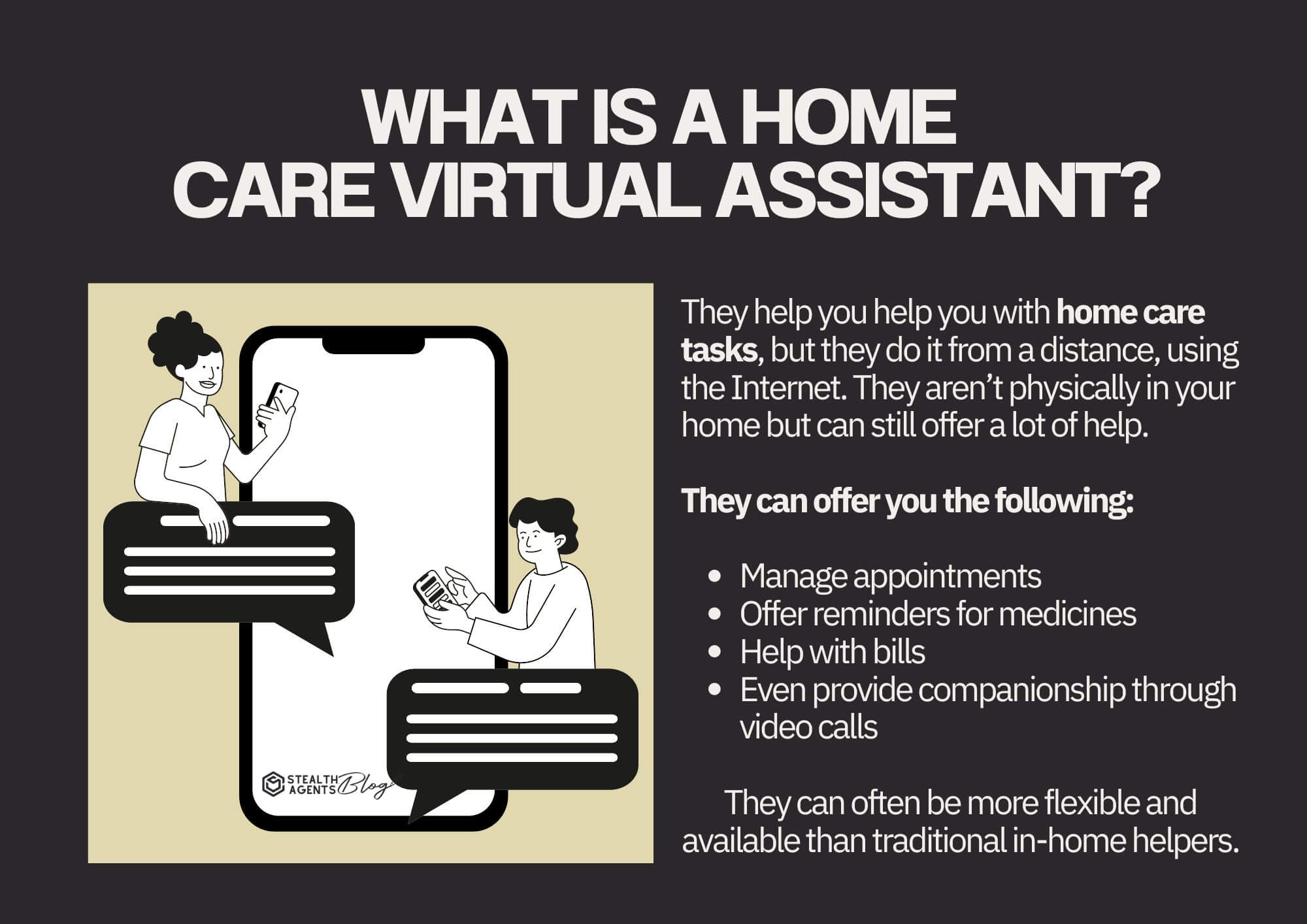
Home Care virtual assistants help you with home care tasks, but they do it from a distance, using the Internet. They aren’t physically in your home, but can still offer a lot of help.
Home care personal assistants can manage appointments, offer reminders for medicines, help with bills, and even provide companionship through video calls.
This kind of support is especially good for people who need some assistance but still want to maintain their independence.
Since these professional virtual assistants work remotely, they can often be more flexible and available than traditional in-home helpers.
What is the Role of a Virtual Recruiter in Hiring Care Providers For Home Care Agencies?
A virtual recruiter for home care agencies makes it easier to find qualified caregivers. Instead of sorting through piles of resumes and emails, they handle the entire hiring process remotely.
Here’s how they help:
- Finding Candidates: They search for the best caregivers using job boards, social media, and other online tools, giving you access to more options.
- Screening and Interviews: They review resumes and do the first interviews to make sure candidates fit your agency’s needs.
- Clear Communication: Virtual recruiters talk with applicants quickly and clearly, creating a good experience and a positive image for your agency.
- Smooth Onboarding: After hiring, they help with background checks, paperwork, and guiding new employees through the onboarding process.
Core Roles of a Home Care Virtual Assistant
A home care virtual assistant can handle many important tasks to help your agency run smoothly. Here’s how they can support you:
- Executive Assistant: They can manage your calendar, set up meetings, and handle emails, so you can focus on bigger decisions.
- Recruiter: Hiring the right team is critical. A virtual assistant can post job ads, review applications, schedule interviews, and stay in touch with candidates to keep the process moving.
- Scheduler: Organizing client appointments and caregiver shifts can be tricky. A virtual scheduler ensures everyone is matched correctly and keeps things running on time.
- Intake Coordinator: First impressions matter. A virtual intake coordinator helps new clients through onboarding, collects important details, answers questions, and sets up assessments.
- Social Media Manager: Growing your agency’s online presence is key. A virtual assistant can create posts, plan campaigns, and engage with your audience on platforms like Facebook and Instagram.
- Bookkeeper: They can organize billing, payroll, and expenses. They also prepare financial reports to give you a clear picture of your agency’s finances, helping you make smart decisions.
Virtual Intake Coordinator Responsibilities in Client Onboarding
A virtual intake coordinator handles the first steps in welcoming new clients to your home care service. Here’s what they do:
- First Contact: They are the first point of contact for new clients, ensuring every call or message is answered courteously and professionally.
- Collecting Information: They ask key questions to understand the client’s needs, preferences, and situation, helping to develop a care plan.
- Scheduling Appointments: Instead of doing everything over the phone, they set up in-person meetings or home care assessments to introduce your services properly.
- Representing Your Agency: They are the friendly voice and welcoming face of your agency, making sure new clients feel cared for and informed from the start.
The Services of a Home Care Virtual Assistant Provide
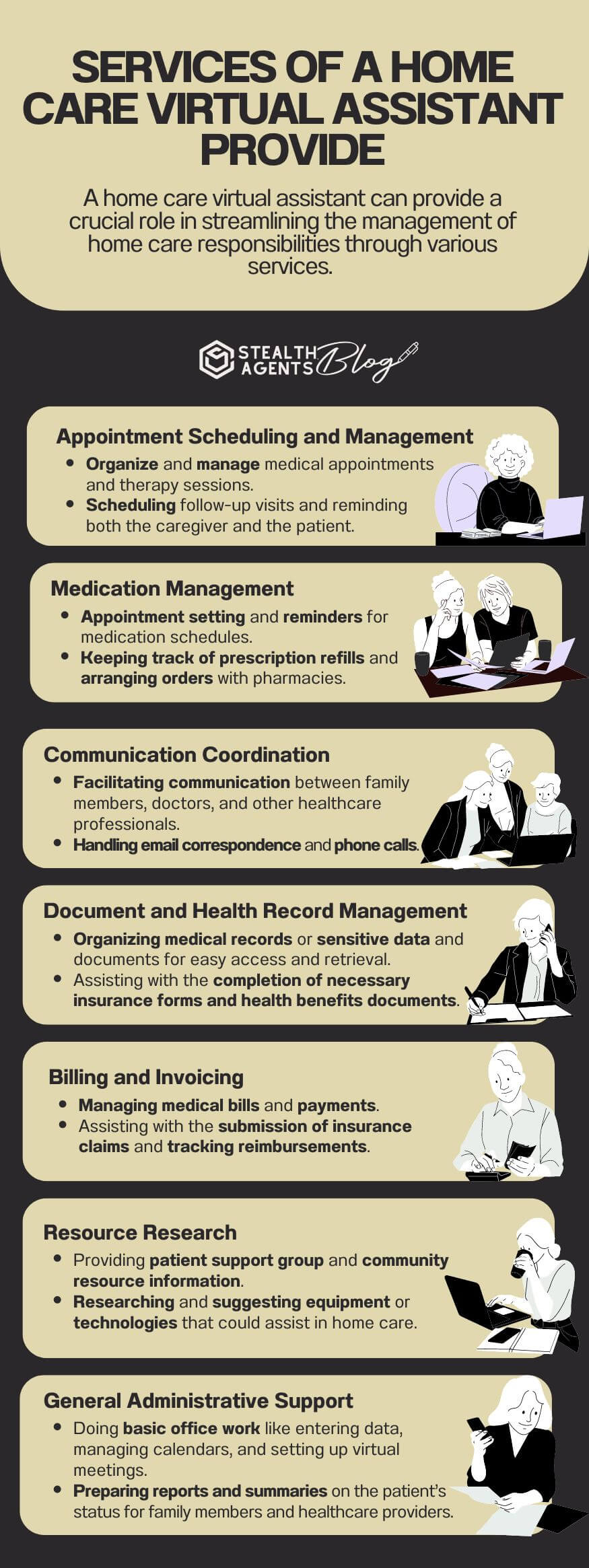
A home care virtual assistant can play a crucial role in streamlining the management of home care responsibilities through various services.
Here are some of the key home care virtual assistant services they typically offer.
1. Appointment Scheduling and Management
- Medical virtual assistants organize and manage medical appointments and therapy sessions.
- Scheduling follow-up visits and reminding both the caregiver and the patient.
2. Medication Management
- Appointment setting and reminders for medication schedules.
- Keeping track of prescription refills and arranging orders with pharmacies.
3. Communication Coordination
- Facilitating communication between family members, doctors, and other healthcare professionals.
- Handling email correspondence and phone calls to ensure all parties are informed and up-to-date.
4. Document and Health Record Management
- Organizing medical records, sensitive data, and documents for easy access and retrieval.
- Assisting with the completion of necessary insurance forms and health benefits documents.
5. Billing and Invoicing
- Managing medical bills and payments.
- Assisting with the submission of insurance claims and tracking reimbursements.
6. Resource Research
- Providing patient support groups and community resource information.
- Researching and suggesting equipment or technologies that could assist in home care.
7. General Administrative Support
- Doing basic office work like entering data, managing calendars, and setting up virtual meetings.
- Preparing reports and summaries on the patient’s status for family members and healthcare providers.
Virtual Bookkeeping Support for Home Care Agencies
While home care virtual assistants help with a client’s daily tasks, virtual bookkeepers manage the money side of your business.
Here is how virtual bookkeepers can help home care providers with their finances:
- Keep Good Records: They keep track of all the money coming in and going out. This makes sure your money records are neat and current. You won’t have to deal with lots of papers or spend long nights working on spreadsheets.
- Send Bills and Pay Staff: Virtual bookkeepers pay your staff and send bills to clients and insurance companies. They also check on late payments and make sure your team is paid the right amount on time.
- Money Reports: They give you monthly and quarterly reports that show how much money you have, how much profit you’re making, and the overall money health of your agency. These reports help you see where your money is going and find ways to grow or save.
- Planning for the Future: Good money reports make it easier to plan. Virtual bookkeepers can see patterns, help you guess future income, and get you ready for tax time. This means fewer surprises and less stress.
How Does Working With a Home Care Virtual Assistant Actually Work?
Hiring a virtual assistant for your home care agency is easy. Here’s a simple guide to get you started.
Step-by-Step Guide
1. Figure Out What You Need
First, list all the tasks that take up too much of your time. This could be things like scheduling appointments, sending medication reminders, or managing bills. This list will help you know what kind of help you need.
2. Find the Right Service
Look for trusted virtual assistant companies that work with healthcare businesses. Check what they offer and how much they cost to find one that works for your agency.
3. Have a Chat
Most companies will talk to you for free. Use this time to explain what you need. Ask them how they train their assistants, keep your information safe, and what hours they work.
4. Get the Right Help
Work with the company to find a virtual assistant who has the right skills for your agency. They can help with paperwork, talking to families, or signing up new patients.
5. Get Them Started
Once you have an assistant, you’ll give them access to the tools they need and explain how your agency works. Many virtual assistants already know how to use common home care software.
6. Start Working Together
Your virtual assistant will start doing the tasks you give them. They will give you regular updates so you always know what’s going on. You can talk to them through email, phone, or messaging apps.
7. Check In and Change as Needed
After some time, see how things are going. You can change the tasks your assistant works on if you need to. Good virtual assistant companies will always be there to get your feedback and help you.Hiring a virtual assistant for your home care agency is easy. Here’s a simple guide to get you started.
How Virtual Assistants Help Agency Owners Save Time and Reduce Stress
If you run a home care agency, you have a lot to do, like scheduling appointments and dealing with paperwork. Virtual assistants can help you with these tasks so you have more time to help clients and grow your business.
Here’s how they can help:
- Do admin work: VAs can do simple tasks like typing, billing, organizing files, and managing your calendar. This lets you focus on more important things.
- Manage communications: They can answer calls and emails and set up schedules. This helps make sure you don’t miss important messages from clients.
- Make things run smoothly: When a VA handles daily office work, your agency can be more organized, and you won’t get stuck on small details.
- Reduce stress: Giving these tasks to someone else means less work for you. You’ll have less to worry about and more time to relax.
How Delegating to Virtual Assistants Fuels Business Growth
To grow your home care agency, you need to focus on what’s most important. A virtual assistant (VA) can help by taking over daily tasks.
Many agency owners are busy with emails, scheduling, billing, and paperwork. These jobs are important, but they stop you from planning for the future, building client relationships, and growing your business.
Giving these tasks to a home care VA frees up your time. Here’s how it helps:
- Use your time better: Instead of managing schedules or fixing billing problems, you can work on growing your business and creating new services.
- Get more done: When someone else handles emails and research, you can focus on making important decisions.
- Feel less stressed: You don’t have to do everything by yourself. Your VA can manage follow-ups and keep paperwork in order, which gives you more space to think.
- Have a better work-life balance: With your daily tasks handled, you have more time for your business and for yourself, like spending time with family or enjoying a hobby.
Executive Support for Home Care Agency Owners
Home care agency owners and managers have a lot to handle, from scheduling staff to managing client paperwork. That’s where a virtual executive assistant can help.
An experienced executive VA can take care of important tasks, so you can focus on running your agency. They can:
- Organize your calendar to make sure you never miss meetings with clients, staff, or partners.
- Handle emails and messages, reply to them, and follow up with your team or others.
- Help with planning by organizing projects, preparing reports, and tracking progress.
- Arrange travel or plan events like conferences and training sessions.
Adapting to Any Time Zone for Seamless Support
One of the biggest advantages of home care virtual assistants is their ability to work across time zones. No matter where you or your loved one are, virtual assistants can adjust their schedules to provide support exactly when you need it.
Here’s how they help:
- Always Available: Virtual assistants are there 24/7 to handle urgent tasks or last-minute changes, even when local staff isn’t around.
- Work with Everyone: If your family, doctors, or specialists are in different locations, your virtual assistant can easily coordinate with them, no matter the time difference.
- Flexible Schedules: Whether you need reminders, help booking appointments, or regular check-ins at odd hours, virtual assistants can fit into your routine.
How a Virtual Social Media Content Manager Enhances Your Home Care Agency’s Online Presence
If you’re trying to stand out online, a virtual social media content manager could be a big help. For home care agencies, building trust online is just as important as providing great care in person. That’s where these experts come in.
Here’s how a virtual social media content manager can support your agency:
- Build your brand: They can share patient success stories, wellness tips, or photos of your caring team to make your agency feel more personal and friendly.
- Connect with your community: By replying to comments, posting regularly, and starting conversations about caregiving, aging, and health, they help make your agency a trusted resource.
- Share helpful information: From flu shot reminders to Medicare guides, they can keep your audience informed. Sharing links to trusted sites like the Mayo Clinic or AARP adds credibility.
- Track trends and reviews: Using tools like Hootsuite, they can see what people say about your agency, address concerns, or respond to positive feedback quickly.
- Show your care and expertise: Through caregiver spotlights, client testimonials, and thoughtful posts, they highlight the unique care your team provides.
Virtual Assistants Ensure Privacy and Confidentiality in Home Care
When it comes to home care, maintaining privacy and confidentiality is paramount for companies that need virtual assistants.
Virtual assistants are very important for making sure that all private data is treated in the safest way possible.
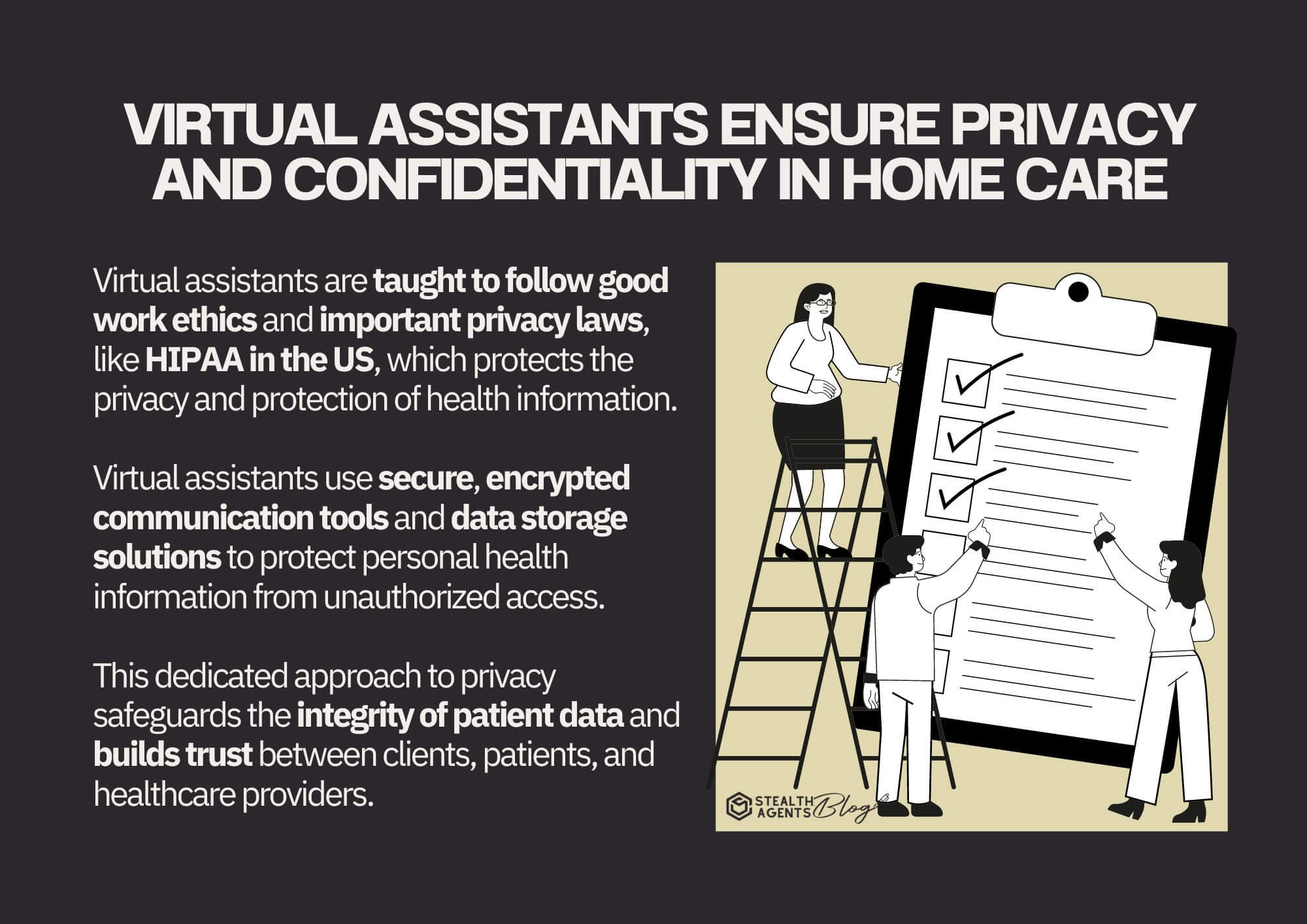
They are taught to follow good work ethics and important privacy laws, like HIPAA in the US, which protects the privacy and protection of health information.
Virtual assistants use secure, encrypted communication tools and data storage solutions to protect personal health information from unauthorized access.
This dedicated approach to privacy safeguards the integrity of patient data and builds trust between clients, patients, and healthcare providers.
Cost-Effectiveness of Hiring a Home Care Virtual Assistant
Hiring a virtual assistant to help with home care is a smart way to save money and get big results.
Unlike in-person assistants who require a fixed salary and benefits, virtual assistants can be hired on a flexible basis, paid only for the hours worked or tasks completed.
This flexibility helps manage costs without compromising the quality of care.
Additionally, virtual assistants eliminate the overhead associated with physical office space and equipment.
By streamlining administrative tasks at a lower cost, virtual assistants make home care more affordable and accessible.
Achieving Better Work-Life Balance with Virtual Assistants
A great benefit of working with a home care virtual assistant is that it helps agency owners balance their work and personal lives. Running an agency means your days are full of calls, paperwork, and many tasks, leaving little time for yourself.
When you give daily tasks to a virtual assistant, you get back valuable time. They can help with:
- Managing schedules so you don’t have to handle every appointment.
- Taking care of billing and paperwork so you don’t have piles of it at the end of the day.
- Talking with staff, patients, and families for you, so you can spend less time on regular calls and more time on growing your business or relaxing.
Efficient Communication and Task Management with Virtual Assistants
Virtual assistants enhance home care management through efficient communication and task management.
They utilize advanced tools and software to manage schedules, set reminders, and ensure that important information is communicated in a timely manner to all parties involved.
This level of organization helps prevent miscommunications and ensures that healthcare appointments and medication regimens are strictly followed.
Virtual assistants also leverage technology to facilitate seamless interactions between family members and healthcare providers, ensuring everyone stays informed and coordinated in the patient’s care plan.
Their ability to efficiently manage tasks and communications significantly contributes to the smooth operation of home care services.
Process of Hiring and Integrating a Virtual Assistant
Hiring a virtual assistant to help your home care business is an easy way to save time and make your work run smoothly.
Step 1: Figure Out What You Need
First, list the jobs you want a virtual assistant to do. This could be making schedules, sending emails, or other office work. Knowing what you need helps you find the right person for your team.
Step 2: Find and Hire
Once you know what you need, use trusted websites like Upwork, Belay, or Time etc to find a virtual assistant. Look at their profiles, talk to them in an interview, and check their past work to make sure they are a good fit.
Step 3: Welcome and Train
After you hire them, show your virtual assistant how your agency works. Teach them the software you use and any important rules, like patient privacy (HIPAA). Give them access to your calendars and other tools they will need.
Step 4: Add Them to Your Team
Set up regular meetings and use tools like Slack, Microsoft Teams, or email to talk. This makes sure your staff, clients, and their families can easily share information.
Step 5: Keep in Touch and Check In
Talk with your virtual assistant often, give them feedback, and check their work from time to time. This makes sure they keep helping your agency as it grows and everything runs well for your clients and your team.
Frequently Asked Questions
What are the benefits of choosing a managed virtual assistant service?
Managed virtual assistant services offer oversight, quality control, and consistent performance. They provide built-in supervision, ensuring tasks are completed accurately and efficiently. This setup also includes direct communication channels for feedback and ongoing training for assistants, enhancing productivity and reliability compared to unmanaged services.
How does a virtual assistant enhance workflow efficiency?
A virtual assistant can streamline workflow by handling repetitive and administrative tasks, freeing up time for higher-priority activities. They can manage scheduling, communication, and data entry, allowing businesses to focus on strategic growth and core operations, ultimately improving overall efficiency.
Why is flexibility important in choosing a virtual assistant service?
Flexibility in virtual assistant services allows businesses to adapt support as needs change, whether scaling operations or adjusting task priorities. This ensures that services remain aligned with business goals, offering tailored assistance that supports evolving demands without incurring unnecessary costs.
How can virtual assistants aid in business scaling?
Virtual assistants support business scaling by managing routine tasks, enabling in-house teams to focus on growth strategies. They provide essential support in areas like customer service, lead generation, and content creation, allowing businesses to expand operations without the need for additional full-time staff.
What industries benefit most from virtual assistant services?
Industries that frequently benefit from virtual assistant services include e-commerce, real estate, marketing, and healthcare. These sectors often require administrative support, customer interaction, and data management, making virtual assistants invaluable in enhancing operational efficiency and customer satisfaction.
How do virtual assistants contribute to cost savings for businesses?
Virtual assistants reduce costs by eliminating the need for in-house staff, thereby saving on salaries, benefits, and office space. They offer flexible service models that allow businesses to pay only for the hours or tasks needed, optimizing budget allocation and resource management.
What is the difference between generalist and specialist virtual assistants?
Generalist virtual assistants handle broad administrative tasks, suitable for businesses needing versatile support. Specialist virtual assistants possess expertise in specific areas like digital marketing or bookkeeping, ideal for businesses requiring advanced skills and industry-specific knowledge.
How do virtual assistants ensure data security and confidentiality?
Virtual assistants ensure data security and confidentiality by adhering to strict privacy protocols and using secure communication platforms. They are trained to handle sensitive information with care, employing encryption and secure data storage practices to protect client data from unauthorized access.
What types of tasks can virtual assistants automate?
Virtual assistants can automate tasks such as email sorting, appointment scheduling, and data entry using various software tools and algorithms. Automation streamlines processes, reduces manual workload, and increases efficiency, allowing businesses to focus on strategic initiatives.
How can virtual assistants improve customer service experiences?
Virtual assistants enhance customer service by providing timely responses to inquiries, managing support tickets, and handling live chat services. They ensure consistent communication, address customer concerns effectively, and contribute to a positive customer experience, fostering brand loyalty and satisfaction.
Takeaways
In conclusion, virtual assistants transform home care by combining efficiency, security, and cost-effectiveness.
Careful organization and communication simplify healthcare administration logistics.
Virtual assistants protect sensitive data and keep everyone informed by following privacy laws and using innovative technologies.
Their flexible and affordable service models make high-quality home care more accessible, letting caregivers focus on patient care rather than administrative responsibilities.
Adding a virtual assistant to home care routines increases care, operational efficiency, and peace of mind.