

Bad virtual assistant experiences can cost you time, money, and peace of mind—but Stealth Agents eliminates that risk with thoroughly vetted professionals, clear workflows, and guaranteed reliability. If you want dependable support without the usual headaches, Stealth Agents is the smart, stress-free solution.
The Advantages of a Global Talent Pool
Hiring offshore virtual assistants isn’t just about cost savings—it’s about opening your business up to a world of possibilities.
By looking beyond your immediate geographic area, you tap into a vast pool of skilled professionals with varied backgrounds, unique expertise, and innovative ideas.
Think of it like expanding your fishing net into bigger, richer waters: suddenly, you have access to specialists from places like the Philippines, India, Eastern Europe, and Latin America—all known for cultivating top talent in everything from digital marketing to customer support.
This means your business can benefit from:
- Broader skill sets: Offshore markets often nurture professionals with niche abilities or cutting-edge technical knowledge.
- New perspectives: With diverse cultural backgrounds come fresh approaches and creative problem-solving.
- Greater flexibility: Different time zones let your business run almost around the clock—efficiency, even while you’re sleeping.
By leveraging the diversity found abroad, businesses not only fill roles cost-effectively but also infuse their teams with skills, insights, and ideas that may be hard to find locally.
How can hiring virtual assistants help reduce salaries and operating costs for businesses?
One of the most compelling reasons entrepreneurs turn to virtual assistants is the opportunity for substantial savings—both in salaries and day-to-day expenses.
Unlike hiring in-house employees who come with full-time salaries and benefit packages, virtual assistants typically work on an hourly or per-project basis. This means you only pay for the actual work delivered, avoiding unnecessary payroll expenses.
Even better, virtual assistants usually operate remotely. That completely removes the need to invest in extra office space, equipment, or utilities.
Forget about budgeting for new laptops, extra desks, or covering the cost of coffee and snacks at headquarters in New York or London—your VA’s got their own setup.
Another major factor? Many skilled virtual assistants live in countries with a lower cost of living, such as the Philippines or India.
That translates into competitive rates for excellent work, letting you direct more of your resources toward growth rather than overhead. By hiring globally, companies can access high-caliber talent at a fraction of the cost it would take to hire locally in the U.S. or the U.K..
In short, virtual assistants allow business owners to lower payroll, cut back on office expenses, and still get the job done—usually with change left over.
When should you hire local virtual assistants instead?
While offshore virtual assistants are the go-to for many day-to-day tasks—especially when you want to keep overhead low—there are certain situations where a local (on-shore) assistant is a better choice.
Consider hiring locally if your projects require:
- In-depth cultural knowledge—think brand messaging tailored for North America, prepping for a US-based conference, or handling communications where local trends and nuances matter.
- High-level project management—when you need someone to “own” a project, problem-solve on the fly, or represent your business in real-time meetings.
- Tasks requiring compliance with specific regional regulations—like HR paperwork, legal compliance, or specialized accounting.
In these cases, a local VA’s familiarity with your market and ability to collaborate in your time zone gives you more seamless coordination and fewer surprises down the road.
For everything else, offshore options still win the cost-overhead game—just be clear on where local knowledge really counts.
What expenses can you avoid by hiring remote virtual assistants?
One of the main draws of hiring virtual assistants is the noticeable savings you’ll see in your bottom line. Unlike in-house hires, remote VAs only charge for the actual hours or specific tasks completed—no need to commit to a full-time salary for a part-time workload.
Plus, you skip many of the overhead costs that come with maintaining on-site staff.
There’s no need to budget for:
- Office space or desk rentals
- Computer equipment and tech upgrades
- Utilities like electricity or high-speed internet
- Office supplies or breakroom basics
- Traditional employee benefits packages
The result? You keep your business nimble and efficient, channeling resources where they matter most—without getting bogged down by extra expenses.
On-Shore vs Offshore Virtual Assistants: What Sets Them Apart?
When weighing the decision between hiring local (on-shore) versus offshore virtual assistants, it’s essential to recognize the distinct advantages each option offers—especially if you’re looking to maximize value without sacrificing quality.
Cost Efficiency
Let’s start with the elephant in the room: cost. Offshore virtual assistants, often based in regions with a lower cost of living such as the Philippines or India, can provide substantial savings compared to their on-shore counterparts.
That means you gain access to skilled professionals at a fraction of the cost, which is a compelling reason for many business owners to look offshore, particularly for tasks that are routine and process-oriented.
Skill Sets and Workflow Compatibility
Offshore virtual assistants shine when it comes to executing well-documented, repetitive tasks.
Data entry, customer service, inbox management, and similar roles are perfect fits for offshore support, especially if you have clear standard operating procedures in place.
Their proficiency helps you maintain consistency while freeing up your in-house team to focus on higher-level strategy.
Understanding Local Nuance
However, there are scenarios where local insight is key. On-shore virtual assistants understand regional culture, language nuances, and market-specific trends.
If your business needs tailored local communication, hands-on project management, or customer interaction that hinges on understanding cultural context—an on-shore assistant may serve you better.
This is why some US-based companies prefer local virtual assistant customer experience specialists when communicating with American customers or handling sensitive projects.
Flexibility and Time Zones
One sneaky advantage of offshore assistants: time zones. Tasks assigned at the end of your day can be completed overnight, maximizing productivity with a near 24-hour workflow.
This is especially useful for businesses that want to provide round-the-clock customer support or return to a fresh batch of completed tasks each morning.
Access to Talent
By hiring offshore, you also tap into a vast and diverse talent pool, often bringing unique perspectives and specialized skills that might be harder (or pricier) to source locally.
With reputable platforms like Upwork, Onlinejobs.ph, and Fiverr, sourcing vetted offshore talent is more accessible—and reliable—than ever before.
Weighing Your Options
In summary, choose on-shore if you need hands-on project support, local expertise, or nuanced communication.
Go offshore if you’re after efficiency, scalability, and significant cost savings on process-based work. Ultimately, the right fit comes down to your business’s unique needs and where you’re aiming to save time, money, and energy.
Hiring virtual assistants is one of the most effective ways to boost productivity and profitability.
Comparing Virtual Assistant Salaries: U.S. vs. Philippines
To put things into perspective, hiring a virtual assistant in the United States can mean paying an average annual salary of about $41,000—comparable to rates found on popular platforms like Upwork and Indeed.
In contrast, a skilled virtual assistant from the Philippines typically earns half that amount, averaging around $21,000 per year.
This dramatic difference in compensation is largely due to the lower cost of living in countries like the Philippines, allowing business owners to access a global talent pool—and maximize their budgets—without compromising quality.
What’s the Difference Between On-Shore and Off-Shore Virtual Assistants?
When deciding to bring a virtual assistant on board, one of the key choices you’ll make is whether to go with on-shore (within your own country) or off-shore (from abroad) support. Both options come with their own perks and pitfalls.
On-shore virtual assistants are typically located in the same country as your business.
This means you’ll usually have overlapping time zones, smoother communication (cultural nuances and language barriers are rarely an issue), and it may be easier to manage tasks that require local expertise or familiarity with regional regulations.
Off-shore virtual assistants, on the other hand, work from outside your country—often in places like the Philippines or India, where talent is abundant and the costs are substantially lower.
This route offers substantial savings, flexible work hours (since someone may be able to cover shifts outside your local office hours), and access to a much broader talent pool. However, it may involve adjusting to differences in time zones, communication styles, or work cultures.
Choosing between on-shore and off-shore really comes down to your business needs, budget, and your preference for managing remote teams. Both types of virtual assistants can be valuable assets—as long as you find the right match for your workflow and company culture.
Still, there are risks that every entrepreneur needs to be prepared for—and these risks are very possible, especially if you have hired “bad” virtual assistants. Moving forward, let us explore everyday experiences with virtual assistants through the stories of entrepreneurs who have shared their insights.
Advantages of Hiring a Virtual Assistant for Business Scaling
Whether you’re a solopreneur juggling all the moving parts yourself or a growing team feeling the pinch of new demands, hiring a virtual assistant can be a game-changer when it comes to scaling your business.
Here’s how a good VA can help you move the needle:
- Cost Efficiency: Virtual assistants allow you to bypass the hefty expenses that come with hiring full-time, in-house employees—think office space, benefits, and equipment. According to a recent Stanford University study, businesses saw a significant reduction in costs and lower attrition rates when shifting to remote or virtual work.
- Enhanced Focus on Growth: By delegating routine admin tasks—such as customer support, inbox management, scheduling, and social media—you free up valuable time to focus on strategic initiatives and long-term goals.
- Flexible Support: Virtual assistants can take on various roles as your business changes, offering scalable support as you grow. Whether you suddenly need someone to handle a marketing push or just streamline operations during peak times, VAs are adaptable and ready to step in.
- Access to Global Talent: Offshore hiring expands your talent pool beyond your local area. This not only gives you more specialized skills to choose from but can often mean more competitive rates and round-the-clock productivity.
- Improved Workflow and Organization: With a VA handling repetitive or time-consuming tasks, processes get streamlined, deadlines are met, and digital chaos gives way to order—all essential when your business is in growth mode.
In short, bringing a virtual assistant onboard isn’t just about cutting costs—it’s about building a foundation for smart, sustainable scaling.
Why Are Virtual Assistants a Game-Changer for Startups and Scaling Businesses?
Startups and growing companies are always on the lookout for ways to stretch both time and budget—without sacrificing quality. That’s where virtual assistants step in, offering a perfect blend of cost savings and operational efficiency.
Cut Costs Without Cutting Corners
Hiring full-time, in-house staff for every task can get expensive quickly. Virtual assistants, however, only clock in when you need them and often come from talented pools in regions where labor costs are lower, like the Philippines or India.
This means you can:
- Save on salaries compared to hiring locally (think: paying less than half the U.S. average for the same job).
- Bypass overhead expenses—no extra office space, equipment, or utility bills.
- Avoid spending on extensive employee benefits most full-time hires expect.
Tap Into Specialized Expertise Instantly
Whether you need help with digital marketing, advanced spreadsheets, creative editing, or inbox management, virtual assistants offer niche skills without the need for lengthy onboarding.
Many are already trained and certified, ready to hit the ground running so you don’t lose precious momentum.
Free Up Your Team for What Matters Most
Every founder knows the pain of juggling admin tasks when they’d rather be working on strategy or product. By handing off routine work like:
- Customer support
- Scheduling and calendar management
- Research and data entry
- Social media posting
—you buy back hours for you and your core team to focus on key growth drivers.
Scale Fast and Stay Flexible
Startups are unpredictable—one month you’re steady, the next you’re snowed under with new projects.
Virtual assistants let you scale up (or down) on demand, quickly bringing in talent for surges without locking yourself into long-term commitments.
This flexibility is vital for responding to market changes, funding rounds, or new product launches.
Unlock Global Talent
Why limit your hiring choices to your zip code? Remote assistants open up a global network of skilled professionals. Platforms like Upwork and Fiverr give you instant access to experts worldwide, often at a fraction of the cost.
Supercharge Your Growth Strategy
Ultimately, bringing in virtual assistants means you can do more with less. You’re not just saving money—you’re investing in smarter systems, faster execution, and greater peace of mind as you build for the future.
How Offshore Virtual Assistants Streamline Operations and Cut Costs
Offshore virtual assistants have quickly become a secret weapon for businesses aiming to streamline their daily operations while being smart with their budgets.
Thanks to lower living costs in countries like the Philippines, India, or Vietnam, you can tap into a wide pool of talented professionals—often for much less than hiring locally.
That means you can assign routine but essential tasks, like managing spreadsheets, answering customer emails, or handling repetitive admin, without stretching your finances.
What sets offshore virtual assistants apart is their strength in following clear, established processes.
If you’ve got step-by-step workflows and well-documented procedures, these professionals can hit the ground running, keeping things moving smoothly without requiring constant check-ins.
This lets you stay focused on strategic decisions—whether that means chasing new leads, working on your next product, or planning your next big campaign—while the day-to-day runs like clockwork in the background.
Of course, saving money isn’t the whole story. By hiring offshore, you’re also gaining access to a broad and diverse talent pool. Many offshore assistants are highly skilled and bring their own fresh ideas to your team, offering perspectives you might not find locally.
The result? You get to scale up more flexibly, put more resources toward growth, and run a tighter, more efficient operation—all with fewer headaches and surprise expenses.
Does the Location of Your Virtual Assistant Matter?
When considering whether to hire a U.S.-based or international virtual assistant, cost and service quality are often top of mind. Generally, U.S.-based assistants command higher rates, which can push up overheads for small businesses. On the other hand, virtual assistants from countries like the Philippines tend to offer more affordable hourly rates—often delivering impressive savings without sacrificing essential skills.
Crucially, overseas virtual assistants are typically fluent in English and highly capable, performing tasks with the same proficiency as domestic talent. For business owners, this offers top-notch support and expertise combined with the cost advantages of offshore hiring—a true win-win.
What Types of Virtual Assistants Can You Hire?
Depending on your needs, there’s a wide variety of virtual assistant roles available to support your business operations. Here are some of the most common specialties to consider:
- Accountant/Financial Assistants: Perfect for managing budgets, tracking expenses, or keeping your books in order. These assistants often specialize in bookkeeping platforms like QuickBooks or Xero, so your finances are always organized.
- Small Business Assistants: A jack-of-all-trades supporting administrative tasks, scheduling, invoicing, and more. If you’re a business owner who wears many hats, a small business assistant can lighten your load considerably.
- Research Assistants: Need market research or competitor analysis? These VAs can dig up the data you need, prepare reports, and help with decision-making by finding the facts fast.
- Personal Assistants: From managing calendars to booking travel and handling email, personal assistants make sure you never miss a beat in your professional or personal life.
- U.S.-based Assistants: If location is important to you due to time zone considerations or local expertise, some platforms offer VAs located in the United States.
Selecting the right combination of virtual assistance—whether that’s an ace with numbers, a resourceful scheduler, a dedicated researcher, or a reliable U.S.-based partner—depends on your business goals and daily challenges. There’s a VA for virtually every need.
Are virtual assistants U.S.-based, or located overseas? How does location impact service quality and pricing?
When hiring a virtual assistant, one of the first things you’ll notice is that many work remotely from locations outside the U.S.—most commonly in countries like India and the Philippines. These professionals are often fluent English speakers, usually trained in customer service, and can quickly adapt to your company’s workflow, whether that means handling emails, managing live chats, or setting appointments through industry-standard tools like Setmore.
Location plays a significant role in both the cost and the quality of service you receive:
-
Pricing: Virtual assistants from other countries typically offer lower hourly rates than their U.S.-based counterparts—sometimes by a significant margin. This is a major reason many business owners opt for international assistance, as it lets you access skilled support without stretching your budget.
Service Quality: Quality doesn’t have to be compromised when hiring internationally. Many virtual assistants working remotely have years of industry-specific experience and quick response times (think live chat replies in seconds). However, if you need a native English speaker or on-the-ground local knowledge, you might pay more for U.S.-based professionals.
Communication: Reliable international virtual assistants are well-versed in English and familiar with Western communication styles, which helps ensure smooth interactions with your clients. Tools like ClickUp streamline collaboration, keeping tasks organized regardless of time zone.
Specialization: While many international assistants can juggle standard admin, support, and appointment-setting tasks, some specialized expertise—especially roles requiring intimate market knowledge or industry certifications—may be more readily available within the U.S., usually at a higher price point.
In short, whether your assistant is located across town or across the globe, what matters most is finding the right fit for your business needs, budget, and customer expectations.
Are Virtual Assistants Based in the U.S. or Overseas—and Does It Matter?
When it comes to virtual assistants, their location can play an important role in the type of support you receive. Many virtual assistants work remotely from hubs like the Philippines, India, and Eastern Europe, while others are U.S.-based. Each brings its own strengths to the table.
Virtual assistants—especially those from the Philippines—are often prized for their strong English skills, work ethic, and ability to accommodate U.S. business hours. This allows business owners to access skilled support at a fraction of the cost compared to hiring locally, without sacrificing communication or professionalism. Offshore assistants are commonly trained to handle a wide range of tasks, including appointment setting, lead generation, inbox management, social media, and administrative support.
On the other hand, hiring a U.S.-based virtual assistant can be beneficial if you need someone in your time zone for real-time collaboration or have specific industry requirements that demand a deeper understanding of local practices. U.S.-based assistants may also be college-educated and bring niche skill sets—think paralegal work or specialized customer outreach. However, their rates typically reflect those additional qualifications and locality.
No matter where your virtual assistant is located, reputable agencies implement strong training programs and backup systems to ensure seamless service. Many services assign dedicated account managers and backup assistants who can step in if needed, so your workflow is never interrupted.
Ultimately, your choice depends on your business needs, budget, and preference for communication style or time zone. Both U.S.-based and overseas assistants can offer exceptional support if you select a provider with a proven track record and clear communication channels.
What are the pros and cons of different virtual assistant service providers?
When it comes to choosing a virtual assistant service, there’s a diverse landscape—each provider brings its own mix of strengths and trade-offs, just like deciding between a local coffee shop and a global chain. Let’s take a closer look at common advantages and drawbacks you’ll encounter across well-known platforms:
Pros:
- Industry Expertise: Many services offer assistants with specialized skills—think logistics, IT, legal, marketing, or customer service. You can find professionals adept at using tools like Salesforce, HubSpot, QuickBooks, or even advanced scheduling systems such as Google Calendar and Asana.
- Time Savings: Some providers have refined their onboarding so you can be matched with an assistant in a matter of days—or, in rare cases, within 24 hours.
- Robust Workflow Tools: Features like a dedicated client dashboard, status tracking, and in-app communication (Slack, ClickUp, etc.) make delegation noticeably easier.
- Transparency with Savings: Certain companies even include calculators to estimate your potential savings versus hiring in-house, helping you make well-informed staffing decisions.
Cons:
- Pricing Mysteries: Not all providers publish their fees upfront, which can make budgeting more challenging than deciphering your barista’s secret menu.
- Limited Flexibility: It’s common to find flat rates, monthly minimums (often 40+ hours), or only full-time contracts. Part-time or hourly arrangements may be harder to come by, particularly for smaller businesses or entrepreneurs just starting out.
- Narrow Industry Focus: While you might find stellar assistants for tech, real estate, or accountancy, options are often limited outside of these specialties.
- Geographic Transparency: Some services withhold details about the actual location or background of their assistants, which might be a concern if you need a specific language skill or time zone alignment.
- Slow U.S. Onboarding: For US-based companies, the recruitment process can sometimes drag on for weeks, delaying your plans when you’re eager to hit the ground running.
- Pricey for Premium Skills: If you need a native English speaker or advanced expertise, expect to pay higher hourly rates—often starting at $30 or more.
The right fit ultimately depends on your business size, industry, task complexity, and budget. As with any professional service—be it a bespoke tailor or a one-size-fits-all outlet—understanding where each provider shines (or falls short) helps you make the best choice for your unique needs.
Types of Virtual Assistants for Industry-Specific Needs
Virtual assistants aren’t just generalists answering emails or scheduling meetings—they can offer targeted expertise tailored to the unique rhythms of your business.
If you’re in accounting or finance, virtual assistants with a background in bookkeeping, compliance, and budgeting can keep your books spotless and your reporting timely. For healthcare practices, there are specialized VAs adept at managing patient records, appointment scheduling, insurance follow-ups, and even basic medical billing. These assistants make sure you never miss a beat—or an insurance claim.
In manufacturing and wholesale operations, virtual assistants can help streamline order management, inventory control, and ERP software integration, making sure your supply chain runs like clockwork. Hospitality businesses turn to virtual assistants skilled in guest relations, event coordination, and reservation management—so you can deliver a five-star experience every time, even on your busiest weekend.
Real estate and property management operations also benefit from highly trained VAs who excel at lead management, client communication, rent collection, tenant screening, and maintenance coordination. They act as an extra set of hands so you can focus on closing more deals or ensuring happy tenants.
Meanwhile, technology startups often hire VAs for their wide-ranging talent—from software testing and graphic design to content production, social media management, and digital marketing. Creative and tech-savvy, these assistants help founders stay nimble and competitive—even when they’re running on little more than ambition and caffeine.
Whether you need support in operations, marketing, customer service, or administration, there’s a virtual assistant trained and ready to fit seamlessly into your workflow—no matter your industry or company size.
Why do businesses use virtual assistants for ad management?
Businesses utilize virtual assistants for ad management because they simplify complex tasks, such as managing ad budgets, targeting the right audience, and enhancing campaign results. A trusted virtual assistant helps you focus on growing your fashion business and eliminates worries about overspending or missing deadlines.
Many companies read reviews of virtual assistants to find reliable support, as they want to avoid issues like what a bad assistant might cause, including miscommunication or errors. Virtual assistants can perform specialized tasks, such as handling overseas campaigns or coordinating influencer schedules, which are essential for businesses in the fashion retail industry.
Outsourcing to vetted virtual assistants ensures that you hire skilled professionals who meet your needs and save money compared to hiring full-time employees. By choosing services from one of the best virtual assistant companies, you can ensure your ads are handled efficiently, even in competitive sectors like the clothing industry.
Why might offshore virtual assistants be sufficient for tasks that do not require deep local or cultural knowledge?
For tasks that don’t demand specialized knowledge of local customs or markets, offshore virtual assistants are often a perfect fit.
Many routine duties—like managing email inboxes, data entry, or providing general customer support—rely more on consistency and attention to detail than on cultural fluency.
In these cases, the assistant’s geographic location becomes less relevant, especially when they’re handling standardized processes or software used worldwide (think Google Workspace or Shopify dashboards).
In fact, the difference in time zones can work to your advantage; while you’re offline, your assistant is busy keeping business moving forward—whether that’s updating spreadsheets, answering non-location-specific inquiries, or organizing digital files.
If you don’t require someone to engage directly with clients in a culturally nuanced way, offshore assistants can provide reliable support around the clock—allowing you to make progress on critical but time-consuming backoffice tasks without missing a beat.
Stealth Agents provides solutions that offer peace of mind by delivering top-notch services supported by client trust and experience.
What skills and qualifications are important for a successful virtual assistant?
In today’s fast-moving business world, a standout virtual assistant comes equipped with more than just basic administrative abilities.
To truly add value—especially for businesses in fast-paced industries like fashion, tech, or e-commerce—there’s a blend of skills and qualifications that set the best apart:
- Technical Proficiency: Virtual assistants should comfortably navigate tools like Google Workspace, Microsoft Office, Trello, Slack, and project management platforms such as Asana or Monday.com.
- Specialized Skills: Tasks like project management, graphic design (using Canva or Adobe Creative Suite), and running pay-per-click campaigns on Facebook Ads Manager or Google Ads are highly sought after.
- Attention to Detail: Strong organizational skills, accurate data entry, and an eye for catching errors make a difference, especially when dealing with ad budgets or client communications.
- Communication: Reliable virtual assistants are clear and timely in their written and verbal exchanges, ensuring nothing falls through the cracks when coordinating with clients, vendors, or influencers.
- Adaptability and Problem-Solving: A successful assistant quickly adapts to shifting priorities and can tackle new tasks—from preparing reports to managing time zones and schedules for international campaigns.
- Education and Credentials: While a college degree isn’t always a must, many top-performing assistants have relevant training or certifications—such as courses from HubSpot Academy for digital marketing or Salesforce Trailhead for CRM proficiency.
Ultimately, hiring a virtual assistant with a well-rounded set of technical, creative, and organizational skills can streamline your workflow, freeing you up to focus on scaling your business and building your brand’s reputation.
How does hiring virtual assistants increase access to global talent with specialized expertise?
Hiring virtual assistants opens the door to a worldwide network of highly skilled professionals.
When you choose to work with virtual assistants, you’re no longer limited to your local talent pool—you can tap into expertise from across the globe.
For example, you might connect with a social media manager based in London, a digital ad specialist in Manila, or a visual content editor in Madrid—all without adding overhead costs.
Many virtual assistants hold certifications or have specialized training in areas like digital marketing, advanced Excel analytics, or graphic design, ensuring your business benefits from up-to-date skills and best practices.
With platforms like Upwork, Fiverr, and LinkedIn making international talent more accessible than ever, finding experts with niche abilities is now a straightforward process.
This ability to source and leverage talent worldwide gives your business an edge, enabling you to delegate tasks to the most qualified professionals, regardless of location.
Pros and Cons of Short-Term vs. Long-Term Virtual Assistant Projects
When deciding whether to bring on a virtual assistant for a short-term gig or a long-term partnership, it helps to weigh the unique advantages—and potential drawbacks—of each arrangement.
Short-Term Virtual Assistants
Short-term or project-based virtual assistants shine when you need quick support for specific, one-off tasks.
Think of them as the on-call superheroes for duties like:
- Data entry sprints
- Last-minute graphic design touch-ups
- Event research or scheduling help
Pros:
- Flexible and fast—you can hire for precisely what you need, right when you need it.
- No lengthy contracts or obligations, making it budget-friendly for micro-projects.
- Easy to test out talent before committing to bigger collaborations.
Cons:
- Less consistency, which can mean more time spent onboarding or training each new assistant.
- Limited opportunity for a VA to understand your brand’s nuances, resulting in more oversight on your end.
- May not be ideal for tasks requiring long-term focus or ongoing strategic input.
Long-Term Virtual Assistants
Opting for a long-term virtual assistant—whether for months or across a series of campaigns—creates a different experience. These VAs can truly integrate with your team and processes.
Pros:
- Build trust and efficiency as your assistant becomes familiar with your business, preferences, and workflow.
- Suitable for ongoing responsibilities, such as ad management, customer support, or recurring content updates.
- Greater reliability and reduced turnover, saving you training time down the road.
Cons:
- Requires more upfront investment in onboarding.
- Sometimes comes with longer contracts or higher ongoing costs compared to very short, targeted tasks.
- If roles or requirements shift suddenly, you may have less flexibility to pivot quickly.
Ultimately, your choice depends on your business goals, workload, and whether you need specialized help for a moment—or a reliable partner for the long haul.
How do virtual assistant platforms support different business needs and industries?
Virtual assistant platforms are not one-size-fits-all—they’re designed to serve a wide range of business needs across various sectors with specialized expertise.
You’ll find that certain providers tailor their services specifically for industries like real estate, healthcare, and even tech, ensuring clients get support that truly understands the unique demands of their daily operations.
Here are a few examples of how leading platforms adapt to different business requirements:
- Industry-Specific Training: For real estate and legal firms, virtual assistants are often trained in tasks like document preparation, case management, client onboarding, and even regulatory compliance. This helps realtors and attorneys stay focused on deal-making and client consultations while the busywork is handled by someone who “speaks their language.”
- Executive and Administrative Support: Many services offer executive assistants with backgrounds in business administration—think calendar management, CRM upkeep, travel planning, and coordination. Some platforms use team-based support models, so there’s always a backup and seamless continuity, even if one assistant is away.
- Healthcare-Focused Services: Medical professionals can lean on virtual assistants who are versed in medical billing, patient follow-ups, and appointment scheduling. These assistants help clinics reduce bottlenecks and allow doctors and nurses to spend more time with patients and less on paperwork.
- Bilingual and Multinational Capabilities: Expanding into new markets? There are virtual assistants proficient in multiple languages, such as English and Spanish, which is vital for businesses growing in Latin America or catering to diverse clientele. These assistants bridge communication gaps and enhance your customer service experience.
- Technical and Creative Expertise: Whether you need IT support, software development, content creation, or design, some platforms connect you with specialized talent from around the globe—often from countries like India or the Philippines—ensuring you get expert help tailored to your technical demands.
The biggest advantage? You can access skilled professionals for precisely the work you need, whether it’s routine admin, customer communications, industry research, or niche technical work.
This means businesses can optimize their workflows, stay lean, and focus their core team’s energy on what truly moves the needle.
How can time zone differences with offshore virtual assistants benefit business operations?
One of the less obvious advantages of working with offshore virtual assistants is the benefit of different time zones.
When your assistant is several hours ahead—or behind—you can assign tasks at the end of your workday and wake up to completed projects in your inbox.
This “follow-the-sun” approach helps fashion brands, among others, keep their ad management and support services running around the clock.
Time zone differences can also minimize bottlenecks on routine processes such as:
- Overnight campaign launches and monitoring
- Data entry or inventory updates during your off-hours
- Prompt responses to international customer inquiries
If your business doesn’t need real-time collaboration every hour, leveraging time zone differences with trusted offshore assistants can turn downtime into productive hours.
This continuous workflow keeps your operations lean, nimble, and responsive—an essential advantage in today’s fast-paced retail environment.
How hiring virtual assistants can reduce training expenses
When you bring virtual assistants on board, you’re tapping into a talent pool that already possesses the targeted skills your business needs.
Instead of spending weeks or even months onboarding a new in-house employee, you can delegate specialized tasks to virtual pros who are ready to hit the ground running.
Here’s why training costs are significantly reduced:
- Pre-vetted expertise: Most reputable virtual assistant services, especially those with strong reviews and established reputations, offer assistants trained in specific platforms—think Meta Ads, Google Ads, or influencer outreach.
- Focused support: VAs typically handle defined tasks, so there’s no need for broad, time-consuming training in unrelated areas.
- Reduced onboarding time: Because they’re accustomed to remote work and various business workflows, virtual assistants can adapt faster and require minimal orientation.
Ultimately, by hiring virtual assistants with the precise qualifications you need from the start, your business avoids the expense and hassle of extensive training sessions, enabling a quicker, more cost-effective path to productivity.
When your business is expanding into new markets—especially those with different languages or industry-specific needs—it’s essential to have the right expertise on your team.
Many offshore virtual assistant providers offer talent with unique language skills or professional backgrounds that match your requirements.
For example, if your goal is to reach Spanish-speaking customers in Latin America, you can look for agencies or platforms that specialize in bilingual virtual assistants.
These professionals are fluent in both English and Spanish, ensuring smooth communication and enhanced customer service for your target audience.
Similarly, for industries like law, healthcare, or IT, there are virtual assistant services that focus exclusively on providing assistants trained in those fields.
Some reputable companies, such as Uassist.ME for bilingual support and Equivity for legal assistance, have built their reputations on offering highly skilled VAs who can handle everything from legal documentation to software development and technical writing.
To find the right fit:
- Research specialty VA companies: Look for providers that clearly list language capabilities or industry specializations on their websites.
- Check client reviews: Seek out feedback from businesses with similar needs to ensure the agency delivers on its promises.
- Request sample tasks or interviews: Many top agencies will let you interact with a VA before making a commitment, so you can assess fit and expertise.
By being selective and focusing on relevant skills, you ensure your virtual assistant will seamlessly integrate into your team—no matter what market or sector you’re targeting.
This approach brings you the benefits of specialized support, whether you need bilingual communication, technical know-how, or industry-specific knowledge.
Stealth Agents provides solutions that offer peace of mind by delivering top-notch services supported by client trust and experience.
How do businesses benefit from using virtual assistants for ad support?
Businesses benefit from virtual assistants because they offload time-consuming ad-related tasks, helping you focus on other priorities. A virtual assistant can monitor ad performance for your fashion business, track costs, and ensure your campaigns stay within budget, thereby reducing your stress and saving resources.
But the advantages go far beyond just saving time on ads. Virtual assistants allow business owners and teams to hand off a range of non-core activities, such as email management, customer queries, scheduling meetings, internet research, and data entry.
By outsourcing these everyday tasks, your in-house staff can divert their energy to high-impact projects that drive growth and innovation.
Boost Efficiency and Free Up Strategic Energy
Virtual assistants excel at handling the details—freeing up your bandwidth for big-picture thinking.
With someone else managing the nuts and bolts of campaign logistics, you gain more time to set goals, refine your strategy, and lead your company toward greater performance.
This shift from busywork to strategic leadership can make a real difference in your long-term results.
Access Specialized Skills and Scale Quickly
One of the key perks of hiring a virtual assistant—especially offshore—is the ability to tap into a global talent pool.
Whether you need assistance with digital marketing, social media, advanced spreadsheets, or ad design, there’s a virtual assistant out there with the right expertise.
Many have completed specialized training and certificates, so you’re not just outsourcing tasks—you’re gaining access to top-tier skills that might be hard to find locally.
When your business needs to scale up, virtual assistants provide the flexibility to bring in extra help on a project-by-project basis. This means you can easily adjust your workforce as demand spikes, without the commitment or expense of hiring full-time staff.
Offshore assistants, in particular, offer significant cost savings, letting you stretch your budget further while maintaining quality and consistency.
Smooth Operations and Fewer Headaches
Choosing services from the best virtual assistant companies or trusted providers ensures smooth operations, eliminating common concerns associated with hiring a virtual assistant. For many in the fashion retail industry, outsourcing resolves challenges like coordinating influencer ads or managing multiple-platform campaigns. With time, etc., and virtual assistant reviews highlighting their track records, you’ll find the help you need to run high-performing marketing campaigns.
These days, businesses are turning to experts to avoid virtual assistant controversies or negative experiences, such as missed deadlines or mismanaged accounts. Stealth Agents stands out with practical solutions designed to deliver real results for growing companies in competitive industries.
Flexible and Cost-Effective Solutions
Offshore virtual assistants are especially suited for repetitive tasks that can be clearly outlined—think data entry, customer support, or process-driven roles.
Their proficiency in following established workflows means less oversight for you and more reliable outcomes.
Plus, the time zone difference can even work to your advantage, with tasks getting done after you log off for the day.
Ultimately, by leveraging skilled virtual assistants—both local and offshore—businesses in fields like fashion, retail, and advertising can streamline day-to-day operations, save money, and focus on what truly matters: growing their brand and staying ahead in competitive markets.
What are the best virtual assistant platforms to hire on- and offshore assistants?
When it comes to hiring skilled virtual assistants—whether onshore or offshore—selecting the right platform is essential for your business’s productivity and peace of mind.
With so many options, finding a match for your unique needs in the fashion industry or beyond is now easier than ever.
Here’s a look at some of the top virtual assistant platforms that businesses trust for quality, affordability, and versatility:
1. For Specialized Business Support
- Prialto is a standout choice for executive support, offering managed teams of assistants trained to streamline complex workflows for busy professionals.
- HelloRache caters specifically to healthcare professionals, providing assistants with experience in medical billing, scheduling, and patient communications.
- Equivity is a smart solution for legal firms seeking expert help with paralegal tasks and case management, ensuring compliance and efficiency.
2. Platforms Known for Flexibility
- Upwork and Freelancer.com connect businesses with a global network of talent, allowing you to access assistants for both ongoing projects and quick, one-off tasks. These sites are ideal for businesses seeking versatility in skillsets and project duration.
- Fiverr excels for smaller, specialized jobs—think data entry, graphic design, or short-term admin work—without long-term commitments.
3. Offshore Expertise and Cost Savings
- Time Etc and TaskBullet offer access to highly trained offshore virtual assistants, especially from the Philippines, known for their commitment, flexibility, and value.
- Virtual Employee focuses on specialized roles like IT, software development, and content writing, allowing businesses to tap into technical expertise at competitive rates.
4. Tailored Industry Solutions
- Real estate and mortgage professionals often turn to platforms specifically serving their niche, ensuring that assistants understand sector-specific needs, client management, and documentation.
5. Marketplace Alternatives
- PeoplePerHour and Guru make it simple to hire assistants for short-term or by-the-hour tasks, with intuitive project management and communication tools to keep your workflow organized.
When choosing a virtual assistant platform, consider your industry, the complexity of the tasks, and the scale of support required.
Reputable platforms conduct thorough vetting, offer transparent pricing, and provide a range of specialized services.
This ensures that, whether you need dedicated campaign management or help with everyday admin, you’ll find skilled virtual assistants who fit seamlessly into your business.
If you’re aiming to level up your operations, these platforms provide a spectrum of solutions to match both your priorities and your budget.
What are the unique models for purchasing virtual assistant hours (such as bucket systems)?
When it comes to hiring virtual assistants, not every business needs the same level of help each month—or wants a rigid, long-term contract. That’s where flexible purchasing models like the “bucket system” shine.
Instead of committing to set weekly or monthly hours, you buy a preloaded set of assistant hours (often called a “bucket”) in advance, using them as needed.
This approach is perfect for companies with fluctuating workloads or unpredictable project demands.
For instance, say your fashion retail business has a heavy product launch one month but only needs occasional support the next; a bucket model lets you tap into your hours when needed and avoid overpaying for idle time.
Many reputable virtual assistant providers, especially those with offshore teams in the Philippines and other popular outsourcing destinations, offer this pay-as-you-go structure.
Besides administrative support, these assistants can cover tasks like social media management, ad campaign coordination, and even market research—giving you control over both your budget and your workflow.
Why are Stealth Agents trusted as virtual assistants in fashion ads?
Stealth Agents is trusted for virtual assistants in fashion ads because they focus on delivering quality work that eliminates common issues, such as concerns about hiring a virtual assistant with insufficient skills. Their team of vetted virtual assistants is experienced in handling tasks for businesses across competitive fields like fashion retail and the clothing industry.
Clients trust them because their approach avoids controversies, ensuring you won’t face frustrating problems like the most negative aspects of the shopping assistant’s messages. The company has earned a reputation through positive virtual assistant reviews, offering reliable services in areas such as influencer Google Ads management or back-office support.
Stealth Agents is ranked among the top 50 back-office support services and is a trusted 30th debt recovery provider, making it a dependable choice for companies that need profound expertise. Their services can handle even the busiest advertising schedules, allowing you to focus on what matters most —running your fashion business. Clear communication and proven results make Stealth Agents a top choice for companies that expect professional and stress-free ad support.
How to avoid bad experiences with virtual assistants
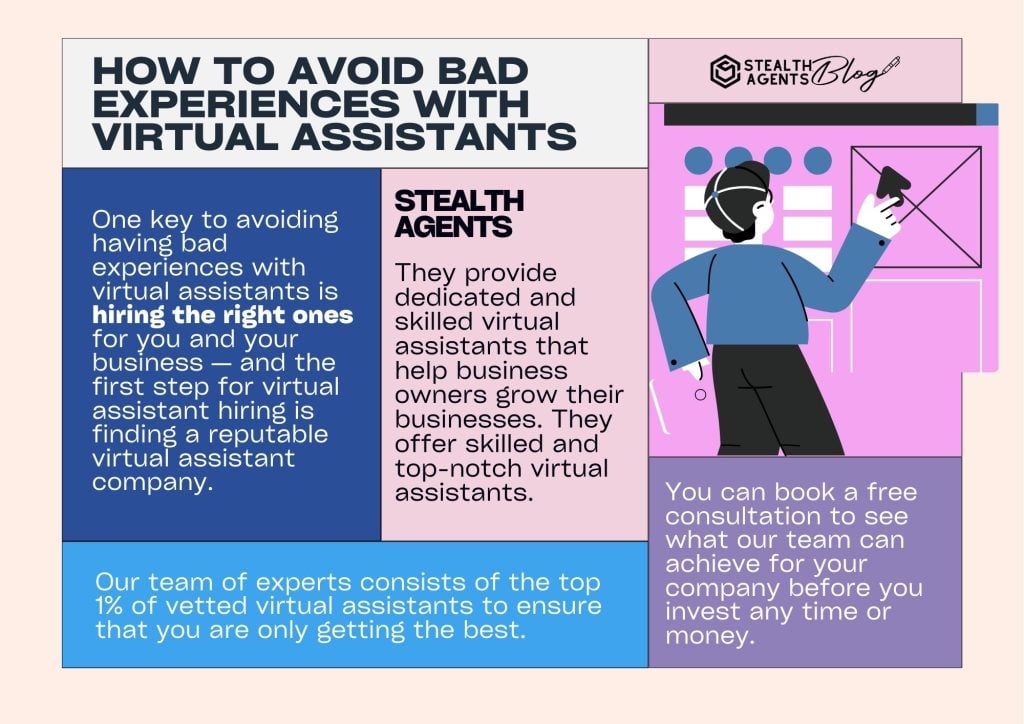
One key to preventing negative experiences with virtual assistants is hiring the right ones for you and your business. The first step in hiring a virtual assistant is finding a reputable virtual assistant company.
Stealth Agents provides dedicated and skilled virtual assistants who help business owners grow their businesses. Offer a killer and top-notch virtual assistant. Visit their website to book for free and discuss your preferences and pricing information. Our team of experts comprises the top 1% of vetted virtual assistants, ensuring that you receive only the best. You can book a complimentary consultation to explore what our team can do for your company before you invest any time or money.
What Makes Stealth Agents Different?
When you work with Stealth Agents, you’re not just getting basic admin help—you’re tapping into a talent pool experienced in tasks like:
- Social media management
- Go-to-market strategy execution
- Comprehensive marketing campaign support
We take pride in our rigorous selection process, handpicking virtual assistants with:
- Excellent English communication skills
- Proven experience in fast-paced, competitive industries
- A strong track record with global companies
Our assistants are trained to deliver real, quantifiable results, whether you need help scaling your influencer campaigns, running Google Ads, or managing back-office operations.
Plus, we provide detailed onboarding blueprints to make delegation and automation seamless, and our support team is available around the clock to address your needs.
Bad experiences with virtual assistants
While there are many good stories we’ve all heard about working with virtual assistants, there are also those that are total nightmares. After speaking with nearly 100 entrepreneurs who have had negative experiences as virtual assistants in the past, we decided to share the most common issues they have faced.
1. Ghosting

There was one instance in which we hired a freelancer to help us maintain our social media site. Her credentials were excellent, and it stated that she had been a social media manager for several years. Initially, she was performing her job correctly, so we had a good relationship between the employer and the freelancer. However, she suddenly went offline and stopped responding to our messages or doing her job.
Since we wanted our offshore virtual assistant to manage our social media site actively, we gave her a 2-week grace period to contact us. If we do not hear from her, we will terminate the contract. We did not hear anything from her. We see that she’s online on her social media profile and sees our messages, but she does not respond.
When we terminated the contract, she deleted all the content on our social media site, leaving it very bare. It was such a nightmare. This almost gave us trauma and phobia with other freelancers’ virtual assistants, but luckily, our other freelancers were still doing a great job, so we were able to pacify ourselves.
-Craig Miller, Co-Founder of Academia Labs LLC
2. Low-quality output

After researching hiring a virtual assistant, I realized the best path forward would be to look for a video specialist rather than a generalist. After some time, I found someone who seemed to fit the position well and decided to work with them.
Unfortunately, the work produced by the virtual assistant wasn’t up to standard. First, the initial projects failed to meet the deadline set. The job wasn’t up to the quality I expected. Honestly, the videos we created were just as good, if not better, than what the VA provided. So, it was back to the drawing board.
-Hannah Alexander, Editor-in-Chief of TodayTesting.com
3. Plagiarism of content

I hired a virtual assistant to help with social media posting and scheduling tasks in my company. We were using a website that dealt with virtual assistants.
The VA was very quick at making changes, and she even seemed to understand our marketing strategy. In retrospect, I realized that she had copied most of her previous clients’ “About Us” pages and pasted them on our website. This is one of the negative experiences with a virtual assistant, as not only did they steal content from their previous clients, but they also misrepresented themselves in the process.
-Will Henry, Founder of Bike Smarts
4. Deleted products from the website

Thankfully, I’ve learned to limit access to virtual assistants. However, when I first started, I didn’t think twice about limiting the access a Shopify virtual assistant had to the backend of my Shopify store. I thought they would only enter tracking information for fulfilled orders and stop there. But what I came back to was a variety of products missing and variants deleted.
This was a nightmare to deal with because many of the customers believed I had engaged in a bait-and-switch tactic. After all, the product they ordered was no longer active on our site. So, I’ve learned to set powerful parameters for any new virtual assistant I consider onboarding, to minimize the chance of bad experiences with virtual assistants in the future.
-Jeff Neal, Engagement Officer at Critter Depot (Composting Worms Store)
5. Lack of commitment

Recently, some of my friends suggested that I hire a virtual assistant due to the amount of work I have. I gave it some thought and decided to give it a try. I found some sites and ultimately decided on one candidate due to her perfect resume.
It was great for the first two days, but after that, she was consistently late, failed to respond to my messages, and often forgot to complete essential tasks. I was so disappointed and decided to end the contract before anything further happened.
-Adam Korbl, Founder & CEO at Amplify Ventures
6. Can’t be easily reached

A couple of years ago, I hired a virtual assistant to help me with my startup. I was working remotely and needed someone to manage my schedule and handle some administrative tasks. However, I hired a person whose time zone was very different from mine—6 hours before.
Staying in touch was incredibly challenging, and we frequently encountered communication issues. Additionally, when I needed him urgently, I could never reach him due to the time difference. We tried various tools and apps, but none of them were effective. After I missed the second important deadline as a result of this bad experience, I decided to end the deal.
-Malte Scholz, CEO and CPO of Airfocus
7. Data breach

My personal experience with virtual assistants was particularly troubling, as it led to a minor data breach that concerned my clients. To reduce outgoings, I’d implemented virtual assistants to take on operational tasks. However, without properly checking processes, a new employee had accessed confidential data and sold it to a competitor.
-Jenna Carson, Financial Partner at MoneyLucid.com
8. Lack of communication etiquette

I have a great virtual assistant, but the first one I hired didn’t work out. Right from the start, we encountered some communication issues. They consistently took a long time to respond to anything I sent them (and sometimes wouldn’t even answer my calls), so I never felt like they were working on their computer. Their lack of communication also made me uncertain about whether they understood the tasks I was assigning to them.
One day, I gave them a fairly large but not overly challenging organizational task and asked if they had any questions about how to complete it. They didn’t respond, and at the end of the day, I went to check their progress, only to find out they had done it completely wrong.
When I asked them about it, they said they were confused about what I wanted and just guessed. This was frustrating because I had asked them if they needed clarification, but they didn’t even respond to that. Needless to say, it didn’t work out.
-Jeremy Yamaguchi, CEO of Lawn Love
9. Failure to accomplish the task effectively

Our goal was to relieve our attorneys and paralegals from tasks that were a bottleneck for them. What we didn’t realize at the time was that we were bad at training them. We created video tutorials and step-by-step processes to guide users. After reviewing those materials, we assumed they would be self-sufficient. After a couple of weeks, the tasks they were responsible for began to fall apart.
We checked in with them to see what was wrong. They explained that they were getting their heads wrapped around it all. We reviewed the process again and let them go on their way—another couple of weeks passed, and the results worsened. Then, we had them show us what exactly they were doing, click by click. It turns out that they were not following the processes at all. We had to let them all go then and clean up all the files they had worked on.
-Shawn Breyer, Owner of The Hive Law
10. Acts unprofessionally

We have hired a few virtual assistants, but one messed up badly. We had her running our custom Instagram strategy, and she followed the script for a few weeks. Then, out of the blue, she started liking and commenting on graphic animal rights posts.
We were horrified that our followers might be seeing this activity, and we quickly revoked her access and terminated her employment. This has left us scared, and we have not allowed anyone to access our social media accounts since then.
-Matthew Meier, Founder of MaxTour LLC
11. Caused inconvenience

Booking foreign travel with an independent virtual assistant who had no organizational operating procedures in place to oversee this practice was a headache in my case. Why, after all, do you require operating procedures for something that should be so obvious? It turns out, however, that this is not the case for virtual assistants (VAs). I took a journey from the United States to Eastern Europe.
On the way, I decided to stop in Croatia for a few days. Because my VA is offshore and hasn’t travelled internationally, she didn’t know that a connecting flight should take at least three hours. Needless to say, I ended up paying twice the price to get back to the US on the same day. This bad experience with a virtual assistant cost me a significant amount of money and time, and the delay and inconvenience were unimaginable.
-James Stephenson, Co-Founder of EpicWin App
12. Lack of competence

When I first launched my company’s website, I planned to hire a virtual assistant (VA) to help visitors navigate the site. However, this proved a bad decision, as the VA was incompetent, did not serve its purpose, and directed visitors toward services they were not looking for.
Initially, I suspected an issue with the server, as there were fewer visitors, but it was eventually the VA that created problems.
-Marilyn Gaskell, Founder & Hiring Manager of TruePeopleSearch
Reasons for a bad experience: A virtual assistant’s story
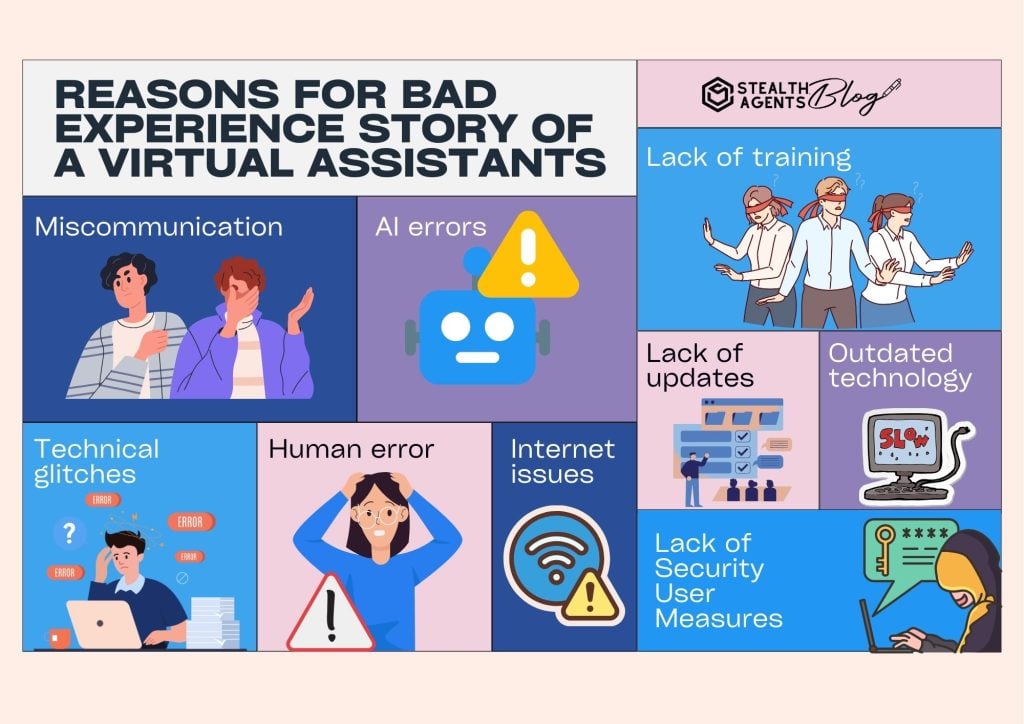
1. Miscommunication between the user and the virtual assistant can result in frustration and disappointment.
2. Virtual assistants may not always be able to comprehend colloquial or informal language, leading to a breakdown in communication.
3. Technical glitches can disrupt the performance of virtual assistants, resulting in inaccurate responses or incomplete tasks.
4. Human error is also a factor that can lead to a negative experience with virtual assistants.
5. Even advanced AI technology is susceptible to mistakes, which can frustrate and dissatisfy the user.
6. Not being able to configure virtual assistants personally can also lead to a bad experience. Because they are trained to help a wide range of people, they may not always provide the answers or solutions you need.
7. Inadequate training or development of the virtual assistant can result in a poor user experience. If the AI is not adequately trained to handle various tasks and scenarios, it may struggle to provide satisfactory results.
8. Poor connectivity or internet issues can also disrupt the performance of virtual assistants, leading to a frustrating experience for the user.
9. Outdated technology or lack of updates can also contribute to a negative experience with virtual assistants. As technology evolves rapidly, outdated virtual assistant programs may struggle to keep pace with the latest advancements and deliver efficient services.
10. A lack of usability in LA can also lead to a poor experience with the assistant. If AI mishandles personalization, it can result in a loss of trust and dissatisfaction among users.
Takeaways
The previously mentioned list of negative experiences with virtual assistants should not deter you from hiring VAs. These everyday negative experiences with virtual assistants only teach you to be careful who you let into your company.
Take some time to find the perfect fit for your company. By applying the proper outsourcing practices, you can land dedicated virtual assistants whom you can rely on and who can help you achieve success. Most importantly, you can avoid such a negative virtual assistant experience.
Why Consider Hiring a Virtual Assistant Anyway?
Despite the pitfalls, hiring a virtual assistant (VA) can significantly lessen your business’s overhead costs.
In fact, a Stanford University study found that remote work reduced attrition rates by half—a powerful indicator of the long-term value VAs can bring.
When you hire VAs, you can save money in several key ways:
- Reduced Office Costs: With VAs working remotely, expenses like rent, utilities, and office supplies can be trimmed or eliminated altogether.
- Lower Payroll: Virtual assistants often work as independent contractors, meaning you save on benefits, taxes, and full-time salaries.
- Scalable Support: Need extra help during busy seasons? VAs make it easy to scale your workforce up or down without the hassle of traditional hiring and onboarding.
- Access to Global Talent: You’re not limited to your local area—find the right skills for your needs, wherever they are in the world.
So, while being aware of the common challenges is crucial, the benefits of hiring a well-matched virtual assistant can far outweigh the risks. The key is a thoughtful selection process and clear communication from the outset.

Frequently Asked Questions
What are the biggest red flags that indicate a bad virtual assistant before hiring?
Red flags include slow or inconsistent communication, unclear work samples, refusal to provide references, unwillingness to sign contracts or NDAs, asking for full payment upfront, lack of proof of skills, poor English for communication-heavy tasks, and making unrealistic promises. Always check their background and interview them carefully.
How do bad virtual assistant experiences typically impact business productivity and revenue?
A bad virtual assistant can lower productivity by 30-50% due to missed deadlines, incomplete tasks, and time spent fixing mistakes. This can lead to lost clients, delayed projects, higher costs to find replacements, and lost opportunities because business owners have to redo work instead of focusing on growth.
What legal protections should businesses have when hiring virtual assistants to avoid problems?
Use contracts that clearly explain the work, deadlines, and payment terms. Include NDAs to protect private information, rules about who owns the work, and steps for ending the agreement. Add data security rules and limits on liability. For international hires, include clauses about which country’s laws apply.
How can businesses recover data and access after a bad virtual assistant relationship ends?
Always keep admin access to accounts, use company-owned email addresses, and require regular data backups. Store passwords in secure tools and include data return rules in contracts. Avoid giving VAs access to sensitive financial accounts. This ensures you stay in control of your business assets.
What are the warning signs of virtual assistant scams or fraudulent service providers?
Scam signs include asking for full payment upfront, offering very low rates, no proof of business registration, no client reviews or work samples, pressuring you to hire quickly, only communicating through messaging apps, refusing to use trusted platforms, and promising results without understanding your needs.
How long should businesses wait before replacing an underperforming virtual assistant?
Give them 2-4 weeks to improve after clear feedback and training. If there’s no improvement or if they miss deadlines, communicate poorly, or break confidentiality, replace them immediately. Keep records of their performance and give written warnings to protect your business legally.
What backup plans should businesses have in place when virtual assistant relationships fail?
Have updated task guides and processes ready, keep a list of backup VAs or agencies, and cross-train team members on key tasks. Make sure you have access to all tools and accounts. Plan temporary solutions for important tasks until you find a replacement.
How do cultural differences contribute to bad virtual assistant experiences and miscommunications?
Cultural differences can cause confusion about work expectations, deadlines, feedback, and communication styles. Different holidays, business manners, and ways of solving problems can also create issues. To avoid this, give clear instructions, check in regularly, and make sure both sides understand each other’s expectations.
What specific interview questions help identify potentially problematic virtual assistants before hiring?
Ask questions like, “What would you do if you missed a deadline?” or “Tell me about a time you disagreed with a client.” Request examples of past work, ask about their backup plans for tech issues, discuss their workspace setup, and check their understanding of confidentiality and problem-solving skills.
How can businesses document and learn from bad virtual assistant experiences to improve future hiring?
Keep records of what went wrong, like missed deadlines or poor communication. Use this to create better job descriptions, interview questions, and hiring checklists. Update onboarding steps, gather feedback from your team, and set clear performance goals to catch problems early with future hires.