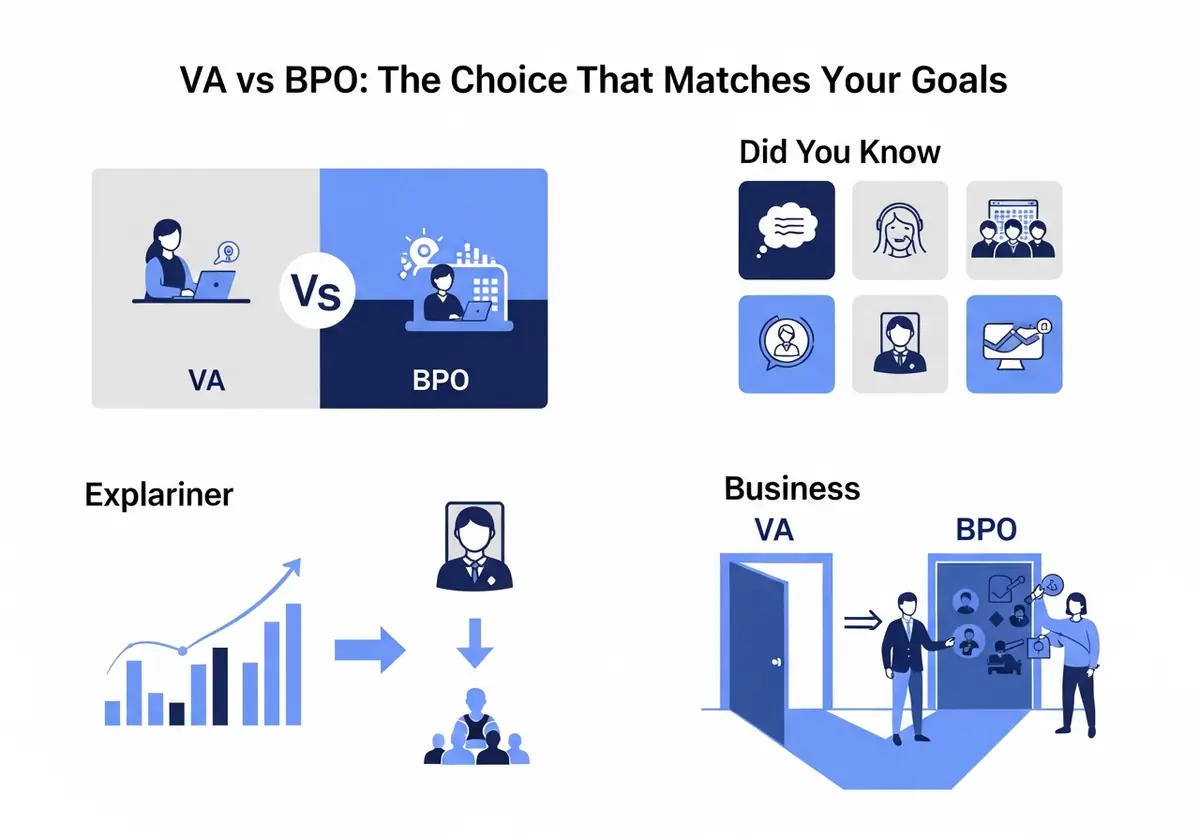
Virtual Assistant vs. BPO is all about choosing the right support for your business goals, if you need flexible, personalized help without the overhead, virtual assistants are the smart choice. Stealth Agents makes it easy by providing highly trained VAs who can streamline your operations and save you time and money. Start today with Stealth Agents and scale smarter.
The global business process outsourcing (BPO) market surpassed $550 billion in 2024 and continues to expand as companies seek ways to scale operations efficiently. Meanwhile, virtual assistant (VA) services are growing rapidly, and businesses using VAs report saving up to 78% in operating costs compared to hiring in-house employees. (timeetc.com) While BPOs excel at handling large-scale, process-driven functions, VAs shine in personalized, flexible support that grows with your business. Stealth Agents helps you identify the right fit, whether you need a dedicated VA or a robust BPO solution, to match your goals and boost productivity. Outsourcing is a critical decision for businesses aiming to streamline operations and cut costs. The difficulty comes in deciding between business process outsourcing (BPO) services vs virtual assistants (VAs), both of which have special advantages to match particular requirements.
Many companies struggle to find reliable, cost-effective solutions for tasks like customer service, administrative support, and beyond. This can lead to inefficiencies, lost opportunities, and squandered money. By comparing these options carefully, businesses can identify the perfect fit for their goals. Stealth Agents, a trusted name offering top-tier outsourcing services, specializes in helping companies hire virtual assistants who deliver exceptional value and performance.
How to Decide Which Outsourcing Solution Fits Your Needs
When weighing your outsourcing options, it helps to step back and get clear on a few essentials:
- Evaluate Your Business Needs: Are you looking for highly specialized, one-on-one support, or do you need a team that can handle a range of standardized, repetitive tasks? Pinpointing the kinds of support your business truly needs will narrow your choices.
- Consider Your Stage of Growth: Startups might benefit from the flexibility and personalized approach of virtual assistants, while larger businesses with established, high-volume workflows may find BPO services more scalable and cost-effective.
- Balance Quality vs. Budget: Decide whether investing in premium, tailored assistance will move your business forward faster, or if your priority right now is reducing costs with basic, reliable support.
Take stock of your goals, resources, and growth trajectory.
When you’re clear on these factors, finding the best fit—whether it’s a VA or BPO—becomes straightforward, saving you headaches and setting your business up for success.
Key Factors When Choosing Your Outsourcing Path
Before making a decision between hiring a virtual assistant or engaging a BPO provider, it’s essential to pause and evaluate what will best support your business’s unique journey.
Consider these guiding points:
- Business Goals and Priorities: Are you looking for nimble, task-specific support or full-scale departmental coverage? Outline exactly what success looks like for your business.
- Growth Stage: A startup scaling rapidly may lean toward flexible, hands-on help (hello, VAs!), while an established organization tackling high-volume, repetitive tasks might benefit more from a BPO’s broader capabilities.
- Budget vs. Quality: Think about what matters most: shaving costs or securing premium expertise? Sometimes, a hybrid approach strikes the right balance.
- Operational Control: Do you want direct oversight and the ability to train team members closely, or are you seeking a more hands-off approach where a third-party manages workflows independently?
- Industry Demands: Some sectors—like financial services or healthcare—might require rigorous compliance and specialized skills, tipping the scales in favor of BPOs with proven track records.
With competitive virtual assistant pricing, tailored services, and a proven track record, Stealth Agents ensures businesses save time and gain professional, dependable support. Understanding your business objectives is key to making the right choice. Explore the advantages of VAs vs. BPOs to secure optimized results with trusted support.
How Virtual Assistant Companies Stand Apart from Other Outsourcing Solutions
Unlike traditional BPO providers, virtual assistant companies deliver flexible, high-touch support that’s seamlessly tailored to your day-to-day operations.
Rather than assigning your projects to large, impersonal teams, VAs give you a dedicated partner who can step into the trenches with you—managing everything from inbox overload and calendar chaos to social media engagement and lead generation.
The scope of services a VA can provide is remarkably broad. Whether your business needs someone to take charge of travel bookings, smooth out client communications, or build winning presentations, VAs step up with practical skills and a personal touch—no corporate red tape required.
Instead of wading through rigid service contracts and layered approval processes, you’ll enjoy direct communication and quick pivots as your business shifts and grows.
This makes VA companies especially valuable for small businesses and startups.
If you’re running lean, hiring a full-time employee may not be feasible—recruiting, training, and providing benefits all add up. Virtual assistants, by contrast, offer a cost-effective alternative: you pay for the expertise you need, only when you need it, with zero overhead on office space or equipment.
Think of it as hiring the right specialist on demand, not just outsourcing tasks to a faceless call center.
And that personalized, efficient support isn’t just for the admin side. Many VAs have niche skills, from crafting sharp LinkedIn outreach for your sales pipeline to keeping your digital marketing on point—all while freeing up your calendar so you can focus on strategic growth.
In short, virtual assistant companies provide agile, personalized business support designed to reduce bottlenecks, eliminate busywork, and help you scale with confidence—without locking you into the one-size-fits-all models common among larger outsourcing firms.
Understanding Nearshore Outsourcing
When evaluating your outsourcing options, it’s worth considering nearshore outsourcing as a practical middle ground between hiring locally and sending tasks offshore.
Unlike traditional outsourcing, where teams may be located halfway around the world, nearshore outsourcing involves partnering with professionals in neighboring or nearby countries.
For example, a U.S.-based business might collaborate with teams in Mexico, Central America, or even nearby Canada, rather than reaching across continents.
Why Consider Nearshore?
Nearshore outsourcing offers several unique advantages that make it appealing for companies seeking efficiency without the potential drawbacks of working with distant teams:
- Time Zone Alignment: With service providers located in similar time zones, coordination is much simpler. Meetings, real-time collaboration, and fast responses become more manageable, reducing project delays and communication headaches.
- Cultural Compatibility: Neighboring countries often share similarities in work culture, business etiquette, and even holiday calendars. This can make team integration smoother and reduce misunderstandings.
- Cost Savings: Rates are typically more affordable than hiring locally, while avoiding some of the challenges and hidden expenses that can come with offshoring to distant regions.
- Language Proficiency: Many nearshore professionals have strong English skills, sometimes tested through formal certification, minimizing language barriers.
- Talent Accessibility: Nearshore regions, particularly in Latin America and Eastern Europe, produce well-educated professionals with certifications and specialized training, especially in areas like digital marketing, software development, and customer support.
Nearshore vs. Local and Offshore Outsourcing
To put it simply, local outsourcing keeps every aspect of your support close to home—ideal for those who prioritize proximity over budget.
Offshore outsourcing, on the other hand, prioritizes substantial cost savings and access to vast talent pools but may require overcoming time zone, communication, and cultural differences.
Nearshore outsourcing strikes a balance: it delivers much of the flexibility and economy of offshore outsourcing, yet remains approachable, accessible, and relatable for your business’s day-to-day needs.
By considering nearshore options, you can expand your team seamlessly, enjoy reliable support, and keep your operations agile and competitive.
What Is Local Outsourcing? Benefits and Challenges
Local outsourcing refers to hiring external professionals or agencies within your own country or region, rather than bringing full-time staff in-house.
Unlike traditional employees, these outsourced team members typically work remotely and aren’t tied to regular office hours or mandatory on-site presence.
Primary Benefits
Choosing local outsourcing offers several clear advantages:
- Aligned Time Zones: Working with professionals in the same or similar time zone means faster responses and fewer snags in scheduling—even for last-minute meetings or urgent tasks.
- Shared Language and Culture: Communication is generally smoother, as local providers are fluent in your preferred language and familiar with cultural business norms. This minimizes the risk of misunderstood instructions or missed details.
- Onsite Flexibility: While most collaboration happens remotely, there’s always the possibility of bringing a local contractor in for face-to-face sessions or in-office work if the situation demands it. This reassurance can be a comfort for teams who prefer occasional in-person interactions.
Key Challenges
However, local outsourcing isn’t free from hurdles:
- Cost Considerations: Local suppliers often command higher rates than offshore alternatives, given regional salary standards and cost of living.
- Talent Pool Limitations: Your options are limited to the expertise available within your country or city, which may not always match your needs, especially for niche roles.
Pricing
Virtual Assistant
Monthly Subscription
Stealth Agents offers a full-time executive virtual assistant for $3,000 per month. This includes 160 working hours, a dedicated account manager, and a 100% money-back guarantee if expectations are not met.
Three-Month Package
Businesses save 2% compared to monthly payments by paying $8,820 every three months. This package includes the same benefits as the monthly plan, focusing on long-term support and cost savings.
BPO Services
Fixed Package
Competitors in the BPO sector often provide fixed packages for back-office tasks. Pricing varies widely, but many offshore providers, including Philippines BPO services, offer competitive rates for high-volume operations.
Budget-Friendly Options
Some BPO companies offer budget-friendly plans to small businesses. These plans typically focus on tasks like data entry or customer support, ensuring affordability without compromising quality.
Cost Considerations: Virtual Assistants vs. Call Centers
When weighing the financial side of hiring a virtual assistant versus running a call center, virtual assistants often emerge as the more affordable choice—especially for targeted projects or short-term needs.
With VAs, businesses avoid the high upfront costs tied to infrastructure, long-term contracts, or staffing entire teams.
There’s no need to budget for office space, telecom systems, or large-scale training programs.
On the other hand, call centers—whether in-house or outsourced—usually require significant commitments.
These include ongoing expenses for facilities, equipment, IT support, and staff onboarding. Even outsourcing to regions like the Philippines, while cost-effective at high volumes, can lock you into pricing models that aren’t always flexible if your needs change.
In short, virtual assistants offer a streamlined, pay-for-what-you-need approach, while call centers typically involve greater investments and fixed costs, making VAs an attractive option for businesses seeking efficiency and budget control.
Contract, Project-Based, and Full-Time Outsourcing: What’s the Difference?
When it comes to outsourcing talent, businesses have several flexible options to match their workload and goals: contract, project-based, and full-time arrangements.
Each serves a unique purpose and fits different business scenarios.
- Project-Based Outsourcing:
- Think of this as hiring a specialist for a single, well-defined task. Need a new logo, a polished website, or a snappy explainer video? Platforms like Fiverr and Upwork are packed with freelancers ready to handle these one-off assignments. You pay for just the completed project—no ongoing commitment required. It’s perfect when you need a quick, skill-specific solution and don’t want to add permanent overhead.
- Contract Outsourcing:
- With contract outsourcing, you bring on talent to address a recurring need or work over a designated contract period. These contracts can range from a few weeks to several months, depending on your project’s demands. Contract workers can tackle ongoing responsibilities, such as managing a seasonal campaign or covering maternity leave. There’s flexibility here—some contracts can even transition into full-time roles if both parties are a good match.
- Full-Time Outsourcing:
- Opt for this route when you want external staff to become a regular part of your team, often integrating into your day-to-day operations. A full-time outsourced worker—such as an executive virtual assistant—handles a steady flow of tasks, learns your workflow, and provides ongoing support. This arrangement is ideal for companies seeking stability, consistency, and long-term growth, without navigating the costs or logistics of direct hires.
Featured Services
Virtual Assistant
1. Administrative Support
Virtual assistants excel at managing schedules, emails, and invoicing, ensuring your workflow runs smoothly. They adapt to meet business needs and offer personalized task handling.
2. Social Media Management
A virtual assistant can plan, post, and engage with audiences on social platforms. Their skills help maintain consistent and engaging content.
3. Content Writing
Many virtual assistants provide blog posts and articles tailored to your industry. This service keeps your website up to date and improves audience engagement.
4. Research Tasks
From market analysis to competitor reviews, VAs help gather valuable data. Their research saves you time and delivers actionable insights.
5. Customer Support
Hiring a virtual assistant for email or chat inquiries ensures quick and helpful customer responses. This service prioritizes customer satisfaction.
Virtual Assistant Expertise
Virtual assistants bring a strong background of training and professionalism to every project.
Most VAs have specialized skills honed through experience in diverse industries—from administrative support to creative content work.
Many undergo rigorous onboarding and continuous learning, especially with agencies like Stealth Agents, ensuring they’re always up to speed on the latest software, tools, and business best practices.
Some virtual assistants hold certifications in project management, digital marketing, or industry-specific platforms such as Salesforce or QuickBooks, further demonstrating their expertise.
This high standard of training means you can trust a cold calling virtual assistant to handle complex assignments, adapt quickly, and maintain confidentiality and reliability across the board.
Their professionalism makes them a valuable extension of your team—confidently managing the tasks you delegate with care and precision.
Business Development & Lead Generation
Virtual assistants are a secret weapon for business development and lead generation when you need to move fast and work smart. Instead of juggling prospecting tasks on your own, a VA can help you:
- Build robust lead lists: Whether you’re targeting decision-makers on LinkedIn or sourcing contacts from platforms like Crunchbase, a VA can gather, verify, and organize data neatly in your CRM.
- Personalize outreach: Crafting and sending personalized emails or LinkedIn messages is time-consuming. Your virtual assistant can draft, schedule, and manage follow-ups to nurture warm leads—no more missed opportunities.
- Support proposal preparation: From creating polished pitch decks in PowerPoint to updating case studies or one-pagers, a VA helps ensure you always put your best foot forward in client communications.
- Research opportunities: Curious about your competitors or emerging market trends? VAs can compile research reports, track industry news, and even set up alerts for new leads or partnership possibilities.
- Stay organized: Your assistant can maintain your lead pipeline, set reminders for follow-ups, and make sure that nothing falls through the cracks during a hectic sales cycle.
BPO Services
1. Center Operations
BPO companies specialize in handling high-volume customer support calls. They offer multilingual teams equipped for different business needs.
A typical call center agent is the first point of contact for your customers—fielding incoming or outgoing calls, resolving complaints, providing product information, and ensuring that every interaction is timely and efficient.
Whether working in a bustling office alongside other agents or remotely from home, these professionals use phones, computers, and specialized software to track conversations and deliver consistent service.
Many follow proven scripts or guidelines to maintain quality and uphold your company’s reputation with every call. The goal? To keep customers satisfied while streamlining your business operations.
Outsourcing to Call Centers: Impact on Your Business Operations
Outsourcing call center functions can reshape how your organization manages customer interactions, offering notable benefits but also posing a few key challenges.
Advantages for Business Efficiency
- Cost Savings: One standout advantage is significant cost reduction. Many companies choose to outsource call centers to countries like India or the Philippines, where operational expenses—including salaries and infrastructure—are far lower than maintaining an in-house team. This allows for streamlined budgets and scalable operations as your business grows.
- Capacity to Handle High Call Volumes: Outsourced call centers are specifically built for flexibility. When your business experiences unpredictable spikes—perhaps after launching a new service—outside teams can quickly ramp up to meet demand. This means you’re less likely to miss customer inquiries or put undue stress on your existing staff.
- Reduced HR Workload: Working with a call center vendor takes the hiring, training, and supervision of customer support personnel off your plate. Instead of daily recruiting and scheduling headaches, you can focus resources on core business areas while seasoned professionals handle your calls.
Potential Drawbacks to Keep in Mind
- Less Familiarity with Your Brand: External agents may not fully grasp the unique culture, values, or nuances of your business. This can sometimes lead to interactions that feel less authentic or personalized than those provided by an internal team.
- Divided Focus: Many call centers juggle multiple clients at once. This could mean your business doesn’t always receive the full, dedicated attention you’d expect, potentially impacting the quality of customer care.
- Limited Direct Oversight: By outsourcing, you relinquish a certain level of control over how your customer service is delivered. Adjusting policies, managing quality, and swiftly responding to issues can become more complex when these functions are handled remotely.
- Language and Cultural Barriers: Since many outsourced call centers are based overseas, occasional miscommunications or misunderstandings may occur—especially if agents aren’t fully fluent in your language or well-versed in your local business culture. This can sometimes affect the customer experience, particularly for nuanced or sensitive matters.
Despite these considerations, many organizations find call center outsourcing a practical strategy for streamlining operations and improving scalability.
Success often depends on careful vendor selection and clear communication to ensure that outsourced teams align closely with your standards and expectations.
Potential Drawbacks of Outsourcing Call Centers
While outsourcing call center operations can deliver substantial efficiencies, it’s essential to be aware of some challenges that often come with this model.
1. Limited Knowledge of Your Business Culture
Outsourced call center staff typically operate outside your organization’s direct reach and may not fully understand your company’s unique culture and values. This can mean customer interactions don’t always align perfectly with your brand’s tone or service standards, potentially leaving customers with a less-than-ideal impression.
2. Divided Focus and Priority
Many third-party call centers handle inquiries for multiple clients at once. This divided attention can sometimes result in less personalized service, as your business may compete for focus with other accounts, especially during peak periods.
3. Reduced Direct Oversight
Handing operations to a virtual assistant agency means giving up some day-to-day control. Businesses may find it harder to monitor call quality, enforce policies, or implement quick adjustments based on customer feedback. This can slow down your ability to address service gaps or drive continuous improvement.
4. Language and Cultural Barriers
Offshore call centers—often located in countries like India or the Philippines—may bring cost savings but can also introduce challenges. Accents, language fluency, or differing cultural references might affect customer satisfaction, especially if callers expect a certain level of familiarity or nuance.
Carefully weighing these potential pitfalls against the benefits helps ensure that outsourcing aligns with your company’s service expectations and long-term goals.
Benefits of Outsourcing to Call Centers
Outsourcing call center functions can unlock several business advantages—particularly for organizations juggling fluctuating demand or aiming to control expenditures.
1. Cost Efficiency
Offshore call centers, commonly found in regions like India or the Philippines, leverage lower labor costs to deliver substantial savings.
Instead of investing in infrastructure, employee benefits, and ongoing training for an in-house team, businesses can redirect those resources. This approach keeps operational expenses streamlined while still maintaining access to skilled professionals.
2. Streamlined Call Management
Periods of high call volume no longer spell chaos for your staff. With an outsourced team, overflow and spikes—like those that happen during a product launch or seasonal promos—are readily absorbed.
Customers experience shorter wait times and fewer dropped calls. More importantly, your core team can keep their focus on high-impact projects instead of stretching thin to answer the phones.
3. Reduced Staffing Headaches
Managing an internal call center isn’t just about answering calls; it involves recruiting, training, shift planning, and tackling everyday HR hurdles. Outsourcing eliminates much of this complexity.
Providers handle workforce logistics and performance monitoring, ensuring your business gets the service coverage it needs without adding administrative burden.
By tapping into call center outsourcing, companies can mitigate costs, boost customer satisfaction, and free up valuable time and energy for their teams to drive business growth.
Call Centers and Contact Centers: Internal vs. External Structures
When deciding how to structure customer communication operations, businesses have options to suit their size, budget, and goals.
Both call centers and contact centers play vital roles, but how they’re managed—internally or through outsourcing—can make a world of difference.
Internal Call Centers and Contact Centers
Some businesses, especially larger corporations with the resources, choose to keep their call centers or contact centers in-house.
This approach allows for direct supervision, robust training aligned with company culture, and immediate problem-solving for both customers and staff.
Companies like American Express and USAA often invest in their own teams to maintain tight control over quality and data security.
Outsourced Call Centers and Contact Centers
For many, outsourcing these services is a practical and cost-effective solution.
Offshore hubs like India and the Philippines are popular choices, thanks to a skilled workforce and competitive pricing. Businesses partner with specialized firms to manage everything from basic customer inquiries to complex sales campaigns across different time zones and languages.
These external providers offer scalable teams and access to a wider pool of expertise, which can be invaluable for fast-growing or multinational companies.
Comparing the Models:
- Internal model: Full oversight, seamless alignment with company values, and direct communication with staff.
- External model: Lower overhead, flexibility to ramp resources up or down, and access to multilingual, 24/7 support.
Contact Centers: Expanding on Communication Channels
While traditional call centers focus solely on voice communication, modern contact centers cover multiple channels—think email, messaging apps, live chat, and even social media.
Whether kept in-house or outsourced, contact centers allow businesses to meet customers wherever they prefer to connect.
In short, both call centers and contact centers can be tailored for internal integration or entrusted to third-party experts.
The right arrangement comes down to the level of control, budget, and breadth of service a business needs to provide exceptional support.
Benefits of Call Center Outsourcing for Internal Teams
One of the standout benefits of outsourcing call center operations is the positive effect it has on your in-house staff.
During peak seasons—think holiday rushes, stormy weather creating a spike in inquiries, or the chaos of new product launches—internal teams can easily become stretched thin.
Instead of scrambling to add temporary hires or overloading your current employees, a dedicated outsourced team can step in, effortlessly scaling to handle the spike in call volume.
This flexibility means your in-house teams aren’t left shouldering the stress of unpredictable demand.
For HR and management, this isn’t just a convenience—it’s a relief. Juggling recruiting, onboarding, and scheduling for a fluctuating call center team can eat up countless hours.
With outsourcing, those logistical headaches shift to your provider, freeing your leadership to focus on higher-level priorities and strategy.
By lightening the internal workload and handling staffing challenges externally, call center outsourcing supports not only smoother operations but also higher morale within your organization.
Your staff can zero in on their core responsibilities, knowing that customer communications are swiftly and professionally managed.
How Outsourcing to Call Centers Impacts Your In-House Team
Shifting customer support operations to an outsourced call center doesn’t just change business outcomes—it also shapes daily experiences for your internal staff. Let’s take a closer look at how these changes can affect your team on the ground.
Easing the Workload During Busy Periods
When customer call volumes spike—think stormy weather, Black Friday sales, or a sudden promotion—your in-house employees can quickly feel overloaded.
Outsourcing offers a built-in relief valve: external call centers, like those found in the Philippines or India, are designed to flex with demand. By shouldering overflow calls, they allow your staff to focus on their core responsibilities without drowning in unexpected surges.
Streamlining HR and Management Efforts
Managing a bustling support center in-house means HR and team leaders are frequently chasing the moving targets of recruitment, scheduling, and staffing crises.
By partnering with an outsourced provider, those staffing headaches largely shift away from your HR department.
Freed from the grind of sourcing temporary agents or juggling shift swaps, your internal leadership can zero in on bigger-picture goals and employee development.
Potential Downsides: Reduced Internal Roles
Of course, there’s a flip side. Offloading support functions to external partners may reduce the need for as many internal customer service roles.
This shift can lead to workforce downsizing, reassignments, or role changes—impacts that directly affect employees’ job security and morale. Businesses need to weigh these changes carefully and communicate openly throughout any transition.
By recognizing both the opportunities and challenges, you ensure your in-house team remains supported, empowered, and engaged—no matter where your customer calls land.
Call Centers vs. Contact Centers: Key Service Differences
When evaluating outsourcing options, it’s important to understand how contact centers offer expanded services compared to traditional call centers. While both act as frontline support for your customers, there are notable differences in the range of interactions they handle.
Call Centers:
At their core, call centers focus primarily on voice support. They manage high-volume inbound and outbound calls—think customer inquiries, appointment reminders, billing questions, telemarketing, or even collections.
For example, many Fortune 500 companies use offshore call centers in locations like India or the Philippines to efficiently field customer service calls and provide round-the-clock access.
Contact Centers:
A contact center takes this foundation and builds on it. In addition to handling calls, contact centers also manage customer communications on digital channels.
This means they can engage with your clients via email, live chat, text messages, apps, or through social media platforms such as Facebook or WhatsApp.
So, if a customer prefers to tweet a support question or use a web chat feature instead of dialing in, a contact center ensures someone is ready to respond accordingly.
In a Nutshell:
- Call centers: Primarily phone-based support (calls in and out).
- Contact centers: Multichannel support—calls plus email, chat, text, and social media.
For businesses needing to keep up with modern customer expectations, contact centers deliver a cohesive support experience across platforms, whereas call centers remain a reliable choice for those who need dedicated, high-volume phone assistance.
Whether you aim for broader engagement or efficient call handling, the choice depends on your business goals and your customers’ preferred ways to connect.
2. Entry Services
BPO providers are strong at handling large amounts of data entry. They focus on maintaining accuracy for backend operations.
3. Payroll Processing
Many BPOs offer payroll management for error-free employee payments. This service ensures compliance with tax laws and timely transactions.
4. IT Support Services
BPO firms provide dedicated IT teams for server monitoring and troubleshooting. Businesses rely on them for round-the-clock technical assistance.
5. HR Outsourcing
From recruitment to onboarding, BPOs manage comprehensive HR processes. Their expertise ensures streamlined hiring and staff management.
Tools and Technologies Used by Virtual Assistants and Call Center Agents
When it comes to getting the job done efficiently, both virtual assistants and call center agents rely on a suite of purpose-built tools.
Virtual assistants typically harness a versatile digital toolkit, including:
- Project management platforms like Asana or Trello to keep tasks organized
- Communication apps such as Slack or Zoom for seamless remote collaboration
- Scheduling software like Google Calendar for managing appointments
- Cloud storage solutions such as Google Drive or Dropbox for document sharing
- Digital marketing tools—including Hootsuite, Buffer, or Canva—for social media and creative work
On the other side, call center agents use specialized systems designed for high-volume support, such as:
- Customer Relationship Management (CRM) software like Salesforce or HubSpot for tracking customer interactions
- Call routing and management platforms like Five9 or Genesys to handle inbound and outbound calls efficiently
- Ticketing tools such as Zendesk for managing and resolving support requests
- Quality monitoring solutions for ensuring compliance and tracking agent performance
By leveraging these technologies, both roles can enhance productivity, maintain organization, and deliver top-tier support for clients.
Main Forms of Outsourcing Solutions
When exploring outsourcing options, businesses have access to a variety of specialized solutions designed to enhance efficiency and support growth.
Two of the most common categories are call centers and contact centers, each serving distinct communication needs.
Call Centers
Call centers focus primarily on managing customer or client calls. They handle everything from answering product inquiries and resolving customer issues to tasks like billing support, telemarketing, and even collections.
These centers can operate domestically or offshore—countries like India are well-known for large-scale call center operations.
Typically staffed by skilled customer service professionals, call centers can be run in-house, but are frequently outsourced for scale, cost efficiency, and round-the-clock coverage.
Contact Centers
Expanding on the traditional call center model, contact centers manage customer interactions across multiple platforms—not just phone calls. This could include email support, web chat, SMS, social media, and app-based messaging.
By integrating these additional digital channels, businesses are able to provide seamless support and more responsive service, meeting customers where they are most active.
Outsourcing contact centers is popular for organizations looking to offer multi-platform engagement without building those resources internally.
These forms of outsourcing are flexible—companies can tailor solutions based on volume, language support, and technical requirements, using partners around the globe.
Ultimately, whether you need direct voice communication or a suite of digital engagement tools, outsourcing offers a scalable way to meet ongoing business demands.
Challenges of Offshore Outsourcing: Distance, Language, and Culture
While offshore outsourcing can certainly be budget-friendly—especially when partnering with well-known hubs like India or the Philippines—it’s important to weigh more than just the sticker price when evaluating effectiveness.
Working closely with teams across continents introduces a unique set of hurdles related to distance, language, and culture.
Communication Gaps and Misunderstandings
One of the most common challenges is communication. Different time zones often mean delayed responses, turning what might be a quick chat into an overnight wait.
Even with detailed instructions, differences in language fluency can lead to misunderstandings or misinterpretations of project requirements. What seems crystal clear in an email or chat might get lost in translation, resulting in a final product that doesn’t match your original expectations.
Cultural Barriers at Play
Cultural nuances can’t be ignored either. Business norms, holidays, and work styles vary from country to country.
For example, approaches to feedback, deadlines, or customer interaction may differ significantly between a team based in New York and a partner in Manila or Mumbai. This sometimes impacts workflow, collaboration, and even the tone used in client communication.
Distance Dilemmas
Physical distance also presents its own headaches. If an urgent problem pops up, jumping on a plane for a face-to-face meeting isn’t practical for most businesses.
Scheduling virtual meetings becomes a puzzle, and the lack of in-person interaction can make it more difficult to build trust or resolve complex issues swiftly.
Ultimately, while offshore outsourcing can deliver cost savings, businesses should factor in these potential barriers.
Proactive communication strategies, clear documentation, and an appreciation of global perspectives go a long way in bridging the gap between continents.
Offshore Outsourcing: Communication and Logistical Challenges
While offshore outsourcing—often involving partnerships with professionals in countries like India or the Philippines—can be attractive for its cost-effectiveness, businesses should be aware of some critical challenges that can impact results.
Communication Hurdles
When your team operates across time zones and continents, clear communication becomes a top priority—yet, ironically, it’s where issues often arise. Factors that can complicate collaboration include:
- Language Differences: Even with English proficiency, nuances get lost in translation, potentially leading to misunderstandings about scope or expectations.
- Cultural Barriers: Work styles, feedback approaches, and business etiquette may differ. For example, a casual request in the US might be interpreted less directly by teams based in Asia.
- Time Zone Gaps: Coordinating meetings or resolving urgent issues can be difficult, especially when work hours barely overlap.
Logistical Obstacles
Distance also introduces practical complications:
- Limited In-Person Interaction: Face-to-face meetings for clarifying goals or troubleshooting just aren’t feasible without significant travel, which adds cost and time.
- Delayed Response Times: An urgent fix that would take minutes locally might take hours or even days to resolve due to opposite working schedules.
- Emergency Support Constraints: When immediate attention is needed, relying on overseas teams can result in frustrating wait times and escalated problems.
When considering offshore outsourcing, weigh these communication and logistical barriers against the potential savings.
Establishing structured processes, setting clear expectations, and leveraging modern collaboration tools (like Slack, Zoom, or Asana) can certainly help, but proactive planning remains essential for keeping projects on track.
Benefits of Nearshore Professional Outsourcing for Businesses
Nearshore professional outsourcing offers businesses a sweet spot between the familiarity of local talent and the cost benefits of offshore options.
By partnering with teams in neighboring or nearby countries, companies enjoy several unique advantages:
- Time Zone Compatibility: Working with nearshore professionals often means sharing similar or overlapping business hours. This minimizes delays, streamlines project collaboration, and keeps communication responsive—gone are the days of late-night (or early-morning) email marathons.
- Highly Qualified Talent: Many nearshore professionals are university graduates who bring both specialized training and up-to-date digital marketing certifications, often from globally recognized U.S. or European programs.
- Lower Costs Without Compromising Quality: Nearshore outsourcing typically results in significant savings compared to hiring domestically, while maintaining high work standards.
- Seamless Communication: With bilingual or multilingual professionals—particularly across the Americas and Europe—businesses eliminate language barriers and foster clear, effective teamwork.
- Flexible Hiring Models: Companies can enjoy the flexibility to engage talent through direct hiring or with additional recruitment support, depending on their needs.
- Cultural Alignment: Nearshore teams usually have a strong understanding of Western business practices and culture, making it easier to align on project goals and brand voice.
This combination of proximity, skill, and adaptability makes nearshore outsourcing a practical choice for businesses seeking efficient, high-quality support that feels integrated into their daily operations.
Ideal Tasks for Project-Based Outsourcing
Project-based outsourcing shines when your business needs specialized expertise on a one-off or short-term assignment.
For example, if you lack in-house graphic design skills but need a polished company logo, platforms like Fiverr make it simple to hire a professional for the task. This approach is especially valuable when deadlines are tight and your team doesn’t have the required experience.
Other tasks well suited to project-based outsourcing include:
- Video Creation and Editing: Need a promotional video to highlight your company’s offerings? Outsourcing lets you quickly access skilled video editors who can deliver professional results.
- Website Design: Launching a website or revamping your current one can benefit from specialists who bring fresh ideas and technical proficiency.
- Content Development: From SEO-focused articles to engaging blog posts, freelance writers can produce tailored content that attracts and educates your audience.
- Marketing Campaigns: Campaigns often demand diverse skills, such as email marketing setup or ad graphic design, which are efficiently handled by external experts.
For any project that requires specific skills your core team doesn’t possess—or where flexibility and speed are priorities—project-based outsourcing offers a practical, cost-effective solution.
What Is Project-Based Outsourcing and How Does It Work?
Project-based outsourcing is a flexible approach where businesses hire skilled professionals to complete specific, standalone tasks or projects, rather than engaging ongoing support.
Sites like Fiverr and Upwork have made this method popular and accessible, connecting companies with experts worldwide at the click of a button.
With this model, you simply define your project’s requirements—whether it’s designing a new logo, writing marketing copy, editing a video, or developing a website—and then find a professional who specializes in that area. Once the project is completed and delivered to your satisfaction, the engagement ends, typically with a one-time payment.
Project-based outsourcing is especially advantageous for tasks that demand specialized skills not available within your current team or for one-off assignments that don’t warrant a long-term hire.
It allows businesses to tap into global talent for urgent needs or creative projects—no onboarding, no lengthy contracts, just targeted expertise for your immediate objectives. This not only fills skill gaps but also keeps budgets in check by paying only for the work you need, when you need it.
Contact Centers vs. Call Centers: What Sets Them Apart?
While call centers focus on managing inbound and outbound telephone calls, contact centers offer a significant edge with their multi-channel approach to customer communication.
This means that, beyond phone calls, contact centers can connect with your clients via email, live chat, social media platforms, SMS, and even specialized apps—meeting customers where they are most comfortable.
Advantages of Contact Centers Over Call Centers:
- Omnichannel Support: Contact centers allow your business to assist customers through various digital channels, not just the phone. This flexibility leads to quicker responses and higher overall satisfaction.
- Consistent Customer Experience: Regardless of whether a customer reaches out by phone, chat, or social media, contact centers can offer a seamless and unified support experience.
- Better Data Tracking: Engaging customers across multiple channels means richer insights into preferences and behaviors, allowing for improved service and targeted strategies.
- Higher Efficiency: Handling multiple channels enables agents to multitask—responding to several inquiries at once—boosting productivity without sacrificing quality.
- Enhanced Accessibility: As customers increasingly expect around-the-clock service, contact centers provide the always-on support businesses need in a digital-first world.
Tools and Technologies Used by Virtual Assistants and Call Center Agents
When it comes to getting the job done efficiently, both virtual assistants and call center agents rely on a suite of purpose-built tools.
Virtual assistants typically harness a versatile digital toolkit, including:
- Project management platforms like Asana or Trello to keep tasks organized
- Communication apps such as Slack or Zoom for seamless remote collaboration
- Scheduling software like Google Calendar for managing appointments
- Cloud storage solutions such as Google Drive or Dropbox for document sharing
- Digital marketing tools—including Hootsuite, Buffer, or Canva—for social media and creative work
On the other side, call center agents use specialized systems designed for high-volume support, such as:
- Customer Relationship Management (CRM) software like Salesforce or HubSpot for tracking customer interactions
- Call routing and management platforms like Five9 or Genesys to handle inbound and outbound calls efficiently
- Ticketing tools such as Zendesk for managing and resolving support requests
- Quality monitoring solutions for ensuring compliance and tracking agent performance
By leveraging these technologies, both roles can enhance productivity, maintain organization, and deliver top-tier support for clients.
Main Forms of Outsourcing Solutions
When exploring outsourcing options, businesses have access to a variety of specialized solutions designed to enhance efficiency and support growth.
Two of the most common categories are call centers and contact centers, each serving distinct communication needs.
Call Centers
Call centers focus primarily on managing customer or client calls. They handle everything from answering product inquiries and resolving customer issues to tasks like billing support, telemarketing, and even collections.
These centers can operate domestically or offshore—countries like India are well-known for large-scale call center operations.
Typically staffed by skilled customer service professionals, call centers can be run in-house, but are frequently outsourced for scale, cost efficiency, and round-the-clock coverage.
Contact Centers
Expanding on the traditional call center model, contact centers manage customer interactions across multiple platforms—not just phone calls.
This could include email support, web chat, SMS, social media, and app-based messaging.
By integrating these additional digital channels, businesses are able to provide seamless support and more responsive service, meeting customers where they are most active.
Outsourcing contact centers is popular for organizations looking to offer multi-platform engagement without building those resources internally.
These forms of outsourcing are flexible—companies can tailor solutions based on volume, language support, and technical requirements, using partners around the globe.
Ultimately, whether you need direct voice communication or a suite of digital engagement tools, outsourcing offers a scalable way to meet ongoing business demands.
Challenges of Offshore Outsourcing: Distance, Language, and Culture
While offshore outsourcing can certainly be budget-friendly—especially when partnering with well-known hubs like India or the Philippines—it’s important to weigh more than just the sticker price when evaluating effectiveness.
Working closely with teams across continents introduces a unique set of hurdles related to distance, language, and culture.
Communication Gaps and Misunderstandings
One of the most common challenges is communication. Different time zones often mean delayed responses, turning what might be a quick chat into an overnight wait.
Even with detailed instructions, differences in language fluency can lead to misunderstandings or misinterpretations of project requirements.
What seems crystal clear in an email or chat might get lost in translation, resulting in a final product that doesn’t match your original expectations.
Cultural Barriers at Play
Cultural nuances can’t be ignored either. Business norms, holidays, and work styles vary from country to country.
For example, approaches to feedback, deadlines, or customer interaction may differ significantly between a team based in New York and a partner in Manila or Mumbai.
This sometimes impacts workflow, collaboration, and even the tone used in client communication.
Distance Dilemmas
Physical distance also presents its own headaches. If an urgent problem pops up, jumping on a plane for a face-to-face meeting isn’t practical for most businesses.
Scheduling virtual meetings becomes a puzzle, and the lack of in-person interaction can make it more difficult to build trust or resolve complex issues swiftly.
Ultimately, while offshore outsourcing can deliver cost savings, businesses should factor in these potential barriers.
Proactive communication strategies, clear documentation, and an appreciation of global perspectives go a long way in bridging the gap between continents.
Offshore Outsourcing: Communication and Logistical Challenges
While offshore outsourcing—often involving partnerships with professionals in countries like India or the Philippines—can be attractive for its cost-effectiveness, businesses should be aware of some critical challenges that can impact results.
Communication Hurdles
When your team operates across time zones and continents, clear communication becomes a top priority—yet, ironically, it’s where issues often arise.
Factors that can complicate collaboration include:
- Language Differences: Even with English proficiency, nuances get lost in translation, potentially leading to misunderstandings about scope or expectations.
- Cultural Barriers: Work styles, feedback approaches, and business etiquette may differ. For example, a casual request in the US might be interpreted less directly by teams based in Asia.
- Time Zone Gaps: Coordinating meetings or resolving urgent issues can be difficult, especially when work hours barely overlap.
Logistical Obstacles
Distance also introduces practical complications:
- Limited In-Person Interaction: Face-to-face meetings for clarifying goals or troubleshooting just aren’t feasible without significant travel, which adds cost and time.
- Delayed Response Times: An urgent fix that would take minutes locally might take hours or even days to resolve due to opposite working schedules.
- Emergency Support Constraints: When immediate attention is needed, relying on overseas teams can result in frustrating wait times and escalated problems.
When considering offshore outsourcing, weigh these communication and logistical barriers against the potential savings.
Establishing structured processes, setting clear expectations, and leveraging modern collaboration tools (like Slack, Zoom, or Asana) can certainly help, but proactive planning remains essential for keeping projects on track.
Benefits of Nearshore Professional Outsourcing for Businesses
Nearshore professional outsourcing offers businesses a sweet spot between the familiarity of local talent and the cost benefits of offshore options.
By partnering with teams in neighboring or nearby countries, companies enjoy several unique advantages:
- Time Zone Compatibility: Working with nearshore professionals often means sharing similar or overlapping business hours. This minimizes delays, streamlines project collaboration, and keeps communication responsive—gone are the days of late-night (or early-morning) email marathons.
- Highly Qualified Talent: Many nearshore professionals are university graduates who bring both specialized training and up-to-date digital marketing certifications, often from globally recognized U.S. or European programs.
- Lower Costs Without Compromising Quality: Nearshore outsourcing typically results in significant savings compared to hiring domestically, while maintaining high work standards.
- Seamless Communication: With bilingual or multilingual professionals—particularly across the Americas and Europe—businesses eliminate language barriers and foster clear, effective teamwork.
- Flexible Hiring Models: Companies can enjoy the flexibility to engage talent through direct hiring or with additional recruitment support, depending on their needs.
- Cultural Alignment: Nearshore teams usually have a strong understanding of Western business practices and culture, making it easier to align on project goals and brand voice.
This combination of proximity, skill, and adaptability makes nearshore outsourcing a practical choice for businesses seeking efficient, high-quality support that feels integrated into their daily operations.
Ideal Tasks for Project-Based Outsourcing
Project-based outsourcing shines when your business needs specialized expertise on a one-off or short-term assignment.
For example, if you lack in-house graphic design skills but need a polished company logo, platforms like Fiverr make it simple to hire a professional for the task.
This approach is especially valuable when deadlines are tight and your team doesn’t have the required experience.
Other tasks well suited to project-based outsourcing include:
- Video Creation and Editing: Need a promotional video to highlight your company’s offerings? Outsourcing lets you quickly access skilled video editors who can deliver professional results.
- Website Design: Launching a website or revamping your current one can benefit from specialists who bring fresh ideas and technical proficiency.
- Content Development: From SEO-focused articles to engaging blog posts, freelance writers can produce tailored content that attracts and educates your audience.
- Marketing Campaigns: Campaigns often demand diverse skills, such as email marketing setup or ad graphic design, which are efficiently handled by external experts.
For any project that requires specific skills your core team doesn’t possess—or where flexibility and speed are priorities—project-based outsourcing offers a practical, cost-effective solution.
What Is Project-Based Outsourcing and How Does It Work?
Project-based outsourcing is a flexible approach where businesses hire skilled professionals to complete specific, standalone tasks or projects, rather than engaging ongoing support.
Sites like Fiverr and Upwork have made this method popular and accessible, connecting companies with experts worldwide at the click of a button.
With this model, you simply define your project’s requirements—whether it’s designing a new logo, writing marketing copy, editing a video, or developing a website—and then find a professional who specializes in that area.
Once the project is completed and delivered to your satisfaction, the engagement ends, typically with a one-time payment.
Project-based outsourcing is especially advantageous for tasks that demand specialized skills not available within your current team or for one-off assignments that don’t warrant a long-term hire.
It allows businesses to tap into global talent for urgent needs or creative projects—no onboarding, no lengthy contracts, just targeted expertise for your immediate objectives. This not only fills skill gaps but also keeps budgets in check by paying only for the work you need, when you need it.
Contact Centers vs. Call Centers: What Sets Them Apart?
While call centers focus on managing inbound and outbound telephone calls, contact centers offer a significant edge with their multi-channel approach to customer communication.
This means that, beyond phone calls, contact centers can connect with your clients via email, live chat, social media platforms, SMS, and even specialized apps—meeting customers where they are most comfortable.
Advantages of Contact Centers Over Call Centers:
- Omnichannel Support: Contact centers allow your business to assist customers through various digital channels, not just the phone. This flexibility leads to quicker responses and higher overall satisfaction.
- Consistent Customer Experience: Regardless of whether a customer reaches out by phone, chat, or social media, contact centers can offer a seamless and unified support experience.
- Better Data Tracking: Engaging customers across multiple channels means richer insights into preferences and behaviors, allowing for improved service and targeted strategies.
- Higher Efficiency: Handling multiple channels enables agents to multitask—responding to several inquiries at once—boosting productivity without sacrificing quality.
- Enhanced Accessibility: As customers increasingly expect around-the-clock service, contact centers provide the always-on support businesses need in a digital-first world.
How Do Virtual Assistants Simplify Business Operations?
Virtual assistants streamline business operations by taking over time-consuming chores and freeing companies to concentrate on development and strategy. Hiring female virtual assistants provides versatile support tailored to specific business needs, from administrative duties to social media management. Studies reveal that hiring a virtual assistant can save companies up to 78% in running expenses compared to hiring full-time personnel.
The flexibility of virtual assistants makes them ideal for startups or businesses needing on-demand skills. Compared to virtual assistants, they often offer personalized assistance and direct client communication. The VA vs. BPO comparison highlights that virtual assistants excel in tasks requiring adaptability and a close working relationship.
Additionally, virtual assistants are reported to improve productivity by 13%, as they handle repetitive tasks efficiently. Their support streamlines daily operations, giving businesses the tools to achieve their goals effectively.
Regional Advantages: Why Location Matters for U.S. Companies
When it comes to hiring virtual assistants, choosing candidates from regions with cultural and linguistic similarities to the U.S. can deliver real operational benefits.
For instance, Latin American virtual assistants often share similar work habits, communication styles, and time zones with their U.S.-based clients.
This can lead to smoother collaboration, fewer misunderstandings, and quicker turnaround on tasks—key factors that help keep businesses agile and productive.
The proximity in both time and culture means that communication flows more naturally, responses are timely, and expectations stay aligned.
Team members can jump on a call during regular business hours without a twelve-hour time difference at play—goodbye midnight emails and delayed replies! Ultimately, prioritizing regionally matched virtual assistants helps ensure your business experiences fewer hiccups and more seamless results.
Why Employees Appreciate Virtual Assistants
Outsourcing tasks to virtual assistants isn’t just a win for upper management—it’s a breath of fresh air for employees, too.
Here’s how virtual assistants positively impact your in-house team:
- Reduced Workload and Stress
- When VAs handle repetitive or time-consuming administrative work, your team can finally catch their breath. No more racing to clear a cluttered inbox after a full day of meetings, or scrambling to finalize reports by Friday. By removing these routine tasks, employees have more space to focus on their primary responsibilities—or even sneak in a well-earned coffee break.
- More Time for High-Value Projects
- As businesses grow, the mountain of “small” tasks tends to grow faster than the team itself. Virtual assistants take over these expanding duties—think data entry, calendar management, and travel arrangements—freeing up your employees to dig into projects that really move the needle, like strategy development or client relations.
- Greater Job Satisfaction
- When employees spend less time on tedious chores, job satisfaction often climbs. People generally prefer applying their skills to challenging or creative work over shuffling paperwork. With the help of VAs, your staff can invest their energy where it counts—and it’s not unusual to see increased morale as a result.
- A Collaborative, Focused Environment
- By delegating peripheral tasks to virtual assistants, your team can collaborate on more impactful work. This shift creates an environment where employees feel valued and empowered to make meaningful contributions, rather than feeling bogged down by routine obligations.
How Does Outsourcing to Virtual Assistants Impact In-House Employees?
When virtual assistants join your business, the shift doesn’t just benefit your management team—the effects ripple through your internal workforce as well. Let’s break down what this change means for your full-time staff.
Reduced Workload and Stress
By delegating repetitive, time-consuming tasks to virtual assistants, your core employees are relieved from juggling multiple hats.
Instead of slogging through scheduling, data entry, or routine follow-ups, team members can devote their energy to projects that require their expertise or creative problem-solving. This redistribution often leads to lower stress and increased job satisfaction across the office.
More Focus on Core Responsibilities
As virtual assistants take care of background operations, your staff are empowered to double down on their strengths.
Account managers can nurture client relationships without distraction, marketers can focus on strategy over logistics, and HR professionals can dedicate time to building culture rather than paper-pushing. Over time, this focus can improve morale and spark innovation.
Potential Collaboration Challenges
Yet, it’s important to recognize that adding a remote member—or several—to your team may present communication hurdles.
Differences in language, culture, or time zones can require some adjustment and patience. However, adopting tools like Slack, Zoom, and Trello can keep everyone in sync and minimize misunderstandings.
Companies such as Buffer and Zapier have successfully scaled distributed teams by fostering transparent communication and regular check-ins.
Supervision and Integration
Another consideration is oversight. Virtual assistants are usually experienced and capable of working independently, but the lack of in-person supervision means that clear expectations, training, and accessible guidelines become crucial.
Establishing regular feedback loops helps ensure alignment and accountability, keeping everyone rowing in the same direction.
Ultimately, a balanced approach—pairing effective onboarding with open communication—helps your virtual assistants become a seamless extension of your internal team, supporting productivity without sacrificing cohesion.
What Are the Potential Downsides of Outsourcing to Virtual Assistants?
While hiring virtual assistants offers clear advantages, it’s important to be aware of some potential pitfalls before you take the leap.
Here are considerations to keep in mind as you evaluate the right fit for your business:
Limited Face-to-Face Interaction
Relying on remote communication tools like Slack, Zoom, or email can create a gap in real-time, in-person collaboration.
Some teams may find that nuances get lost in virtual conversations, leading to occasional miscommunication or misunderstandings.
Additionally, collaborating virtually can sometimes slow down problem-solving, particularly when technical difficulties pop up or when immediate feedback is needed.
Cultural and Language Differences
Working with virtual assistants from different regions—be it abroad or across your own country—can introduce subtle but meaningful cultural or linguistic differences. Even among domestic teams, local expressions and work habits can vary.
These differences may require a period of adjustment and clear documentation to ensure everyone’s on the same page and nothing gets lost in translation.
By anticipating these challenges, you can put guidelines in place and build a strong onboarding process that maximizes the benefits of virtual assistants while minimizing downside risks.
Potential Drawbacks: Limited Face-to-Face Interaction
While virtual assistants offer flexibility and specialized skills, one area that requires thoughtful consideration is limited in-person communication.
For some businesses, the lack of face-to-face interaction can pose challenges, especially if they’re used to impromptu office chats or quick, hands-on collaboration.
Relying solely on digital channels—like Slack, Zoom, or email—sometimes introduces opportunities for misunderstandings or delays in relaying information.
This can potentially impact task accuracy or slow down project turnaround when instructions or feedback aren’t crystal clear the first time around.
What’s more, technical hiccups, such as unstable internet connections or unfamiliarity with business-specific systems, may take longer to resolve without a physical IT department close at hand.
Adopting clear communication protocols and leveraging reliable collaboration tools like Microsoft Teams or Google Workspace can help bridge these gaps, keeping virtual teamwork running smoothly.
What Main Advantages Does Hiring Virtual Assistants Bring?
Virtual assistants provide unmatched value if you’re exploring options to enhance your business’s efficiency while keeping costs low. Here’s a checklist covering the top benefits of hiring virtual assistants and how they can elevate your operations.
✔ Cost-Effective Support
Since virtual assistants cut out office space and perks, they are a less expensive substitute for full-time workers. For example, a 2022 survey showed that outsourcing to virtual assistants can cut operational costs by up to 78%. This affordability allows businesses to redirect their savings into other growth initiatives without sacrificing quality.
✔ Increased Productivity
By delegating routine tasks, virtual assistants help businesses regain valuable time. Research estimates virtual assistants save business owners up to 20 hours a week. This extra time allows leadership to focus on strategic decisions and business growth.
✔ Access to Skilled Talent
Hiring virtual assistants gives you access to experienced professionals around the globe. Geographical limits disappear, making it easier to find precisely the skills and expertise you need. Virtual assistants fill the gap effectively, whether it’s administrative work or specialized support.
✔ Scalability for Business Growth
Virtual assistants offer flexibility for businesses that experience fluctuating workloads. This adaptability is crucial as companies expand or face seasonal demands. Roles can be quickly adjusted without the long-term commitments required by traditional employees.
✔ Time-Saving Convenience
Virtual assistants efficiently handle repetitive tasks, from managing calendars to replying to emails. This delegation saves significant time, keeping you organized and on track for achieving bigger goals. Ultimately, virtual assistants provide a seamless way to meet deadlines without overwhelming workloads.
✔ Improved Customer Service
Virtual assistants who manage live chats, emails, and calls benefit from reliable customer interaction. A notable statistic indicates a 33% rise in client satisfaction rates in businesses with dedicated assistance. Virtual assistants ensure your brand stays responsive and engaged.
✔ Flexible Work Arrangement
Virtual assistants operate remotely, making them a practical solution for businesses with wide-ranging needs or global clients. Their flexible schedules mean businesses can effortlessly maintain operations across different time zones, which is particularly advantageous for teams that require varying levels of availability.
✔ Gender-Specific Preferences
When specific hiring preferences arise, such as appointing a female virtual assistant for particular roles, this option aligns effortlessly with client requirements. Virtual assistants offer tailored service options, whether for cultural fit or customer needs. Comparing “va vs. bpo,” this level of personalization adds an edge in creating customer-centric strategies.
✔ Cultural Compatibility Drives Outsourcing Success
Cultural alignment plays a key role in the effectiveness of outsourcing relationships. When your virtual assistant shares a similar cultural background to your organization—say, between Latin America and the U.S.—communication naturally becomes smoother.
This similarity reduces the risk of misunderstandings and helps maintain momentum, especially compared to outsourcing partnerships that span vastly different time zones or cultural norms, like those between American and South Asian teams.
Companies like Google and IBM have long acknowledged that successful outsourcing isn’t just about skills but also about how well teams connect and collaborate.
A shared cultural foundation means expectations are understood more intuitively, feedback loops are shorter, and your business enjoys more seamless integration with its remote support.
This harmony pays off in less time spent clarifying details and more time driving business results.
✔ Navigating Language and Cultural Differences
A potential obstacle when integrating virtual assistants into your team stems from language or cultural differences.
Even with nearshore hiring, subtle discrepancies in communication styles or cultural norms can crop up. These misalignments might lead to misunderstandings—whether it’s an unexpected interpretation of instructions or differences in workplace etiquette.
It’s not just about accents or fluency. Communication hiccups can happen at the level of tone, business customs, or even how feedback is given and received.
This can make teamwork feel less fluid and slow down collaborative projects. Keeping an eye out for these nuances, and fostering open dialogue, is the key to minimizing friction and preserving your team’s productivity.
✔ Cultural and Linguistic Considerations
While virtual assistants offer broad advantages, it’s wise to be mindful of potential cultural and linguistic challenges that could crop up—especially when hiring from different countries or regions.
Even with a nearshore VA, subtle differences in language, communication style, or workplace etiquette can sometimes lead to misunderstandings.
- Language Nuances: Even fluent speakers may interpret instructions differently due to unique idioms, phrasing, or local jargon. This can occasionally result in tasks being completed in a way you didn’t expect, or may require a bit more clarification than with someone from your local area.
- Cultural Norms: Work expectations, approaches to feedback, and even humor can vary across cultures. For example, in some regions, direct feedback is welcomed, while in others, a more indirect approach is customary. These variations can influence collaboration, team dynamics, and efficiency.
- Timezone Differences: While remote work bridges distance, large timezone gaps may delay responses or feedback cycles, which can be challenging for teams needing real-time collaboration.
To minimize these hurdles, clear and consistent communication is your superpower.
Providing detailed instructions, encouraging open dialogue, and being aware of cultural context will smooth over any bumps in the road.
Many businesses also find success by using collaboration tools like Slack or Trello to keep everyone on the same page, regardless of location.
Being proactive about these considerations ensures your virtual assistant becomes an integrated, reliable part of your workflow.
✔ Risks of Limited Supervision
While virtual assistants are known for autonomy and professionalism, reduced oversight can sometimes introduce certain challenges. When working remotely and independently, there’s a possibility of miscommunication or tasks being completed in ways that deviate from your expectations.
Without daily, in-person interaction, it may take longer to spot and correct errors or address evolving priorities.
However, it’s worth noting that most virtual assistants are seasoned experts accustomed to self-management and delivering reliable results.
Setting up clear reporting structures, regular check-ins, and using project management tools like Asana or Trello can significantly minimize these risks.
By establishing solid expectations and open lines of communication, businesses can maintain high productivity and quality, even in the absence of close supervision.
Potential Concerns for Employees Working with Virtual Assistants
While hiring virtual assistants brings a suite of advantages, it’s important to consider a few common challenges from the perspective of your in-house team.
Language and Cultural Differences
One issue that occasionally surfaces is the potential for language or cultural barriers. When team members and virtual assistants hail from different backgrounds, communication hiccups may arise.
Differences in business etiquette, work hours, or even holiday schedules can create misunderstandings or disrupt workflows. Setting clear expectations and investing in cross-cultural onboarding can help minimize the initial adjustment period.
Reduced Supervision and Accountability
Another concern is related to oversight. With virtual assistants working remotely—sometimes across continents—direct supervision is limited. This shift can make some employees uneasy, especially if they’re used to in-person collaboration or immediate feedback.
However, most virtual assistants undergo thorough vetting and bring a high level of professionalism. Establishing robust project management systems and maintaining regular check-ins can help foster trust and keep everyone aligned.
Why Is BPO Suited For Corporate Needs?
Business Process Outsourcing (BPO) suits corporate needs by offering specialized expertise in managing large-scale operations like customer service, IT support, and back-office processes. Companies benefit from offshore BPO services in the USA, which provide global talent pools and cost-effective functionality.
Unlike smaller setups, BPO firms deliver structured solutions for efficiently managing repetitive and complex tasks. Compared to VA, BPO excels in handling corporate-scale demands that require teams with established workflows and advanced technology.
These outsourcing providers ensure seamless integration with core business processes, ensuring reliability and consistency. With scalable resources, BPO companies help corporations meet growing demands without compromising quality. This makes them a go-to choice for enterprises seeking to enhance operational efficiency and focus more on strategic growth.
What Industries Outsource To BPO Companies Most?
Regarding outsourcing, some sectors mostly rely on BPO firms to simplify their processes and concentrate on main operations. The following are the top eight sectors that gain the most from outsourcing:
1. Healthcare
Healthcare providers often outsource administrative tasks like medical billing, insurance claims processing, and appointment scheduling. By outsourcing these responsibilities, healthcare organizations can prioritize patient care while keeping compliance requirements in check. Growing demand for back-office BPO services, which let healthcare facilities of all kinds increase operational efficiency, is one clear trend.
2. Banking and Financial Services
Banks and financial institutions outsource customer service, loan processing, and data management to handle high volumes efficiently. BPO services provide access to skilled teams that ensure accuracy and confidentiality across financial operations. Philippines BPO services are a preferred choice, and many providers offer cost-effective solutions tailored specifically for this competitive sector.
3. Retail and E-Commerce
Retailers and e-commerce platforms outsource customer support, inventory management, and logistics operations. This adaptability helps them to remain competitive in controlling changing order quantities during busy seasons. These businesses have the advantage in keeping client satisfaction by means of BPO solutions in terms of operating expenses.
4. Information Technology (IT)
IT companies rely on BPO teams for software development, technical support, and network monitoring. Outsourcing helps these businesses scale efficiently without compromising on service delivery. Many IT firms choose BPO services for time-sensitive projects requiring domain expertise.
5. Telecommunications
Telecom companies outsource customer service, billing inquiries, and technical troubleshooting to improve response times. This industry significantly benefits from specialized support from BPO providers who are familiar with technical issues. Many operations see improved customer satisfaction rates with virtual assistants available to manage large contact volumes.
6. Travel and Hospitality
Travel agencies and hospitality groups outsource reservation systems, customer inquiries, and loyalty programs. These services ensure seamless experiences for travelers while minimizing operational headaches for companies. Virtual assistants, equipped with expertise in these industries, also play an essential role in quick issue resolution for customers.
7. Education and E-Learning
Educational institutions and e-learning platforms outsource administrative tasks, curriculum development support, and query management. Outsourcing allows platforms to focus on creating engaging student experiences without being bogged down by backend work. A reported 70% of back-office tasks in this segment are handled by outsourcing services.
8. Real Estate
Real estate companies outsource lead nurturing, property management services, and contract processing. BPO providers improve operation flow by ensuring critical back-office functions are handled effectively. Comparing VA vs. BPO shows that virtual assistants often excel in administrative roles like client communication, adding personalized value to real estate businesses.
By focusing on these industries, outsourcing providers can refine their offerings to support diverse business needs. Whether you’re looking for virtual assistants or comprehensive back-office BPO services, outsourcing can deliver efficiency and expertise tailored to your goals.
VA vs. BPO: Which Handles Administrative Tasks Better?
VA vs. BPO often comes down to versatility and task-specific expertise, especially when managing administrative tasks. Virtual assistants excel due to their flexibility and ability to handle diverse administrative roles such as scheduling, email management, and data entry, often becoming a seamless part of a team regardless of location. Studies reveal that virtual assistants can save businesses up to 78% in operational costs by eliminating expenses like office space and employee benefits.
Meanwhile, BPO services are traditionally better suited for large-scale, repetitive administrative processes handled by dedicated teams offshore, including data processing or call center management. BPO virtual assistants add value in highly standardized workflows but may lack the one-on-one, adaptable support needed for varied tasks.
Virtual assistants are often preferred for startups and small businesses due to their personalized approach and cost-effective hourly or project-based hiring models. Another study highlights that businesses using virtual assistants see a 13% increase in overall productivity, showing their tangible impact. Evaluating your business size and administrative needs will determine whether a VA or BPO approach serves your goals better.
VA Vs BPO: Flexibility In Employment Options
When comparing VA vs BPO, flexibility in employment options is crucial. Businesses seeking tailored support often find virtual assistants a more versatile choice, offering the ability to focus on specific tasks like scheduling, email management, and data entry. Virtual assistants are clearly cost-effective since studies reveal that companies using them save up to 78% in running expenses per year.
On the other hand, BPO companies typically provide structured offshore teams that are ideal for handling large-scale processes like customer service and back-office tasks. Philippines BPO services remain popular due to their skilled workforce and reduced labor costs, making them valuable for high-volume operations.
Another statistic reveals that virtual assistants reduce turnaround times for administrative tasks by nearly 50%, providing nimble support for small and medium-sized businesses. Both options present unique advantages, but virtual assistants excel when businesses value personalized and on-demand support. Balancing these employment options depends on your company’s goals and operational priorities.
VA Vs BPO: Expertise In IT And Backend Solutions
Virtual assistants and BPO services each bring unique strengths to IT and backend solutions. Virtual assistants are known for their adaptability, supporting tasks like data management, system updates, and IT scheduling with a personalized touch. Research shows businesses can save up to 78% on operational costs by utilizing virtual assistants. They excel in quick onboarding and delivering tailored support for specific IT needs.
Meanwhile, BPO services, particularly offshore and back-office BPO services, are designed to handle large-scale, technical operations like IT infrastructure management and data processing. They often employ specialized teams for server upkeep and troubleshooting, ensuring efficient workflows.
Comparing VA vs BPO, virtual assistants are ideal for projects requiring flexibility and day-to-day oversight, while BPOs suit businesses focusing on high-volume tasks. With both options, understanding the scale and complexity of your IT needs is essential. Selecting the right partner ensures your business runs smoothly and efficiently.
Which Works Better For Startups Or Small Businesses?
Virtual assistants provide a more flexible and cost-effective option for startups and small businesses than BPO services. Data shows that 78% of business owners save significant time by outsourcing to virtual assistants. These professionals can handle diverse administrative tasks and adapt as your priorities change, offering a personalized approach.
On the other hand, back-office BPO services specialize in managing large-scale, routine operations like data entry or customer handling, typically with an offshore team. When considering VA vs BPO, startups may lean towards virtual assistants for their direct oversight and easier onboarding.
Another key advantage is affordability, with virtual assistants reducing overhead by up to 50% compared to in-house staff. For smaller-scale operations, this approach helps streamline tasks without long-term contracts. Identifying whether your need is for varied, flexible roles or structured, high-volume tasks can guide your choice.
What Is The Onboarding Process For Stealth Agents?
Getting started with Stealth Agents is simple and designed to meet your unique business needs. From the initial call to ongoing supervision, their onboarding process ensures a smooth partnership while keeping your goals in focus.
- ✅ Collaborative Call: We collect all the details for a tailored virtual assistant match after the initial call.
- 🔎 Skill Fit Guarantee: We dedicate seven business hours to train and find the VA with the necessary skills.
- 👨💼 Dedicated Campaign Manager:You’ll have a campaign manager to oversee and fine-tune your VA experience.
- 📊 Monthly Reviews: Regular VA reviews every month help ensure satisfaction, and changes can be requested anytime.
Statistics show that 88% of businesses that outsource to a reliable partner like Stealth Agents report improved work quality compared to handling work in-house. Whether debating between VA vs. BPO, these streamlined steps focus on delivering support that aligns with your goals.
Takeaways
Choosing between VA and BPO ultimately depends on your business needs and long-term goals. Virtual assistants often provide personalized, cost-effective solutions, making them ideal for businesses that value flexibility and specialized skills.
On the other hand, BPO services cater to large-scale operations that require extensive resources and standardized processes. Whichever option you choose, success lies in aligning the service with your specific objectives and operational strategy. Remember, the ultimate decision should enhance productivity and promote organizational efficiency.
Take advantage of Stealth Agents’ top-notch virtual assistant services. Pricing starts at just $18.75 per hour or $3,000 per month for 160 hours, with no part-time options and experienced VAs with over 10 years in the industry.