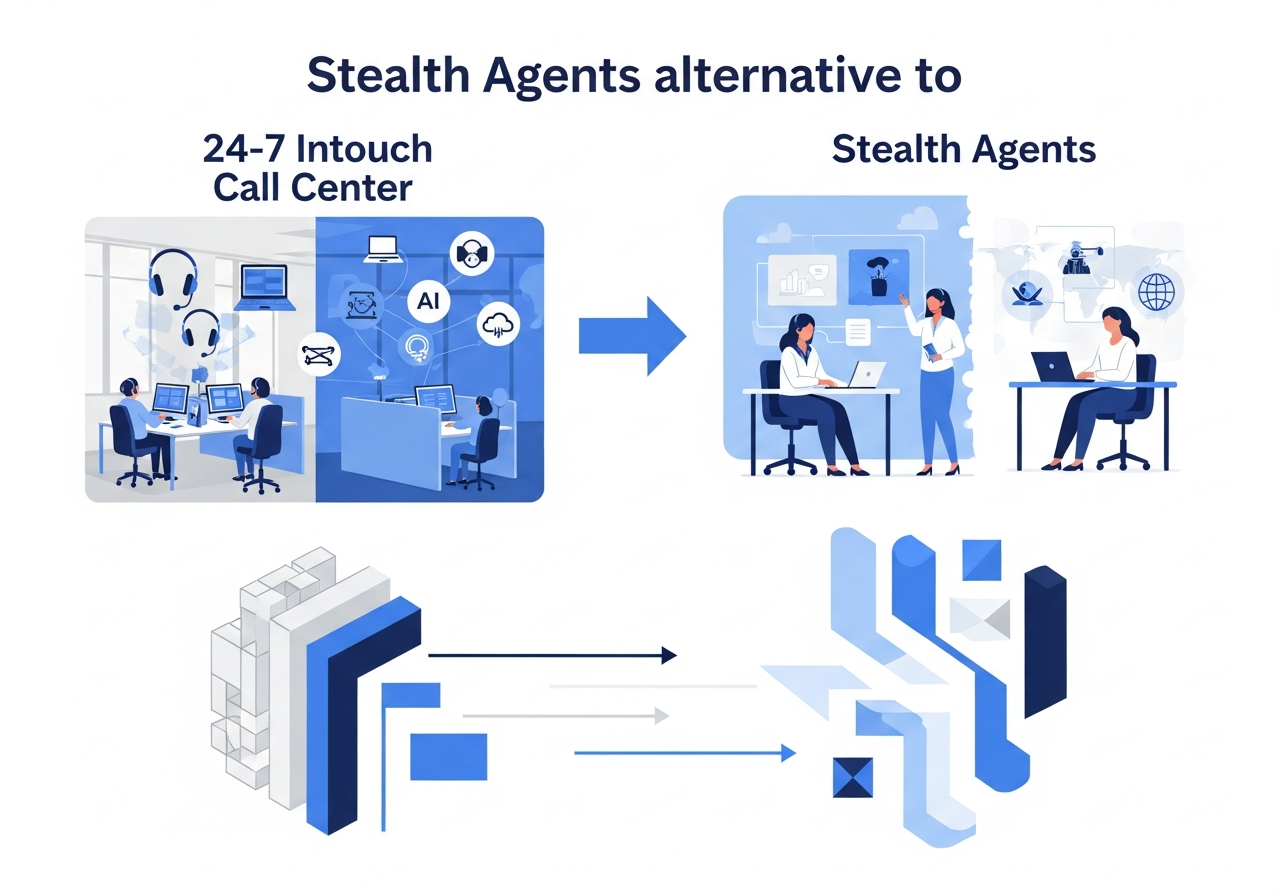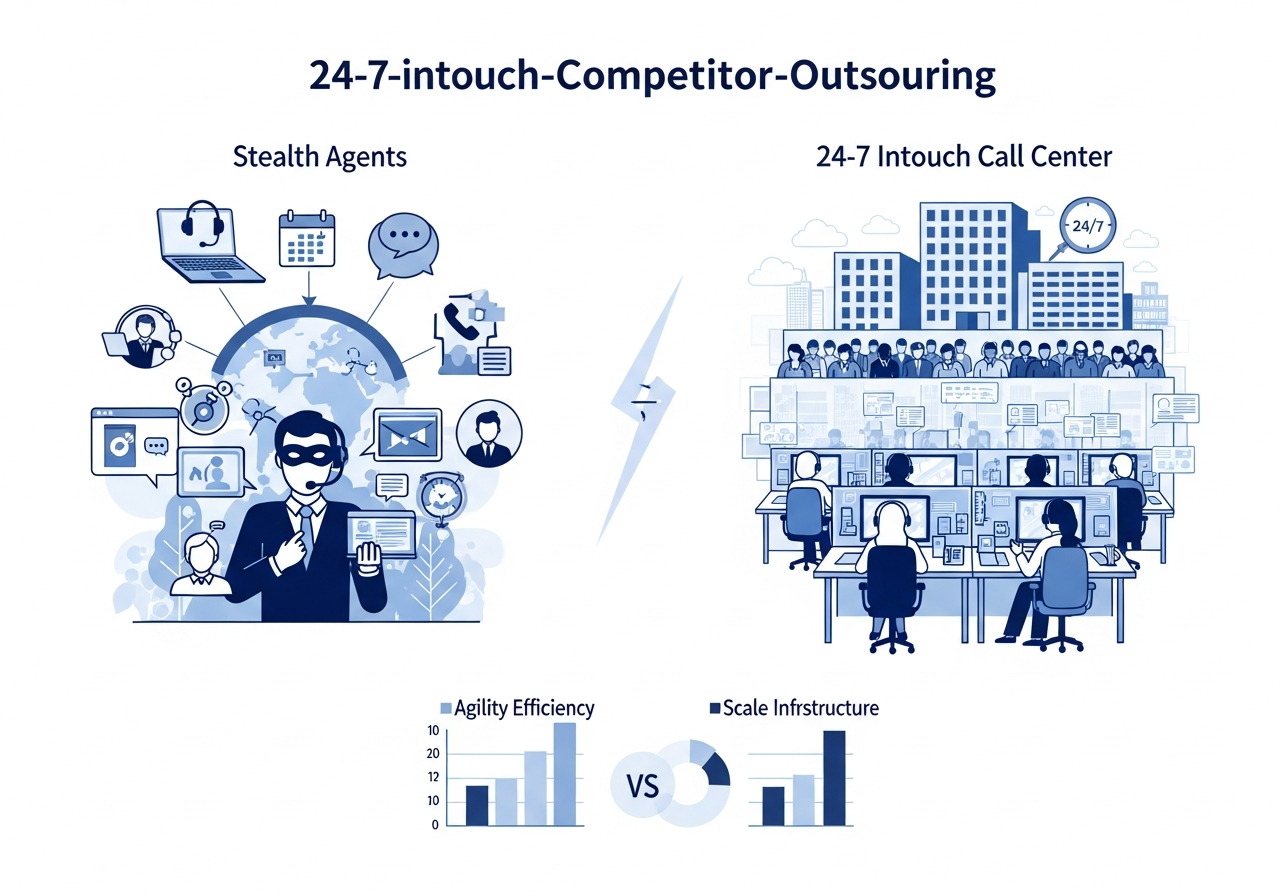
Stealth Agents vs 24-7 Intouch is all about finding the smarter outsourcing choice—Stealth Agents delivers top-tier virtual support with clear pricing, elite talent, and fast results tailored to your business goals. If you’re aiming to scale efficiently while saving up to 70% on staffing costs, Stealth Agents is the winning solution to boost productivity and customer satisfaction.
The global outsourcing market is projected to reach $405.6 billion by 2027, highlighting the critical role of companies like Stealth Agents vs 24-7 Intouch in business operations.
Both firms have carved impressive niches in providing virtual assistance and customer support. Stealth Agents stands out with its unmatched ability to meet diverse client needs and deliver seamless services.
Offering free consultations on client preferences and virtual assistant pricing, Stealth Agents ensures a tailored approach for every business.
Meanwhile, 24-7 Intouch offers reliable customer service solutions and maintains a strong presence in the industry. With 78% of companies planning to outsource more tasks in the near future, choosing the right partner is crucial.
Carefully weigh the offerings of Stealth Agents vs 24-7 Intouch to find the best fit for your business needs.
Key Differences: Call Centers vs Contact Centers
When it comes to outsourcing customer support, understanding the differences between call centers and contact centers can help you pick the right solution for your business.
Call Centers:
Think of call centers as your classic customer support team—they primarily handle voice calls. Whether it’s answering customer questions or resolving issues, their focus is on phone-based communication. For straightforward needs or companies with customers who mostly want to pick up the phone, this remains a tried-and-true approach.
Contact Centers:
Contact centers take things up a notch. Instead of limiting support to phone calls, they provide what’s called “omnichannel” service. This means customers can reach out via email, live chat, social media, and even mobile apps, in addition to traditional calls. So whether your audience prefers Twitter DMs, WhatsApp, or good old-fashioned emails, a contact center meets them wherever they are.
Which Should You Choose?
The best fit depends on your customer expectations and the way you want to connect. If your clients like a human voice on the line, a call center can hit the mark. But if your business wants to offer seamless support across various digital platforms—especially as your customer base becomes more tech-savvy—a contact center provides the flexibility and reach to match.
Ultimately, knowing whether a single channel or a full-spectrum experience suits your goals will make all the difference as you evaluate service providers.
Are Call Centers Becoming Obsolete?
While it may seem like traditional call centers are fading into the background, they remain a vital part of today’s customer service landscape. The difference is in how businesses are evolving—modern organizations are moving toward omni-channel support, with contact centers leading the way. Instead of relying solely on telephone calls, today’s contact centers empower customers to get help through channels like live chat, email, social media, and even SMS—all through a unified platform.
Why the shift? Customers now expect flexibility and faster responses. Contact centers are built for this demand, offering real-time collaboration tools, CRM integration, and the ability to seamlessly resolve complex issues across different platforms. For companies wanting to deliver top-tier support—think airlines, global retailers, or SaaS providers—this agility is essential.
However, that doesn’t mean the classic call center is extinct. There’s still a place where phone support shines:
- Niche businesses or local service providers who cater to audiences preferring a personal touch
- Industries relying on straightforward transactions, like outbound telemarketing or appointment setting
- Smaller companies needing a cost-effective, focused solution
The bottom line: contact centers may be the future, but call centers aren’t relics just yet. Both have unique strengths, and the smartest businesses know when—and how—to harness each model for maximum impact.
PRICING
Stealth Agents
- Hourly Rates: Stealth Agents offers virtual assistant services starting at 15 per hour. This competitive pricing provides access to the top 1% of industry talent, ensuring high-quality assistance for your business needs.
- Quality Assurance: With Stealth Agents, you benefit from experienced professionals with 5-10+ years in the field. Their dedicated management enhances productivity at a cost-effective rate. They also ensure smooth operations, allowing you to focus on growth.
24-7 Intouch
- Comprehensive Solutions: 24-7 Intouch provides extensive customer care services but does not list specific pricing on its website. They focus on delivering tailored customer experience strategies, bringing value through advanced technology and personalized support.
- Custom-Fit Ecosystems: Their approach emphasizes creating a bespoke customer service environment designed to meet the unique needs of different industries. While specific costs aren’t disclosed online, their solutions are crafted to optimize and elevate client satisfaction.
Web Addresses
Stealth Agents: https://stealthagents.com/
24-7 Intouch: https://www.intouchcx.com/
FEATURED SERVICES
Stealth Agents
- Virtual Assistant Services: Stealth Agents offer highly skilled virtual assistants who handle tasks ranging from scheduling to bookkeeping, allowing businesses to focus on growth. Their assistants work behind the scenes to streamline operations and reduce day-to-day stress.
- Lead Generation: By leveraging their expertise, Stealth Agents assist businesses in nurturing leads and increasing conversion rates. Their dedicated team focuses on driving growth and expanding client reach efficiently.
- Customer Support: Stealth Agents provide comprehensive customer support services, ensuring that client inquiries are managed professionally. This service enhances customer satisfaction and helps maintain strong client relationships.
- Blogging and SEO Tasks: Stealth Agents boost businesses’ online presence with expertly crafted content creation and optimization. They employ tailored blogging and SEO strategies to enhance search engine rankings and attract more visitors. Utilizing a blogging virtual assistant, these services are essential for establishing a strong digital footprint and remaining competitive in today’s market.
- Operational Management: Stealth Agents assist in managing operational tasks, enabling businesses to function smoothly without the owner’s constant oversight. This service allows clients to delegate effectively and focus on high-priority initiatives.
24-7 Intouch
- Omnichannel Customer Care: 24-7 Intouch offers seamless support across various communication channels, ensuring a consistent and personalized customer experience. Their approach adapts to customer needs, enhancing satisfaction and loyalty.
- AI & Automation: By integrating AI and automation, 24-7 Intouch transforms client interactions and streamlines processes. This technology aligns with human efforts to enhance service efficiency and quality.
- Brand Trust & Safety: 24-7 Intouch prioritizes brand safety and customer trust, incorporating security measures into its service offerings. It ensures that both brand image and customer data are protected at all times.
- Strategic Solutions: Their strategic solutions are designed to tailor customer service ecosystems to individual business needs, utilizing advanced systems and quality assurance. This customization enhances support capabilities and client satisfaction.
- Industry-Specific CX Solutions: 24-7 Intouch provides customer experience solutions tailored to specific industries, leveraging technology and expertise. These solutions effectively meet unique industry challenges, positioning clients at the forefront of their sectors.
How Contact Centers Go Beyond Traditional Call Centers
While traditional call centers primarily connect with customers over the phone, contact centers take service to the next level by engaging across a variety of channels. Think of contact centers as the multitaskers of customer support—handling not just calls, but also emails, live chats, social media messages, and even mobile app inquiries. This flexibility allows businesses to meet customers wherever they are, whether that’s on Twitter, Facebook Messenger, or old-fashioned email.
Omnichannel Approach for Modern Expectations
Contact centers are designed for today’s connected world. They offer an omnichannel experience, meaning agents seamlessly support customers switching between channels. For example, a customer might initiate a support request on Facebook, continue via email, and finish the conversation with a quick call—all without repeating their issue.
Enhanced Tools and Streamlined Workflows
Unlike conventional call centers, modern contact centers are powered by a suite of advanced tools:
- Unified Platforms: Agents can view and manage all inquiries from a single dashboard, whether they’re coming by phone, chat, or social media.
- Collaboration Tools: Real-time internal chat, video calls, and document sharing help agents quickly solve complex issues.
- CRM Integration: Contact centers connect customer data and history from multiple touchpoints, ensuring personalized support every time.
Handling Complexity and Escalation
Contact centers aren’t just about convenience—they also excel at resolving sophisticated or multi-step problems. With integrated knowledge bases and support for escalation across channels, agents can loop in the right specialists or transfer a conversation to a different medium without missing a beat.
In short, contact centers outpace traditional call centers by offering a cohesive, holistic support experience that’s tailored to current customer expectations—a necessity for companies aiming to deliver both efficiency and satisfaction.
Types of Call Centers Explained
When it comes to delivering exceptional customer experience, businesses can choose between several different call center models, each providing distinct advantages depending on organizational needs and strategic goals:
- In-House Call Centers: This model involves businesses directly managing their own customer support operations. Companies recruit, train, and oversee agents within their premises, maintaining full control over service quality, brand training, and technology infrastructure. Think of it as building your customer service dream team in your own office.
- Outsourced Call Centers: Instead of handling everything in-house, many organizations partner with third-party specialists, such as Stealth Agents or 24-7 Intouch. This approach eliminates the hassle of recruiting and ongoing training, while offering access to experienced teams and up-to-date technology. Outsourcing also streamlines operations and can help manage costs more efficiently.
- Offshore Call Centers: For global coverage and budget-conscious operations, some businesses outsource support to providers in countries with lower labor costs. By doing so, companies can offer 24/7 support. However, this route may sometimes present challenges, such as differences in language fluency or less familiarity with the brand’s unique culture and offerings.
- Virtual Call Centers: Leveraging cloud-based technology, these centers disperse agents across different locations—sometimes in various cities or even countries. Team members work remotely (from home or satellite offices), enabling scalability and business continuity, especially important for modern, flexible companies or those operating internationally.
Each model is designed to address specific operational priorities—whether it’s retaining close control, reducing overhead, extending hours, or supporting remote work—so businesses can select the structure that aligns best with their goals and client expectations.
How Is the Success of a Call Center Measured?
Evaluating the effectiveness of a call center hinges on a blend of quantitative and qualitative metrics, each shedding light on different aspects of performance. Both inbound and outbound call centers rely on a carefully curated set of benchmarks to ensure their teams are operating at peak efficiency and keeping clients happy.
Key Performance Indicators (KPIs) Commonly Assessed:
- First Call Resolution (FCR): Measures the ability to resolve customer issues during the initial interaction, minimizing follow-ups and bolstering customer satisfaction.
- Average Wait Time: Gauges how long customers spend in the queue before speaking to an agent, a critical measure of responsiveness.
- Abandonment Rate: Tracks the percentage of calls that disconnect before reaching an agent—lower rates are ideal.
- Average Handle Time (AHT): Looks at the total duration of a customer call, from greeting to resolution, helping identify process efficiencies or bottlenecks.
- Customer Satisfaction (CSAT): Surveys and feedback tools are used post-interaction to directly capture the client’s impression—often the gold standard for assessing service quality.
For outbound centers, metrics such as the number of calls made, conversion rates, and revenue generated provide insight into productivity and effectiveness.
On the tech side, advanced tools like speech analytics software are increasingly employed to analyze agent-customer conversations. This technology picks up on trends, pain points, and areas where further training might be beneficial, ultimately sharpening agent skills and improving KPIs like FCR and AHT.
By consistently monitoring and refining these performance indicators, businesses ensure their call centers not only resolve issues efficiently but also deliver a superior customer experience that supports long-term loyalty.
Key Performance Indicators for Call Centers
To ensure smooth operations and exceptional service, call centers rely on a variety of key performance indicators (KPIs) to evaluate both efficiency and customer satisfaction. These metrics are tailored to the specific focus of the call center—whether inbound or outbound—but some benchmarks are universally important.
- First Call Resolution (FCR): Often viewed as a gold standard, this KPI tracks how many customer issues are fully resolved in the very first interaction. High FCR rates mean fewer repeated calls and greater customer contentment.
- Average Wait Time: This measures how long customers spend waiting in queue before reaching an agent. Shorter wait times convey efficiency and respect for the client’s time.
- Average Handle Time: This metric reflects the total time an agent spends engaging with a caller, from greeting to resolution. It helps organizations strike a balance between quality conversations and operational efficiency.
- Abandonment Rate: This figure reveals the percentage of callers who hang up before ever speaking to an agent—often a sign that wait times may need attention.
- Customer Satisfaction Score (CSAT): Usually gathered right after the interaction, this survey-based metric captures how satisfied customers are with the help they received.
In addition, modern call centers are adopting advanced technologies—think speech analytics tools—to monitor conversations for tone, compliance, and agent knowledge gaps. These insights guide targeted training programs, ensuring teams continue to elevate their performance while enhancing key benchmarks like FCR and CSAT.
Main Types of Call Centers
When exploring customer support models, it’s helpful to understand the primary types of call centers available. Each type serves unique business needs and client expectations:
- Inbound Call Centers: These centers focus on managing incoming calls from customers. Whether it’s handling inquiries about product details, processing service requests, managing technical support, or resolving complaints, inbound agents are the friendly first point of contact. Often, advanced systems like Interactive Voice Response (IVR) and automated call distributors streamline these interactions to quickly connect callers with the right support.
- Outbound Call Centers: Here, agents take a more proactive approach by reaching out to customers. Typical outbound activities might include lead generation, telemarketing campaigns, conducting surveys, appointment scheduling, or even following up for feedback and collections. Automated dialers and careful adherence to regulations—such as respecting the National Do Not Call Registry—help ensure these calls are targeted, efficient, and compliant.
- Blended Call Centers: For organizations requiring the best of both worlds, blended centers manage both incoming and outgoing calls. This flexible approach allows agents to switch seamlessly between assisting customers as they reach out and initiating contact for business development or follow-up, making it a versatile solution for dynamic business needs.
Understanding these call center types is the first step toward choosing a solution that aligns with your business’s customer engagement strategy.
Key Differences: Inbound, Outbound, and Blended Call Centers
Understanding the distinctions between inbound, outbound, and blended call centers can help businesses determine the best fit for their unique needs.
- Inbound Call Centers:
In inbound call centers, agents primarily handle incoming calls from customers. These calls can range from account questions and technical support to scheduling requests and product inquiries. Typically, inbound centers are designed to respond rapidly and efficiently, often utilizing interactive voice response (IVR) systems and automated call distribution. The focus is on delivering a responsive, helpful experience, whether a client is seeking support, information, or assistance with a transaction. Think of the experience you have when phoning your bank’s customer service—prompt, professional, and focused on your query. - Outbound Call Centers:
Outbound call centers, by contrast, are all about reaching out. Here, agents initiate calls to customers or prospects. The purposes might include lead generation, sales calls, follow-up surveys, fundraising, appointment reminders, or even debt collections. These centers often deploy automated dialers to maximize efficiency, and agents may need to navigate compliance requirements, such as honoring Do Not Call registries in the United States and beyond. Picture a telecommunications provider following up on your recent inquiry, or a charity organization reaching out to its donor base—these are classic outbound scenarios. - Blended Call Centers:
Blended call centers combine the functionalities of inbound and outbound operations. Agents here are adept at switching between receiving incoming customer requests and proactively reaching out. This hybrid approach allows for flexible staffing and maximizes productivity, making these centers especially valuable for businesses with fluctuating call volumes or complex support needs.
By identifying which of these call center models aligns best with your operational goals, you can ensure that your customer engagement strategy is both efficient and effective.
How Do Call Centers Operate?
Call centers serve as the communication backbone for a wide range of organizations, from e-commerce sites and banks to nonprofits and global retailers. Their core function is managing both incoming and outgoing calls to support customers, drive sales, or gather valuable feedback.
Here’s a typical workflow:
- Customer Initiates Contact: When customers reach out for support or information, they’re often greeted by an interactive voice response (IVR) system. This system offers clear menu options—think “Press 1 for billing, Press 2 for technical support”—helping to quickly direct queries to the right department.
- Smart Call Routing: After selection, the IVR routes each caller to the most suitable, available agent. This not only saves time but also ensures customers are matched with someone equipped to resolve their specific need.
- Agent-Customer Interaction: Once connected, skilled agents—armed with customer history and relevant resources—work to resolve questions, troubleshoot issues, or process orders. Many call centers record calls, using these insights to refine training, improve interactions, and enhance service quality.
- Outbound Engagement: In addition to handling inbound requests, call centers also initiate outbound calls for activities like follow-up surveys, appointment reminders, or lead generation—helping businesses maintain proactive customer relationships.
Modern call centers blend people, technology, and strategy to create responsive, efficient, and personalized customer experiences.
Core Roles Within Call Center Teams
A well-run call center relies on a diverse team, each member playing a critical part in delivering exceptional customer experiences. Here’s a look at the essential roles and their responsibilities:
- Call Center Agents: These front-line team members are the primary point of contact for customers. Skilled in both communication and problem-solving, they handle anything from simple inquiries to complex issues—whether for inbound support or outbound outreach. Their expertise ensures callers feel heard and supported.
- Team Leaders: Call center agents are typically grouped into smaller pods, each led by a team leader. Team leaders coach agents, offer guidance during challenging customer interactions, and help to resolve escalated issues. Their mentoring keeps teams motivated and service consistent.
- Directors and Operations Managers: Overseeing the broader call center operation, directors or operations managers focus on setting performance goals, maintaining workflow efficiency, and ensuring high service standards. They also play a key role in strategic planning and response to changing customer needs.
- Quality Assurance (QA) Teams: QA professionals work behind the scenes to maintain service excellence. Through monitoring calls and evaluating interactions, they ensure that every customer conversation lives up to company standards for quality and compliance.
- IT Support: Especially in today’s technology-driven landscape—and with remote or hybrid teams becoming the norm—IT staff are indispensable. They maintain the call center’s hardware, software, and communication platforms, troubleshooting any technical hiccups to keep operations running seamlessly.
Each role is vital to keeping the call center humming, supporting both customers and business objectives alike.
What Is a Call Center?
A call center serves as a centralized hub where dedicated customer service teams manage and respond to a high volume of incoming and outgoing calls. These centers can operate internally within a business or be outsourced to specialized providers like Teleperformance or Concentrix, known globally for their robust call center operations.
The main goal of a call center is to provide prompt, knowledgeable, and personalized support—whether assisting existing customers, addressing questions, or engaging potential new clients. Agents are trained to deliver exceptional service, ensuring that each interaction leaves a positive impression and contributes to overall customer satisfaction.
Beyond answering inquiries, call centers play a critical role in the broader customer experience (CX) journey. By effectively resolving issues, generating leads, and building brand loyalty, call centers help businesses stay competitive and foster long-term relationships with their audience.
How Do Stealth Agents Personalize Customer Support?
Stealth Agents personalize customer support by focusing on understanding individual client needs and preferences to deliver tailored solutions.
They achieve this through advanced data analysis, which allows them to anticipate customer requirements and provide proactive assistance. Stealth Agents boast an impressive 98% customer satisfaction rate, demonstrating their commitment to excellence.
Additionally, their support team is equipped to handle over 1,000 inquiries daily, ensuring prompt and efficient service.
Unlike many competitors, they maintain a direct line of communication, fostering a strong relationship with clients.
When considering Stealth Agents vs 24-7 Intouch, the former’s dedication to personalized service sets them apart, emphasizing their ability to adapt to various customer demands effectively. This client-centric approach not only enhances the customer experience but also builds long-term loyalty and satisfaction.
What Are The Benefits Of Having Stealth Agents Services In Your Business?
1. Increased Efficiency and Productivity
Stealth Agents services significantly boost your business efficiency by handling various tasks that can free up valuable time for core activities.
Their team is proficient in managing repetitive tasks, allowing your staff to focus on strategic initiatives that drive growth.
Businesses utilizing virtual assistants report a 40% increase in productivity due to time saved on administrative duties. With Stealth Agents, you can delegate tasks such as scheduling, data entry, and customer service, ensuring a smooth operation.
This results in not only higher productivity but also an improved work-life balance for employees. Their expertise in managing workflows ensures your business processes are executed with precision and speed.
As a result, businesses experience fewer errors and faster task completion, enhancing overall operational efficiency.
2. Cost-Effective Solutions
Choosing Stealth Agents can result in substantial cost reductions for your business. By utilizing their services, you bypass the expenses of hiring full-time employees, such as salaries, benefits, and office space.
Instead, you invest only in the services you require, precisely when needed. This cost-effective outsourcing model empowers businesses to adjust their support levels according to demand without financial pressure.
Research indicates that companies can save up to 70% on labor costs by engaging virtual assistants like Stealth Agents.
These savings can be reinvested in vital areas like marketing or product development. Stealth Agents offer competitive pricing structures, ensuring you receive top-notch support without exceeding your budget.
Their cost-effective solutions are crucial in providing your business the agility to stay competitive in a rapidly changing market.
3. Expertise and Specialized Skills
Stealth Agents bring a wealth of expertise and specialized skills to your business, enhancing overall performance. Their team comprises professionals skilled in various domains, offering your business a diverse range of capabilities.
Whether you need assistance with digital marketing, customer support, or administrative tasks, Stealth Agents provide tailored services to meet your specific needs.
Businesses leveraging such expertise often experience a 30% improvement in task execution and customer satisfaction. Their professionals are continually trained to stay abreast of industry trends and best practices, ensuring your business benefits from the latest knowledge and techniques.
This specialized support enables your organization to tackle complex challenges with confidence, reinforcing your reputation as a reliable service provider.
With Stealth Agents, you gain access to a team that is dedicated to elevating your business to new heights.
4. Enhanced Customer Support
Stealth Agents are renowned for delivering outstanding customer support, which is vital to nurturing strong client relationships.
Their team is adeptly trained to manage customer inquiries and concerns with professionalism and empathy, ensuring that each interaction has a lasting positive impact.
Businesses leveraging Stealth Agents for customer support experience a remarkable 50% boost in customer satisfaction due to their prompt and efficient service. By outsourcing your customer service needs to Stealth Agents, your clients will receive consistent, high-quality support at any hour.
The significance of such comprehensive service cannot be overstated, as it not only meets but frequently surpasses customer expectations, cultivating loyalty and encouraging repeat business.
The comparison between Stealth Agents vs 24-7 Intouch illustrates how Stealth Agents prioritize personalized customer care as a fundamental aspect of their offering. Embracing Filipino online customer support, their dedication to exceptional support distinguishes your business in a fiercely competitive market.
5. Scalability and Flexibility
Stealth Agents offer unmatched scalability and flexibility, allowing your business to adapt swiftly to changing demands.
Whether you’re experiencing peak seasons or a sudden increase in workload, their services can be scaled to match your requirements seamlessly. This adaptability is crucial for businesses looking to maintain efficiency without compromising on service quality.
With Stealth Agents, you have the freedom to adjust service levels based on your current needs, ensuring optimal resource allocation.
Businesses that embrace such flexibility often achieve a 25% reduction in operational bottlenecks and delays. Furthermore, Stealth Agents’ ability to quickly onboard new team members ensures that your business is always prepared to meet market demands.
This level of responsiveness enables you to capture new opportunities and drive sustained growth, positioning your business as a leader in its industry.
What Makes 24-7 Intouch A Preferred Partner?
24-7 Intouch is a preferred partner due to its unwavering commitment to providing exceptional customer service and tailored solutions that meet the diverse needs of its clients.
Known for its flexible approach, 24-7 Intouch consistently adapts to the unique demands of various industries, ensuring that businesses receive the personalized attention they deserve. Unlike the Stealth Agents vs 24-7 Intouch debate, where choices can be challenging, 24-7 Intouch stands out with its ability to deliver reliable and consistent results.
Their team of professionals is dedicated to delivering excellence, making them a trusted ally for businesses seeking to enhance their customer experience.
With advanced technology and skilled personnel, 24-7 Intouch seamlessly integrates with clients’ goals, aligning its services to drive success.
Their commitment to quality ensures that every interaction is a step towards achieving greater customer satisfaction. In partnering with a virtual assistant 24/7, businesses are assured of a dependable and expert-driven service that elevates their brand’s reputation.
What Are The Industries 24-7 Intouch Serve?
-
Retail and E-commerce
Retail and e-commerce have seen exponential growth, creating a demand for reliable customer service platforms.
24-7 Intouch excels in offering tailored customer support solutions for retailers looking to enhance customer experience.
Their expertise includes managing multi-channel support services and ensuring seamless interactions across chat, email, and social media. This comprehensive approach helps businesses maintain customer loyalty while managing seasonal spikes efficiently.
The team at 24-7 Intouch is adept at understanding the nuances of consumer behavior, providing insights that drive strategic customer engagement.
Their service-oriented approach ensures that retailers can focus on core business functions while leaving customer interactions to the experts. The debate of “Stealth Agents vs 24-7 Intouch” often highlights the latter’s specialized focus on the retail sector as a key differentiator.
-
Technology and Software
The technology and software industry demands precision and a deep understanding of complex products.
24-7 Intouch is well-equipped to handle technical inquiries, offering support that is both knowledgeable and empathetic.
Their agents undergo rigorous training to ensure they are well-versed in the latest technological advancements and software updates. This prepares them to assist clients with troubleshooting, product navigation, and customer queries effectively.
Their commitment to service excellence has positioned them as a trusted partner in the tech industry.
Companies working with 24-7 Intouch benefit from reduced downtime and an enhanced customer satisfaction rate. This sector-specific expertise ensures that customer issues are resolved promptly, fostering trust and long-term client relationships.
-
Healthcare and Pharmaceuticals
Healthcare and pharmaceutical industries demand precision and empathy. 24-7 Intouch delivers patient-centered communication solutions that emphasize confidentiality and sensitivity.
Their services encompass managing patient inquiries, scheduling appointments, and offering information on medical services. With expertise in healthcare regulations, they guarantee compliance and reliability.
Their pharmaceutical virtual assistant further exemplifies their adaptability, enabling seamless navigation of healthcare communication complexities.
This adaptability is vital, as their professional handling of patient interactions empowers healthcare providers to deliver outstanding service.
The importance of such services lies in enhancing patient satisfaction and ensuring seamless operations, underscoring the intertwined nature of timeliness and care in this sector.
-
Travel and Hospitality
Travel and hospitality sectors thrive on exceptional customer service, and 24-7 Intouch is a leader in this area.
Their expertise in managing reservation inquiries, travel itineraries, and guest services significantly enhances the customer journey. With agents trained to resolve issues promptly, guests experience swift and satisfactory solutions, strengthening the businesses’ brand reputation.
By offering personalized assistance 24-7, Intouch ensures travelers feel valued and supported, distinguishing themselves in a competitive market.
Their proactive approach to anticipating guest needs emphasizes the importance of their services. Their expertise is invaluable for businesses aiming to boost customer satisfaction and loyalty.
Whether assisting with bookings or managing customer feedback, their solutions are designed to exceed expectations. For those seeking to elevate their customer service, consider the option to hire a travel specialist assistant to integrate expert support into your operations seamlessly.
-
Financial Services
The financial sector demands accuracy and security, and 24-7 Intouch is adept at meeting these requirements.
Their customer support solutions are designed to handle inquiries with precision and confidentiality. They manage tasks such as account services, fraud prevention, and customer education with exceptional care.
The team’s expertise in financial regulations ensures compliance and builds trust with clients.
By offering round-the-clock support, 24/7, Intouch helps financial institutions provide uninterrupted service to their customers.
Their commitment to safeguarding sensitive information enhances customer confidence. This dedication to service excellence makes them a key player in the financial services industry.
Who To Choose For A Strategic Partnership: Stealth Agents vs 24-7 Intouch
When considering a strategic partnership, the choice between Stealth Agents and 24-7 Intouch can be pivotal.
Stealth Agents, known for their exceptional customer service, boasts a 95% client satisfaction rate, which speaks volumes about their commitment to quality. Additionally, they have a proven track record of reducing operational costs by up to 30% for their partners, making them a cost-effective choice.
On the other hand, 24-7 Intouch offers a wide range of services that cater to various industries, providing flexibility and adaptability.
However, the decision should be based on specific business needs and goals. Stealth Agents vs 24-7 Intouch is a comparison that requires careful consideration of each company’s strengths and how they align with your strategic objectives.
Ultimately, the right partner will support your business growth and enhance your competitive edge.
Takeaways
The comparison of Stealth Agents vs 24-7 Intouch reveals distinct advantages that each company offers. Stealth Agents takes the lead with its personalized and efficient virtual assistant services, crafted to fulfill a wide range of business needs.
While 24-7 Intouch excels in customer service solutions, Stealth Agents shines by delivering specialized support tailored to ever-changing professional landscapes.
This differentiation is crucial for businesses that demand flexibility and innovation. Stealth Agents not only focuses on client satisfaction but also ensures seamless integration of services to boost productivity and growth.
Unlike its competitor, Stealth Agents emphasizes nurturing long-term client relationships through dependable and consistent performance.
Ultimately, the choice between Stealth Agents and 24-7 Intouch is guided by specific business goals, but Stealth Agents distinguishes itself with exceptional adaptability and a commitment to excellence.
For businesses eager to enhance their operations, selecting Stealth Agents for virtual assistant services is a strategic move, with pricing starting from just $15.
Choosing the right support for your business is important. Stealth Agents can help you save money and boost your results. Get started today to see how we can help.
Frequently Asked Questions
How does Stealth Agents differ from traditional call centers in terms of technology use?
Stealth Agents uses cloud-based technology to provide virtual assistant services, while traditional call centers mostly rely on phone systems. This allows Stealth Agents to work with modern tools like CRM systems and project management platforms, making their services more flexible and effective.
What are the advantages of using virtual assistants for customer support compared to call centers?
Virtual assistants can handle more than just phone calls, like managing emails and social media. They offer personalized support, work across different communication channels, and often have specific skills for certain industries, making them more adaptable than traditional call centers.
How do Stealth Agents ensure quality in their virtual assistant services?
Stealth Agents hires only the top 1% of virtual assistants, who go through strict screening and regular training. This ensures they are skilled, knowledgeable, and able to provide high-quality service across different industries.
What industries benefit most from using Stealth Agents over call centers?
Industries like e-commerce, real estate, and healthcare benefit a lot from Stealth Agents. These fields often need support across multiple platforms, which virtual assistants can handle better than call centers that mainly focus on phone calls.
How does pricing transparency at Stealth Agents compare to call centers like 24-7 Intouch?
Stealth Agents offers clear pricing starting at $15/hour, so businesses know what to expect. Some call centers don’t share pricing details upfront, making it harder to plan budgets. Stealth Agents’ transparency helps businesses manage costs more easily.
What role does AI play in Stealth Agents’ service offerings compared to traditional call centers?
Stealth Agents uses AI to automate tasks and improve how quickly and accurately services are delivered. Many traditional call centers don’t use AI as much, giving Stealth Agents an edge in providing faster and better service.
How can businesses transition from a traditional call center to using Stealth Agents’ services?
Businesses can switch by first looking at their needs and slowly adding virtual assistant services. Stealth Agents offers free consultations to help businesses make the change smoothly and set up services that fit their goals.
Why might a business choose Stealth Agents for lead generation over a call center?
Stealth Agents uses skilled virtual assistants to connect with potential clients on different digital platforms. This allows for more personalized and wider-reaching interactions compared to call centers, which mostly focus on phone calls.
How do Stealth Agents maintain high customer satisfaction compared to traditional call centers?
Stealth Agents provides dedicated virtual assistants who offer consistent and personal service. Regular training, performance checks, and client feedback help them stay in tune with what customers need, unlike call centers that may struggle with personalization.
What are the potential cost benefits of using Stealth Agents over a traditional call center?
Stealth Agents helps businesses save money by cutting costs tied to physical offices and full-time staff. Their affordable hourly rates and flexible options give businesses high-quality support without the high expenses of running a call center.