

The global call center outsourcing industry is entering 2025 stronger than ever. Valued at over $100 billion globally, the sector continues to expand as businesses search for cost savings, scalability, and around-the-clock customer support. Companies in every industry — from e-commerce and fintech to healthcare and logistics — are relying on outsourced call centers to deliver consistent customer experiences at a fraction of the cost of in-house solutions.
A recent wave of technological innovation, including AI-powered chatbots and speech analytics, is reshaping how outsourced teams handle customer interactions. At the same time, rising labor costs and talent shortages in domestic markets are making outsourcing an even more attractive strategy for companies worldwide. With customer expectations higher than ever, the ability to provide fast, accurate, and multilingual support has become a defining factor in brand loyalty.
In this article, we’ll break down the latest 2025 call center outsourcing statistics you need to know. From market size and adoption rates to technology trends and performance benchmarks, you’ll see how the industry is shifting — and what it means for businesses that rely on outsourced customer support to stay competitive.
Market Size & Growth Projections
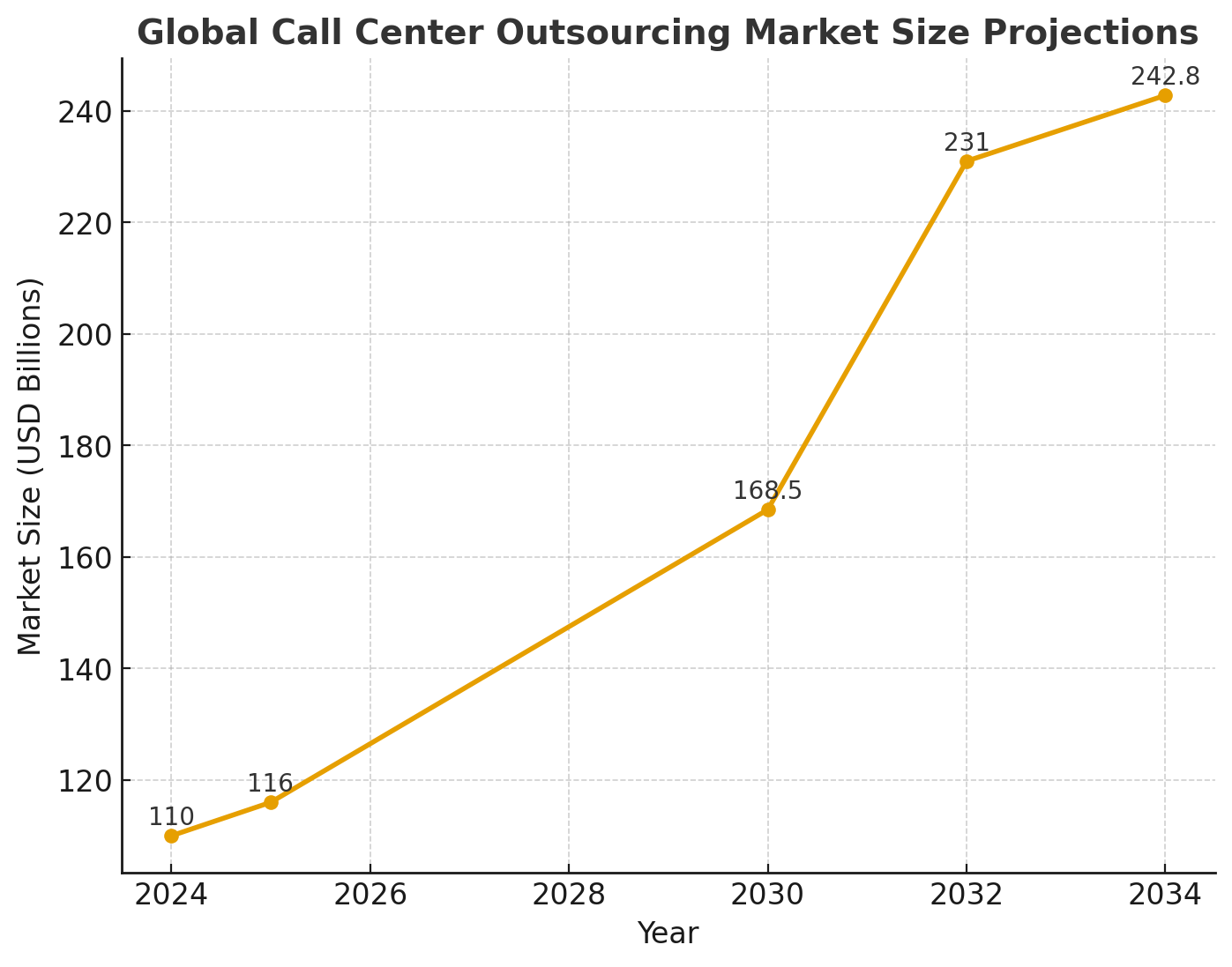
The call center outsourcing industry continues its strong trajectory in 2025, with market estimates ranging between USD 111.9 billion and USD 121.3 billion depending on methodology. This marks steady year-over-year growth from 2024’s valuation of around USD 97–118 billion. Looking ahead, analysts project sustained expansion: Mordor Intelligence forecasts the market to reach USD 168.5 billion by 2030 at a 7.5% CAGR, while Precedence Research suggests it could hit USD 242.8 billion by 2034 at an average 9% CAGR.
Regionally, North America holds the largest share (30%+), thanks to high demand for digital and compliance-driven support, while Asia-Pacific is set to grow the fastest, fueled by its skilled workforce and cost efficiency. Europe remains stable, driven by multilingual and compliance needs. While macroeconomic shifts, labor costs, and rapid AI adoption may influence these projections, the data shows a clear pattern: outsourcing remains a growth engine for businesses worldwide, and demand will continue climbing well into the next decade.
Outsourcing Penetration & Adoption Trends
By 2025, outsourcing has become a mainstream business strategy across industries. Surveys indicate that over 70% of companies outsource at least some portion of their customer support functions, and many now rely on third-party providers for their entire inbound and outbound call operations. This adoption is no longer confined to large corporations — SMBs now make up a growing share of outsourcing clients, using external partners to compete with bigger brands.
Another key shift is the balance between onshore, offshore, and nearshore outsourcing. Offshore outsourcing, particularly to hubs like the Philippines and India, remains dominant due to cost savings and talent availability. However, nearshore solutions in Latin America and Eastern Europe are gaining traction, offering cultural alignment and time zone advantages.
Remote and hybrid working models have also become embedded in outsourcing. Post-pandemic, many providers retained flexible setups, which not only widened the talent pool but also improved retention. Meanwhile, multichannel and omnichannel support adoption is accelerating — voice calls are still central, but channels like live chat, social media, and email are increasingly being handled by outsourced teams, ensuring 24/7 coverage across customer-preferred platforms.
The data paints a clear picture: outsourcing isn’t just a cost-cutting tool anymore; it’s a strategic growth driver, helping companies scale globally, adapt quickly, and meet rising customer expectations.
Technology & Automation Metrics
1. Generative AI Adoption
By the end of 2025, it’s projected that 80% of customer service organizations will be using generative AI, a massive leap from under 10% just two years ago. Outsourced call centers are at the forefront of this shift, deploying AI to handle tasks such as intelligent call routing, predictive analytics for customer behavior, real-time speech recognition, and automated quality monitoring. This not only streamlines efficiency but also reduces the margin of error, allowing businesses to offer faster and more personalized service.
2. Call Center Software Market Growth
The demand for technology-driven support has also fueled explosive growth in the call center software market, which is on track to surpass USD 90 billion by 2030. Much of this growth is tied to cloud-based platforms, which allow providers to scale quickly without massive infrastructure costs. These platforms integrate seamlessly with CRM systems and e-commerce tools, giving outsourced providers the ability to deliver real-time reporting and actionable insights that in-house setups often can’t match.
3. Automation’s Impact on Costs
AI-driven automation is reshaping cost structures across the industry. Studies show that self-service solutions, powered by AI chatbots and IVR systems, can reduce call volumes by up to 30%. This means fewer repetitive tasks for agents and lower cost per contact for businesses. More importantly, it allows human agents to focus on high-value, complex interactions — the kind of conversations that build trust, resolve difficult issues, and improve customer loyalty.
4. Silent Abandonment Risks
While technology has improved efficiency, it has also highlighted new challenges. Text-based support channels such as live chat and messaging apps report abandonment rates ranging anywhere from 3% to as high as 70%, depending on the provider and response speed. To combat this, leading outsourced centers are integrating AI with human support, ensuring that conversations remain active and customers don’t leave out of frustration. This hybrid approach has become essential in meeting rising customer expectations for quick, accurate responses.
5. Analytics & Insight Extraction
Another game-changing trend is the adoption of advanced analytics. Outsourced call centers are now leveraging speech and sentiment analysis, along with large language model (LLM) tools, to extract insights from millions of customer interactions. Beyond resolving issues, these insights can help businesses refine their products, improve service quality, and even identify new revenue opportunities. As a result, call centers are no longer just cost-saving units; they are transforming into data-driven intelligence hubs for client companies.
Performance Benchmarks & KPIs
In 2025, businesses outsourcing their call centers are closely tracking performance through measurable KPIs. Below is a snapshot of the most relevant benchmarks:
| KPI (Key Performance Indicator) | 2025 Benchmark / Average | Insights & Trends |
|---|---|---|
| Average Handle Time (AHT) | 4–6 minutes | Shorter AHT is linked to efficiency, but too short may indicate rushed interactions. |
| First Contact Resolution (FCR) | 70–75% | A top priority metric, as resolving issues on the first call boosts customer satisfaction. |
| Customer Satisfaction (CSAT) | 85%+ average rating | Surveys show CSAT remains the #1 metric for 60%+ of call centers. |
| Abandonment Rate | 5–8% | Customers abandoning before reaching an agent; omnichannel support helps reduce this. |
| Agent Turnover Rate | 30–45% annually | One of the industry’s biggest challenges; remote flexibility is helping reduce attrition. |
| Cost per Contact | USD 5–7 (average) | Varies by region; offshore outsourcing often reduces this by 40–60%. |
| Service Level (Calls Answered within 20s) | 80% target | Widely adopted SLA to balance speed and quality of service. |
| Average Speed of Answer (ASA) | 20–30 seconds | Improving year-over-year with AI-driven routing systems. |
These benchmarks show that while cost reduction remains a major driver for outsourcing, customer experience metrics like CSAT and FCR are increasingly prioritized. Providers that can balance speed, accuracy, and satisfaction are the ones attracting long-term partnerships.
Industry Use Cases & Vertical Breakdown
Call center outsourcing isn’t one-size-fits-all. Different industries adopt it for unique reasons, but the common goal is efficiency, cost reduction, and customer satisfaction. Here’s how the major verticals are leveraging outsourced support in 2025:
-
Telecommunications
The telecom industry continues to be one of the largest users of outsourced call centers. With millions of daily customer interactions, over 60% of global telecom companies outsource some or all of their support operations. Outsourcing allows them to handle high call volumes, billing issues, and tech support inquiries with lower costs and multilingual capabilities.
-
Financial Services & Banking
Security and compliance are top concerns, but banks and financial institutions still rely heavily on outsourcing for non-core functions. In 2025, more than 45% of banks outsource customer service operations, especially for credit card support, loan inquiries, and fraud hotlines. Providers with advanced compliance frameworks (e.g., PCI-DSS, GDPR) are in the highest demand.
-
E-Commerce & Retail
E-commerce is a fast-growing sector for outsourcing, as online retailers need 24/7 global coverage. Up to 70% of mid- to large-sized e-commerce businesses outsource parts of their customer support, especially during seasonal spikes like Black Friday or holiday shopping. Outsourced agents manage order tracking, returns, refunds, and live chat.
-
Healthcare
Healthcare outsourcing is growing steadily, projected at a 7% CAGR between 2025 and 2030. Providers support patient scheduling, insurance claims, and medical billing — all while adhering to HIPAA and data privacy regulations. For many healthcare organizations, outsourcing reduces admin overhead while maintaining compliance.
-
Technology & SaaS
Tech companies often use outsourcing to scale support quickly. By 2025, over 50% of SaaS firms will partner with outsourced call centers, especially to provide multi-time-zone technical support. Outsourcing ensures that customers across the globe receive timely troubleshooting, onboarding help, and subscription management.
-
Global Outsourcing Hubs
– Philippines: Holds ~15% global market share in call center outsourcing, known for English proficiency and cultural affinity with the U.S.
–India: Remains a cost-effective hub with a strong IT integration advantage, serving both Western and domestic markets.
–Latin America: Countries like Mexico and Colombia are seeing double-digit growth rates in nearshore outsourcing, favored for time zone alignment with North America.
Challenges & Risk Statistics
While outsourcing delivers cost savings and scalability, it also comes with measurable risks. The data in 2025 highlights several recurring challenges that businesses must account for when evaluating providers.
🚩 High Agent Turnover
Call centers continue to face annual turnover rates of 30–45%, with some regions reporting even higher numbers. This creates challenges in training consistency, quality control, and maintaining customer satisfaction. Providers offering remote or hybrid flexibility have shown lower attrition, cutting turnover by nearly 15% compared to traditional setups.
🚩 Quality & Service Consistency
A survey of global businesses revealed that 40% cite inconsistent service quality as their top outsourcing concern. This often stems from insufficient training, cultural misalignment, or inadequate oversight. Poor quality control can lead to declines in CSAT scores, which average 85%+ in top-performing centers but drop below 70% in struggling ones.
🚩 Data Security & Compliance Risks
With growing regulatory demands, compliance is a major risk factor. In 2024, 21% of businesses reported data breaches linked to third-party providers, underscoring the importance of strict controls. By 2025, leading providers must demonstrate compliance with GDPR, HIPAA, and PCI-DSS standards. Companies are now ranking data security as the #1 vendor selection criteria in RFPs.
🚩 Silent Abandonment & Efficiency Loss
Silent abandonment in digital channels — where customers drop off before resolution — remains a costly issue. Rates vary dramatically, from 3% in well-managed chat systems to over 70% in poorly optimized platforms. This results in wasted agent time and lost revenue opportunities, with some studies estimating abandonment costs in the billions annually across industries.
🚩 AI-Driven Displacement Concerns
While AI reduces costs and improves efficiency, it also creates anxiety around job displacement and service quality. Industry analysts predict that up to 15% of entry-level call center jobs could be automated away by 2030. However, the hybrid human + AI model is proving most effective, where automation handles repetitive tasks while agents tackle complex interactions.
Stealth Agents: A Smarter Call Center Outsourcing Partner
While the statistics show the rapid growth of outsourcing worldwide, not all providers deliver the same level of reliability and value. This is where Stealth Agents stands out as a proven partner for businesses that want both efficiency and quality in their customer support.
Recognized by Forbes in 2025 as the #2 outsourcing company, Stealth Agents combines scale, technology, and talent to help businesses achieve measurable results. Unlike traditional call centers that focus solely on volume, Stealth Agents emphasizes accuracy, personalization, and performance-driven support.
Key differentiators include:
- 10–15+ years of experience among call center professionals, ensuring clients benefit from seasoned expertise rather than entry-level labor.
- A dedicated account manager for every client, providing hands-on oversight, quality assurance, and strategic alignment with business goals.
- Scalable teams that can grow from a single agent to over 100 agents, making it easy for businesses to adjust capacity as demand fluctuates.
- Proven outcomes, with a 95% client satisfaction rate and cost savings that average 40–60% compared to in-house operations.
- A secure cloud-based platform that guarantees compliance with industry standards like GDPR, HIPAA, and PCI-DSS.
For companies looking to turn outsourcing from a cost-cutting tactic into a strategic advantage, Stealth Agents offers the best of both worlds: highly skilled professionals backed by advanced technology and a reputation for excellence.
Future Outlook & Forecasts
The future of call center outsourcing is being shaped by both technology and shifting customer expectations. Projections show the market will continue expanding rapidly, with values expected to reach USD 168.5 billion by 2030 (Mordor Intelligence) and potentially USD 242.8 billion by 2034 (Precedence Research). This steady growth reflects outsourcing’s evolution from a cost-saving tactic to a strategic function that drives customer loyalty and brand reputation.
A major driver of this growth will be the rise of omnichannel support. Customers increasingly expect seamless service across voice, chat, email, and social media. By 2030, experts predict that over 85% of outsourced call centers will operate fully integrated omnichannel systems, supported by AI-driven analytics.
The role of AI and automation will continue to expand, but rather than replacing human agents, the trend points toward a hybrid model where automation handles repetitive queries while skilled professionals manage complex, high-empathy interactions. This balance is forecast to reduce costs by up to 40% while maintaining or even improving customer satisfaction scores.
Regional shifts will also play a role. While Asia-Pacific remains the fastest-growing hub, nearshore outsourcing in Latin America and Eastern Europe is projected to grow at double-digit CAGRs through 2030, driven by cultural alignment and time zone advantages for Western markets.
In short, the next decade will see outsourcing providers transform into strategic partners, combining global reach, advanced technology, and industry-specific expertise to deliver measurable business outcomes. Companies that adopt these innovations early will be best positioned to compete in an increasingly customer-driven economy.
Takeaways & Strategic Implications
The statistics from 2025 make one thing clear: call center outsourcing is no longer just a cost-cutting measure — it’s a strategic driver of business growth. With the market expected to surpass USD 160 billion by the end of the decade, companies that adopt outsourcing intelligently will gain a strong competitive edge.
For decision-makers, the key takeaways are:
- Benchmark performance: Use KPIs like CSAT, FCR, and cost per contact to measure providers against industry averages.
- Invest in technology maturity: Providers leveraging AI, analytics, and omnichannel platforms deliver superior results and long-term value.
- Mitigate risks early: Address compliance, data security, and quality control in vendor contracts to avoid the common pitfalls highlighted by 2025 data.
- Think globally, act strategically: Explore offshore, nearshore, and onshore options to balance cost savings with cultural alignment and service quality.
- Choose partners, not just vendors: The most successful companies treat outsourcing providers as extensions of their brand, ensuring consistency in customer experience.
Frequently Asked Questions
What is the average cost per hour for call center outsourcing in 2025?
The cost of call center outsourcing varies based on factors like location, the type of services required, and the level of expertise needed. Offshore, nearshore, and onshore providers each come with different pricing models, and specialized services like technical support or multilingual help tend to cost more than standard options.
Which countries offer the best call center outsourcing value in 2025?
The Philippines is a top choice for English-speaking markets, offering 40-60% savings and good cultural alignment. India is the most affordable for technical support. Mexico and Colombia are great nearshore options for North American companies, while Poland and Romania are strong choices for European businesses needing multilingual support.
How do you calculate savings when outsourcing call center operations?
To calculate savings, compare the total cost of running an in-house call center (salaries, benefits, office space, training, and management) with the cost of outsourcing, including any setup fees. Most companies save 30-50% within 6-12 months. Also, consider benefits like better customer satisfaction, faster training, 24/7 service, and the ability to scale up or down.
What should businesses include in call center outsourcing contracts?
Important contract terms include service guarantees (like answering 80% of calls within 20 seconds), customer satisfaction goals (85% or higher), flexible scaling options, data security certifications, and clear rules for ending the contract (30-60 days’ notice). Contracts should also include penalties for poor performance and a trial period to test the service.
How quickly can businesses increase call center capacity?
Most providers can add 5-10 agents in 1-2 weeks. For larger increases (50+ agents), it may take 3-4 weeks to train and integrate new staff. In emergencies, some providers can add agents within 48-72 hours using pre-trained staff, though extra monitoring may be needed to ensure quality.
What training do outsourced call center agents need?
Agents usually need 2-4 weeks of training to learn about your products, company procedures, CRM systems, and communication rules. For industries like healthcare or finance, training may take 6-8 weeks because of extra rules and specialized knowledge. Ongoing training is also important for updates and skill improvement.
How do time zone differences affect call center outsourcing?
Time zone differences can delay responses for complex issues. Offshore providers may have delays of 6-12 hours, while nearshore providers offer better overlap with your business hours. Many companies use a “follow-the-sun” model, with teams in different time zones providing 24/7 service.
What backup plans should call center outsourcing include?
Good providers have strong backup plans, like multiple data centers, cloud-based systems with 99.9% uptime, backup internet connections, and the ability for agents to work from home. They should also have systems that automatically switch to backups and recovery plans that restore service within 4 hours.
How do seasonal changes affect call center pricing and capacity?
During busy times like holidays or product launches, costs can go up by 15-25% because of higher demand and temporary staffing. Contracts should include plans for handling seasonal spikes, with pre-agreed pricing and capacity reservations made 60-90 days in advance to ensure enough staff is available.
What challenges come with setting up call center outsourcing?
Common challenges include making sure your CRM system works with the provider’s tools, moving data, setting up secure logins, and combining reports. It usually takes 2-6 weeks to set everything up, train staff, and adjust workflows. Providers with ready-made integrations for popular platforms like Salesforce or HubSpot can make the process faster.