
Offshoring vs. outsourcing is all about choosing the smartest way to grow your business—whether by relocating tasks overseas or hiring external experts. Stealth Agents makes this decision easy by offering expert support to help you reduce costs, boost efficiency, and scale fast with the right team in place.
Offshoring vs. outsourcing are two strategies that have gained significant attention in recent years.
While these terms are often used interchangeably, it is essential to understand their differences and know the best practices for outsourcing and offshoring.
Stealth Agents can further support your efforts with their expert virtual assistant, ensuring your business excels in connecting with and retaining customers.
Grab a spot now, and we’ll talk about your preferences and pricing options!

In this comprehensive comparison, we will examine the concepts of offshoring and outsourcing, discuss their benefits and drawbacks, highlight key differences, and offer insights on how to choose between them.
How the Pandemic Has Shifted the Lines Between Outsourcing, Offshoring, and Remote Work
Remember when “remote work” mainly meant working from home for a snow day, and the terms “offshoring” and “outsourcing” sounded like big-business buzzwords? Fast-forward to the world post-COVID, and the game has changed.
The global shift to remote work tore down the walls—literally and figuratively—separating teams, time zones, and traditional employment models.
Now, the physical whereabouts of your staff seem almost irrelevant. Whether your marketing guru is a few subway stops away in Brooklyn or dialing in from Cebu, online collaboration tools like Slack, Zoom, and Asana have made it easier to manage projects from any corner of the planet.
As a result, the once-clear lines between outsourcing (hiring third-party providers), offshoring (relocating services to another country), and simply hiring remote employees have blurred.
What’s truly interesting is how the rise of platforms like Upwork, Fiverr, and Toptal has empowered professionals from San Francisco to São Paulo to contribute their expertise on demand. Hiring a virtual assistant san francisco can be part of this flexible approach, giving local businesses access to skilled support when they need it.
This newfound flexibility not only lets businesses tap into a larger talent pool but also allows workers to tailor their schedules and projects—creating a win-win marketplace that’s here to stay.
Understanding Offshoring
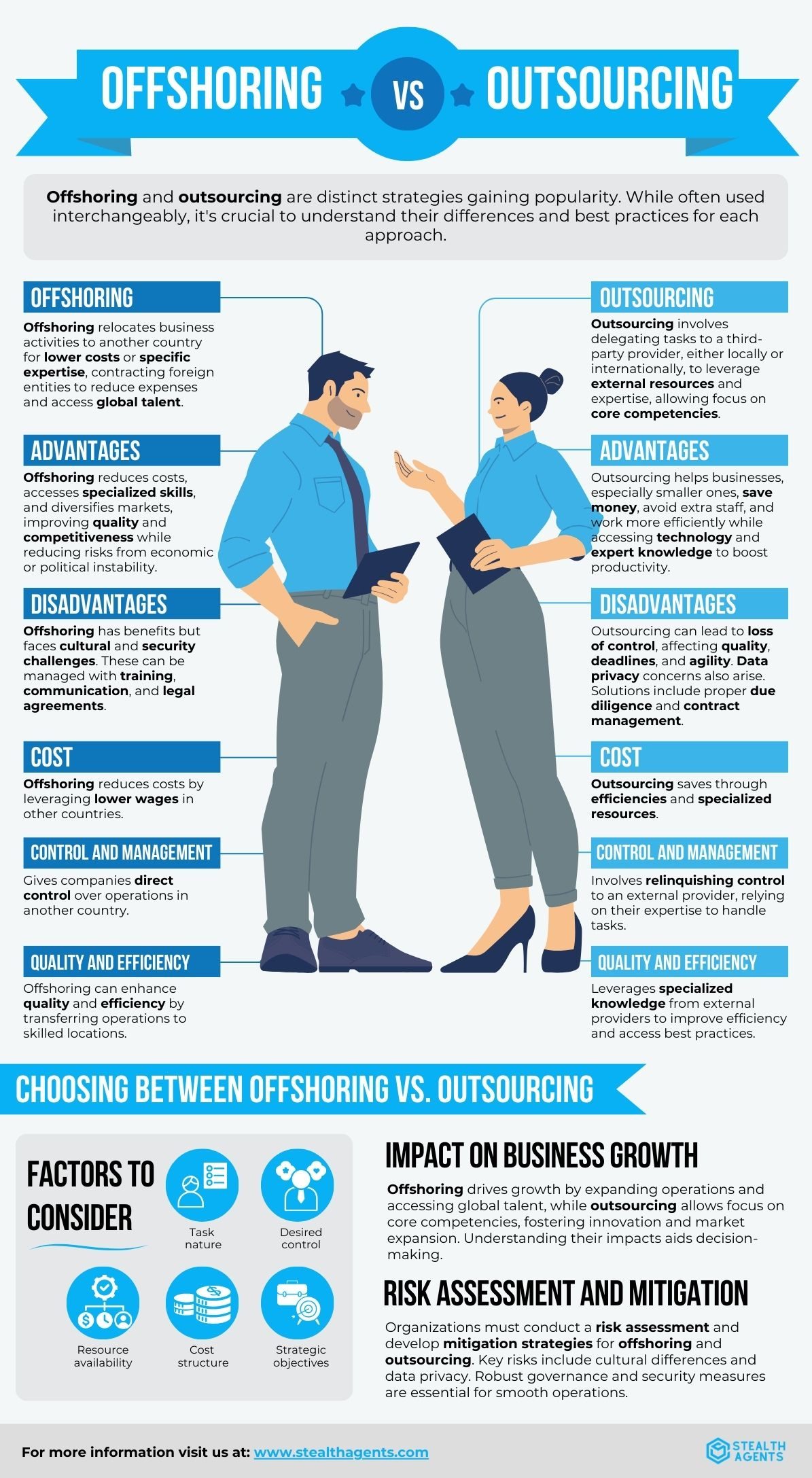
Offshoring refers to relocating business activities or services to another country to take advantage of lower labor costs or specific expertise available in the target location.
It involves establishing or contracting with a foreign entity to handle particular tasks or processes. Offshoring has become increasingly popular among companies seeking to reduce expenses and tap into global talent pools.
Key benefits of offshoring
Offshoring has several advantages, including reducing costs, accessing specialized skills, and establishing a global presence.
Businesses can significantly decrease expenses associated with wages, benefits, and overhead by moving operations to countries with lower labor costs.
Enhanced quality, productivity, and competitiveness can result from this. Additionally, businesses can access a larger pool of skilled professionals with specific knowledge or expertise by expanding their operations to other countries.
You don’t need to worry because there are managers who have received practical chain-of-command training. Industries that require specialized skills, such as information technology, software development, or engineering, can particularly benefit from this.
Finally, businesses can diversify their customer base, reduce dependence on a single market, and mitigate risks associated with economic fluctuations or political instability in a particular region by setting up offices or subsidiaries in different countries.
Potential drawbacks of offshoring
Offshoring has benefits but also challenges, such as cultural differences and data security risks. Companies can overcome these challenges by implementing effective communication strategies, providing cultural training, and establishing legal contract agreements.
Companies need to address concerns transparently and engage in open dialogue with stakeholders to build trust. Careful planning and effective management can help companies maximize the benefits of offshoring and mitigate potential drawbacks.
Understanding outsourcing
Delegating specific business tasks or processes to an external entity involves outsourcing. It typically entails contracting with a third-party provider, either domestically or internationally, to handle particular functions or activities. Many companies leverage an outsourcing company Philippines to access skilled professionals, reduce costs, and maintain high-quality performance. The practice of outsourcing has proven to be a valuable asset for companies that wish to capitalize on external resources and expertise while concentrating on their core competencies.
Advantages of outsourcing
This is a great money saver for companies, particularly smaller ones that are strapped for cash. Indeed, by aiding with the outsourcing of non-core operations, digital marketing service providers may help businesses save money, eliminate the need for extra staff, and work more efficiently. Outsourcing also gives businesses access to cutting-edge technology and outside knowledge, which boosts their productivity.
Disadvantages of outsourcing
While the benefits of outsourcing are evident, it is crucial to consider the potential disadvantages. One of the central drawbacks is losing control over outsourced activities. There are solutions and tips on how to delegate work as a leader.
Companies may face challenges in maintaining quality standards, ensuring adherence to deadlines, and managing the performance of the external provider. A lack of direct control can also limit business agility and responsiveness. Additionally, outsourcing can generate concerns regarding data privacy, as external parties may handle sensitive information. Proper due diligence and contract management are essential to mitigate these risks.
Differences of offshoring vs. outsourcing
Now that we have established a clear understanding of offshoring and outsourcing individually, let’s examine the key differences between these two strategies.
Differences in cost
One of the primary distinctions between offshoring vs. outsourcing is the cost structure. Labor cost differentials primarily drive the use of offshore virtual assistants as companies seek to leverage lower wages or favorable economic conditions in offshore locations.
On the other hand, outsourcing focuses on overall cost savings achieved through economies of scale, increased efficiency, and access to specialized resources. While offshoring vs. outsourcing strategies aim to reduce expenses, the underlying cost drivers vary significantly.
Differences in control and management
Control and management are crucial aspects that differentiate offshoring vs. outsourcing. In offshoring, companies have more direct control over their operations or subsidiaries in the target country. They maintain ownership and have the ability to shape the processes and practices according to their requirements.
In contrast, outsourcing involves entrusting specific activities to an external provider, relinquishing direct control over the tasks. Organizations rely on the expertise and capabilities of the outsourcing partner to perform the delegated functions.
Differences in quality and efficiency
Quality and efficiency are key considerations when choosing between offshoring vs. outsourcing. Offshoring often involves transferring operations to countries known for their skilled workforce or expertise in a specific industry.
This can result in higher-quality deliverables, improved efficiency, and faster turnaround times. Conversely, outsourcing allows companies to benefit from the specialized knowledge and experience of external providers. By leveraging their expertise, businesses can achieve greater efficiency and access to best practices in their respective fields.
Choosing between offshoring vs. outsourcing
As businesses evaluate their options for global expansion and operational optimization, they must consider several factors when deciding between offshoring and outsourcing.
Factors to consider
There are several factors that organizations should consider when deciding between offshoring and outsourcing.
These include the nature of the task or process, the level of control desired, the availability of skills and resources in the target location, the cost structure, and the business’s strategic objectives. Above all, these factors can help companies to make informed decisions that can achieve their specific requirements and goals.
Impact on business growth
Both offshoring and outsourcing can significantly impact business growth. Offshoring can enable companies to expand their operations into new markets, access global talent pools, and achieve cost savings that can fuel growth initiatives.
Outsourcing, however, allows businesses to focus on their core competencies and strategic objectives, thereby creating opportunities for innovation and market expansion. Understanding the potential impact of each strategy on business growth is essential in making informed decisions.
Risk assessment and mitigation
Lastly, organizations must conduct a comprehensive risk assessment and develop effective mitigation strategies when considering offshoring vs. outsourcing.
Assessing the potential risks associated with each strategy, such as cultural differences, data privacy concerns, or regulatory compliance, is crucial for successful implementation.
Establishing robust governance structures, conducting due diligence on potential partners, and implementing adequate security measures are essential in mitigating these risks and ensuring smooth operations.
Takeaways
In conclusion, offshoring and outsourcing are both viable strategies that businesses can leverage to enhance their operational efficiency, reduce costs, and access specialized resources. While offshoring involves relocating operations to another country, outsourcing entails delegating specific tasks to external providers.
Understanding the key differences, benefits, and drawbacks of each strategy is vital in making informed decisions that align with business objectives. By considering various factors, evaluating the impact on business growth, and adequately addressing potential risks, organizations can choose the most suitable approach to drive success in an increasingly globalized marketplace.

Frequently Asked Questions
Which industries benefit most from offshoring vs outsourcing business operations?
Manufacturing, technology, and customer service benefit most from offshoring because of lower labor costs. Professional services like accounting, legal, and marketing often prefer outsourcing for access to experts. Healthcare and finance may outsource to meet strict rules, while software development can use either model depending on the project’s needs.
How long does it typically take to implement offshoring vs outsourcing strategies?
Offshoring takes 6-18 months because it involves setting up legal agreements, facilities, and training staff. Outsourcing is faster, usually taking 2-8 weeks, since you use the provider’s existing setup. Offshoring needs more planning, while outsourcing is quicker for immediate needs.
What are the hidden costs of offshoring vs outsourcing that companies overlook?
Offshoring can have extra costs like legal fees, compliance expenses, building infrastructure, and travel for management. Outsourcing may include fees for changing contracts, transferring knowledge, or ending contracts early. Both models may also require spending on communication tools, training, and managing relationships.
When should startups choose offshoring vs outsourcing for their business growth?
Startups should start with outsourcing because it’s flexible and doesn’t need a big upfront investment. Offshoring is better for companies with steady, high-volume work and at least a year of stable income. Outsourcing works well for early growth, while offshoring suits long-term needs.
How do labor laws differ between offshoring vs outsourcing arrangements?
Offshoring means following the labor laws of the country where you hire, including rules about wages, benefits, and firing. With outsourcing, the service provider handles these legal responsibilities. However, companies still need to ensure contractors follow data protection and industry rules.
What metrics should companies use to measure offshoring vs outsourcing success?
For offshoring, track costs, employee retention, and productivity over time. For outsourcing, focus on meeting service agreements, response times, and return on investment. Both models should measure quality, delivery times, customer satisfaction, and how well they meet business goals.
Where are the top global destinations for offshoring vs outsourcing services?
Popular offshoring locations include India, the Philippines, and Mexico for their skilled workers and lower costs. Eastern Europe (like Poland and Ukraine) offers nearshore options with cultural similarities. Outsourcing hubs include these regions plus Costa Rica, South Africa, and Malaysia, which provide services across different time zones.
How do communication challenges differ between offshoring vs outsourcing models?
Offshoring requires direct communication with foreign employees, which may need language training and cultural understanding. Outsourcing often includes account managers who handle communication for you. Offshoring needs more investment in communication tools, while outsourcing relies on the provider’s systems.
What contract terms are essential for offshoring vs outsourcing agreements?
Offshoring contracts should include employment terms, intellectual property rights, data security rules, and termination procedures under local laws. Outsourcing contracts need clear service agreements, penalties for poor performance, and terms for scaling up or down. Both require confidentiality agreements, but offshoring also needs terms for following local labor laws.
Why do companies switch from outsourcing to offshoring or vice versa?
Companies move from outsourcing to offshoring for more control, stable costs, and better protection of their ideas. They switch back to outsourcing when they need flexibility, want less management work, or face new rules. Many businesses use a mix of both to meet their needs.