

The global demand for virtual assistants (VAs) has surged in 2025, as businesses of all sizes turn to outsourcing for efficiency, scalability, and cost savings. Once seen as a niche service for startups and entrepreneurs, VA outsourcing has now become a mainstream business strategy, supporting industries ranging from e-commerce and real estate to healthcare and finance.
The numbers tell the story: the virtual assistant outsourcing market is valued in the tens of billions of dollars globally, with adoption accelerating at a compound annual growth rate (CAGR) of 7–9% through 2030. Businesses are increasingly delegating administrative tasks, scheduling, bookkeeping, and customer support to remote professionals, freeing in-house teams to focus on growth and innovation.
In this article, we’ll explore the latest 2025 statistics on virtual assistant outsourcing, including market size, adoption trends, cost savings, performance benchmarks, and the future outlook. Whether you’re a startup founder or a corporate executive, these numbers reveal why outsourcing VAs is becoming one of the smartest moves for businesses worldwide.
Market Size & Growth Forecast
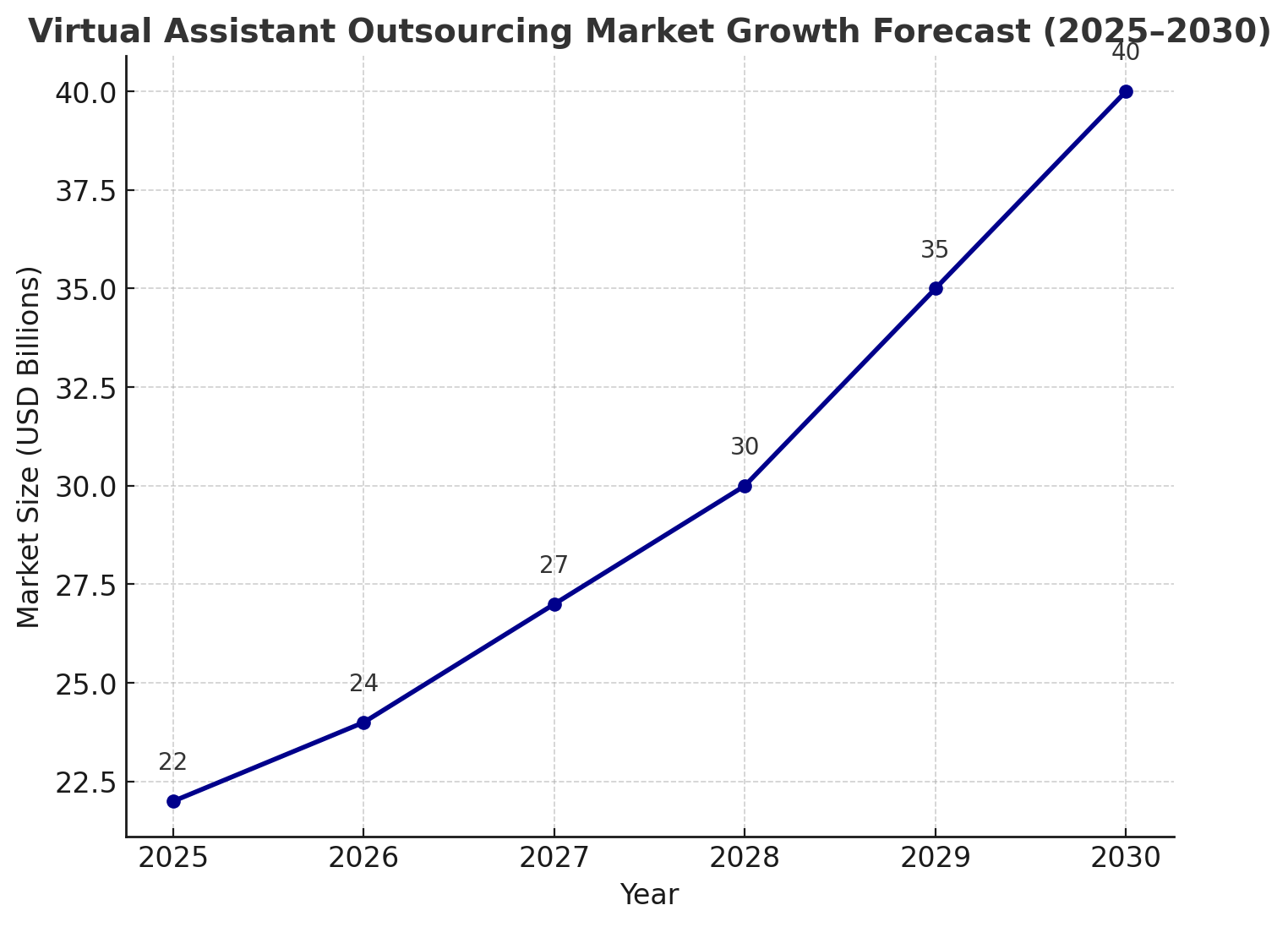
The virtual assistant outsourcing market is on a steep upward trajectory in 2025. Estimates place the global VA services industry at around USD 20–25 billion, with strong growth expected over the next five years. This expansion is being fueled by the twin forces of cost efficiency and digital adoption, as businesses increasingly rely on remote, flexible support to scale operations.
Forecasts suggest the VA outsourcing market will grow at a CAGR of 7–9% through 2030, with some reports projecting the market could surpass USD 40 billion by 2030. The acceleration reflects not just adoption by startups, but also by SMBs and enterprise-level organizations, which now recognize virtual assistants as a critical part of their operational models.
Regionally, Asia-Pacific dominates the VA outsourcing market, with the Philippines and India leading the way due to their large, English-speaking talent pools and cost advantages. The Philippines in particular,ar accounts for a significant share of VA services for U.S. businesses, while India leads in more technical and administrative support. Latin America is quickly emerging as a competitive nearshore destination, offering Spanish-English bilingual talent and time zone alignment for North American clients.
The numbers make it clear: what was once a “startup hack” has evolved into a global industry worth billions, with demand for VAs only expected to rise as businesses adapt to hybrid work models and increasingly digital-first operations.
Adoption Rates & Use Cases
By 2025, outsourcing virtual assistants has become mainstream across industries. Recent surveys show that over 65% of small and medium-sized businesses (SMBs) outsource at least one VA function, while adoption among enterprises has climbed to nearly 40%, particularly in administrative and customer support roles. This marks a significant increase from just five years ago, when VAs were largely seen as a tool for startups and solopreneurs.
The most common outsourced VA tasks remain administrative support, calendar management, and scheduling, which account for roughly 50% of all VA contracts. However, specialized use cases are gaining traction. Bookkeeping and accounting tasks now make up nearly 20% of VA workloads, while digital marketing support (content creation, social media management, and lead generation) has grown by 25% year-over-year.
Industry-specific virtual assistants are also on the rise. E-commerce VAs are in high demand for tasks like product listing, order tracking, and customer service. Healthcare VAs help with patient scheduling and insurance coordination, ensuring compliance with HIPAA regulations. Meanwhile, real estate VAs handle property listings, CRM updates, and client follow-ups, helping agents stay focused on closing deals.
The numbers highlight a clear shift: outsourcing VAs is no longer just about offloading small tasks — it’s about building scalable, specialized remote teams that serve as extensions of in-house staff.
Virtual Assistant Task Adoption Rates
| Task / Use Case | Adoption Rate | Details |
|---|---|---|
| Administrative Support | ~50% of VA contracts | Calendar management, email handling, travel booking, scheduling. |
| Bookkeeping & Accounting | ~20% | Invoicing, expense tracking, payroll prep, QuickBooks/Xero support. |
| Digital Marketing Support | ~25% YoY growth | Social media management, content creation, lead generation, email campaigns. |
| Customer Support (CX) | ~35% | Handling inquiries, live chat, order tracking, customer service tickets. |
| E-Commerce Support | ~30% | Product listing, order fulfillment, refunds/returns, marketplace management. |
| Healthcare Support | ~15% | Patient scheduling, insurance claims, HIPAA-compliant admin tasks. |
| Real Estate Support | ~10–12% | Property listings, CRM updates, lead follow-ups, appointment setting. |
Technology & Tools in VA Outsourcing
Technology is at the heart of virtual assistant outsourcing in 2025. As the demand for VAs grows, the tools they use have become more advanced, enabling them to deliver faster, more accurate, and more secure support.
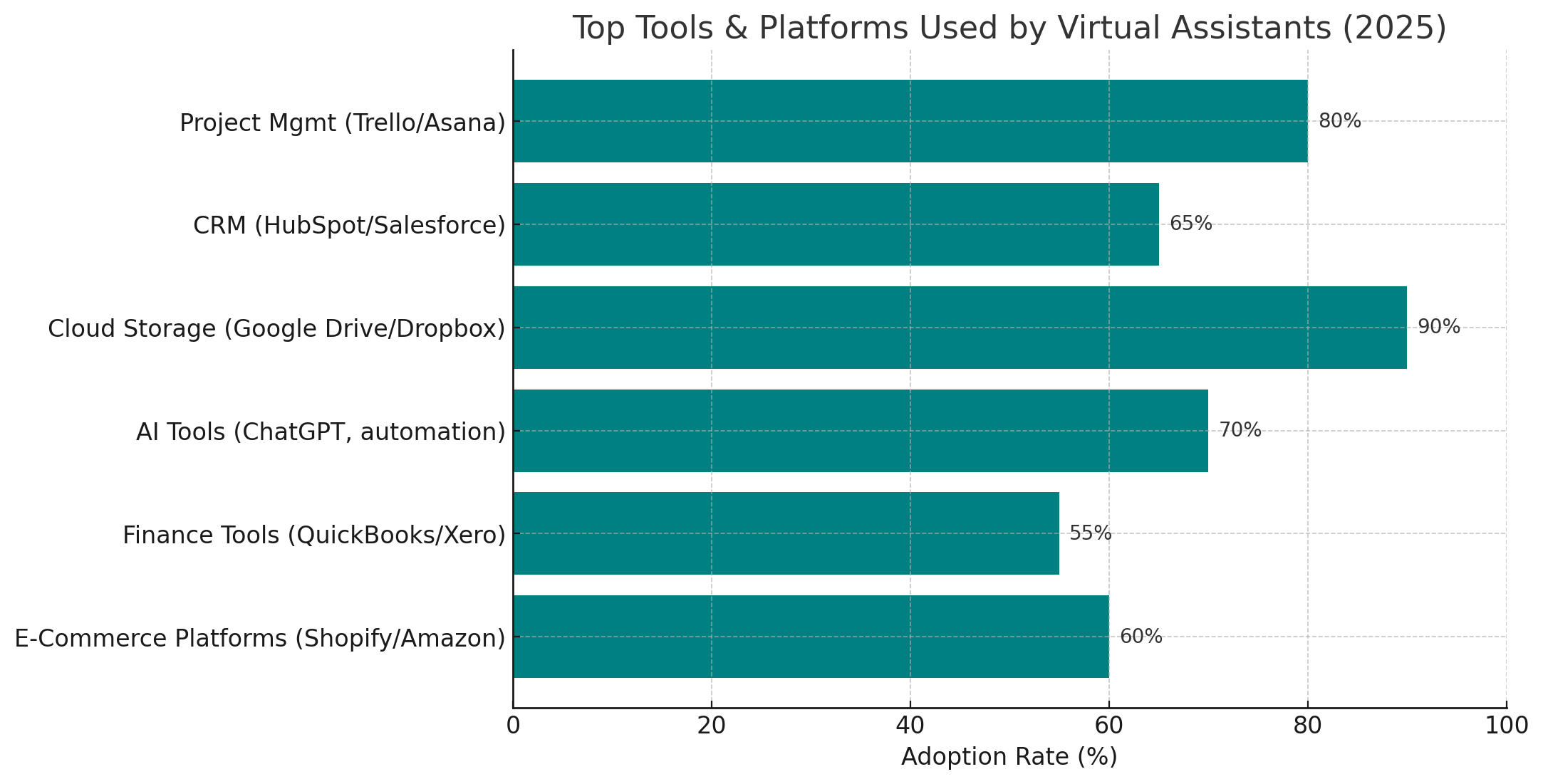
One of the biggest shifts is the integration of AI-powered tools into everyday workflows. Surveys show that over 70% of outsourced VAs now use AI or automation platforms for tasks like drafting emails, generating content, or handling repetitive data entry. Generative AI tools in particular have boosted VA productivity by up to 30%, allowing them to manage larger workloads in less time.
Project management and collaboration platforms are also central to VA operations. Tools like Trello, Asana, Slack, and Microsoft Teams are used by more than 80% of VA teams, enabling seamless communication with clients regardless of time zone. Meanwhile, CRM systems such as HubSpot, Salesforce, and Zoho are widely adopted among VAs working in sales and customer management roles.
Cloud-based solutions are another cornerstone. 90% of VAs rely on cloud storage platforms like Google Drive, Dropbox, and OneDrive to ensure real-time file sharing and secure access. For finance and bookkeeping VAs, tools like QuickBooks, Xero, and FreshBooks dominate the landscape, while e-commerce VAs often specialize in platforms such as Shopify, Amazon Seller Central, and WooCommerce.
Overall, technology has turned virtual assistants into tech-enabled productivity partners. Businesses outsourcing in 2025 aren’t just hiring labor — they’re gaining access to a full tech stack of tools and automation that amplifies efficiency and drives measurable results.
Cost Savings & Efficiency Stats
One of the biggest drivers of virtual assistant outsourcing in 2025 is the cost advantage. Businesses can save 40–70% on labor costs by hiring outsourced VAs compared to in-house employees, depending on the role and region. This makes VAs especially attractive for startups and SMBs operating on tight budgets.
Hourly rates vary significantly by geography. Philippines-based VAs average USD 5–10 per hour, while India averages around USD 6–12 per hour. In contrast, U.S.-based VAs often charge between USD 20–40 per hour. This wide gap explains why Asia-Pacific remains the dominant hub for VA outsourcing, while nearshore regions like Latin America are gaining traction with rates averaging USD 8–15 per hour plus bilingual support advantages.
The return on investment (ROI) is equally compelling. Surveys show that 72% of businesses report higher productivity within the first three months of outsourcing VAs, while 65% cite improved business scalability as a direct result. By offloading repetitive tasks to VAs, companies can reallocate internal teams to focus on growth strategies, customer acquisition, and product development.
Efficiency gains are not only financial but also operational. A study in 2025 found that outsourcing administrative and support tasks to VAs reduced internal workloads by up to 35%, shortening project turnaround times and improving overall employee satisfaction.
In short, outsourcing virtual assistants isn’t just about saving money — it’s about creating a leaner, more agile business model that delivers measurable gains in both efficiency and profitability.
Performance Benchmarks & KPIs
| Metric | Benchmark / Average | Insights |
|---|---|---|
| Average Hourly Rates (by region) | Philippines: $5–10/hr India: $6–12/hr Latin America: $8–15/hr U.S.: $20–40/hr |
Offshore VAs deliver the highest cost savings; nearshore options offer bilingual advantages. |
| Cost Savings vs In-House | 40–70% reduction | Outsourcing reduces hiring, training, and overhead costs significantly. |
| Productivity Gain | +30–35% workload reduction | Businesses report major time savings by offloading repetitive tasks. |
| ROI Realization | 72% see ROI within 3 months | Quick turnaround on efficiency improvements. |
| Client Satisfaction (CSAT) | 85–90% average | Consistently high satisfaction reported by businesses using outsourced VAs. |
| Attrition/Turnover | 20–25% annually | Lower than traditional call centers, especially with remote/hybrid flexibility. |
| Average Contract Length | 12–18 months | Most companies keep long-term VA partnerships after initial trial. |
Challenges & Risks in VA Outsourcing
While the benefits of outsourcing virtual assistants are clear, 2025 data also highlights challenges that businesses must account for when selecting providers.
🚩 Data Security & Confidentiality
With VAs often handling sensitive information such as financial records, client data, or healthcare details, 22% of businesses cite data security as their top concern in outsourcing. Compliance with standards like HIPAA, GDPR, and PCI-DSS is essential for reducing risk.
🚩 Quality & Consistency of Work
One of the most common complaints about VA outsourcing is inconsistency. Reports show that 37% of companies have experienced issues with accuracy or quality due to poor training or lack of oversight. This makes strong onboarding processes and clear SOPs critical.
🚩 Communication & Time Zone Alignment
Though technology bridges many gaps, 29% of businesses report communication challenges with offshore VAs, often related to time zone differences or cultural nuances. Nearshore outsourcing is becoming more popular for companies seeking closer alignment and bilingual capabilities.
🚩 Turnover & Retention Risks
While VA turnover rates are lower than traditional call centers, attrition remains a concern at 20–25% annually. This can disrupt workflows and increase training costs if not managed with retention strategies and proper vendor support.
🚩 Over-Reliance on Outsourcing
For some SMBs, outsourcing becomes the backbone of their operations. However, 15% of businesses report negative impacts when a vendor fails to deliver — highlighting the importance of diversifying providers and having contingency plans.
Stealth Agents: A Trusted VA Outsourcing Partner
Amid the rapid growth of virtual assistant outsourcing, businesses are searching for providers that deliver reliability, compliance, and scalability — not just low costs. This is where Stealth Agents has earned global recognition as a leading outsourcing partner. Ranked by Forbes in 2025 as the outsourcing company, Stealth Agents combines deep industry expertise with a client-first approach.
Key differentiators include:
- Experienced Talent: Stealth Agents’ VAs bring 10–15+ years of professional expertise, ensuring clients work with seasoned specialists rather than entry-level hires.
- Dedicated Account Managers: Every client is paired with a personal account manager who oversees quality, provides direct support, and aligns VA tasks with strategic business goals.
- Scalable Solutions: Businesses can start with one VA and seamlessly scale up to 50–100+ assistants, making it ideal for startups and enterprises alike.
- Proven Results: Stealth Agents consistently achieves 95% client satisfaction rates, helping businesses reduce costs by 40–60% while improving efficiency.
- Secure & Compliant: With a cloud-based platform built to meet HIPAA, GDPR, and PCI-DSS standards, Stealth Agents is a trusted choice for industries like healthcare, finance, and e-commerce.
In an outsourcing market filled with options, Stealth Agents stands out by offering more than just administrative support — they deliver strategic, industry-specific VA solutions that help businesses grow faster, smarter, and more securely.
Future Outlook for VA Outsourcing
The future of virtual assistant outsourcing looks exceptionally strong, with the market projected to double in size by 2030, reaching over USD 40 billion globally. This growth will be fueled by the continued shift toward hybrid and remote work models, rising labor costs in developed markets, and the increasing need for specialized support.
One major trend shaping the outlook is the rise of AI + human hybrid models. By 2030, analysts predict that over 80% of outsourced VAs will use AI-driven tools as part of their daily workflows. Rather than replacing VAs, AI will enhance their productivity — handling repetitive tasks like scheduling, data entry, and reporting, while human assistants focus on strategic, client-facing activities that require creativity and empathy.
Industry specialization is another area of growth. Healthcare, legal, real estate, and e-commerce VAs are projected to expand rapidly, as compliance-heavy and customer-facing sectors demand skilled professionals who understand industry nuances. For instance, HIPAA-trained healthcare VAs and e-commerce VAs fluent in Shopify or Amazon Seller Central are expected to see the highest demand.
Nearshore outsourcing will also continue to grow, with Latin America projected to capture a larger share of the North American market thanks to bilingual talent and time zone alignment. This will complement the strong dominance of Asia-Pacific hubs like the Philippines and India.
In short, the next five years will see virtual assistant outsourcing move from being a tactical solution to becoming a strategic pillar of global business operations, combining human expertise, AI innovation, and global scalability.
Conclusion
The statistics from 2025 prove that virtual assistant outsourcing is no longer just a startup strategy — it’s a global business necessity. With the market already worth over USD 20 billion and projected to double by 2030, companies across every sector are relying on VAs to cut costs, scale operations, and improve productivity.
From administrative tasks and bookkeeping to specialized support in healthcare, e-commerce, and real estate, outsourced VAs are now delivering measurable results backed by technology, automation, and compliance. Businesses that adopt this model benefit from 40–70% cost savings, higher efficiency, and access to experienced global talent.
For organizations ready to leverage these advantages, providers like Stealth Agents stand out as trusted partners, offering scalability, security, and seasoned professionals who align outsourcing with long-term growth goals.
The future is clear: virtual assistant outsourcing is set to become a strategic growth engine for businesses worldwide.
Outsourcing a virtual assistant can save you time and money. With skilled help, you can focus on what really matters in your business. Get started today to find your perfect VA.
Frequently Asked Questions
What are the most accurate virtual assistant outsourcing statistics for small businesses in 2025?
In 2025, 78% of small businesses use virtual assistants (VAs), saving an average of $2,500-$4,000 per month per VA. About 85% of small businesses keep their VAs for more than 18 months, and 92% of business owners report a better work-life balance within 6 months of hiring a VA.
How do virtual assistant outsourcing statistics differ by company size in 2025?
Startups with 1-10 employees have the highest VA usage at 85%, while small-to-medium businesses (11-50 employees) are at 68%, and large companies (500+ employees) are at 42%. Startups usually hire 1-3 VAs, SMBs average 5-8 VAs, and large companies use 50+ VAs for specialized tasks.
Which virtual assistant outsourcing statistics show the highest failure rates in 2025?
In 2025, 28% of VA partnerships fail within the first 90 days due to unclear expectations, and 15% fail because of poor onboarding. Businesses using managed VA services have lower failure rates at just 8%, thanks to better screening and support.
What virtual assistant outsourcing statistics exist for client retention and loyalty in 2025?
In 2025, 82% of businesses continue working with their VAs for more than 2 years, and premium providers have a 94% client satisfaction rate. About 76% of businesses grow their VA teams within the first year, and 89% recommend VA outsourcing to others.
How do virtual assistant outsourcing statistics compare between freelance platforms and agencies in 2025?
Agency-managed VAs have a 91% client satisfaction rate, compared to 67% for freelance platforms. Agencies also have 35% lower turnover, 42% faster project completion, and 58% better communication scores. Freelance platforms are cheaper, with rates 25-40% lower, but they require more time from clients to manage.
What virtual assistant outsourcing statistics reveal seasonal demand patterns in 2025?
Demand for VAs increases by 45% during the Q4 holiday season, with e-commerce support rising by 67%. Tax season (Q1) sees a 38% increase in demand for bookkeeping VAs. Social media and marketing support grows by 23% in summer, while healthcare VAs are in steady demand year-round.
Which virtual assistant outsourcing statistics show the best ROI by task type in 2025?
In 2025, administrative VAs deliver a 340% return on investment (ROI), bookkeeping VAs provide 280% ROI, and customer service VAs generate 425% ROI. Lead generation VAs have the highest ROI at 520%, while creative tasks like graphic design average 190% ROI due to higher costs.
What virtual assistant outsourcing statistics exist for training and onboarding time in 2025?
Basic tasks take 2-3 weeks to train, while specialized roles need 4-6 weeks. About 73% of VAs reach full productivity within 30 days if given structured training. Companies that invest in proper onboarding see 45% better performance and 52% fewer replacements.
How do virtual assistant outsourcing statistics show language and communication preferences in 2025?
In 2025, 84% of North American businesses prefer VAs who are native English speakers, and 67% value neutral accents. Video calls for VA communication have grown by 156%, with 91% of clients holding weekly check-ins. Written communication is still the most common at 78%, followed by instant messaging at 65%.
What virtual assistant outsourcing statistics show contract length and payment preferences in 2025?
Most businesses (58%) start with monthly contracts and switch to 6-12 month agreements after a successful trial. Payment preferences include 52% choosing monthly billing, 31% bi-weekly, and 17% weekly payments. Longer contracts (12+ months) result in 34% better rates and 28% higher VA commitment.