Summarize This Article With AI :

Outsourcing has become more than a cost-saving tactic—it’s now a lifeline for businesses navigating rising expenses and talent shortages. With inflation pushing operational costs higher and skilled workers in short supply, companies are under pressure to do more with less. Business leaders know that efficiency and agility are no longer optional—they’re essential for survival.


This is where outsourcing steps in. By analyzing the latesttps://stealthagents.com/, we can see how companies worldwide are reducing costs, boosting efficiency, and accessing specialized talent at scale. These numbers don’t just tell a story—they reveal the blueprint for business resilience in 2025.


The data also highlights how outsourcing has shifted from a back-office solution to a core driver of growth. What once started as a way to save on labor costs has now evolved into a global strategy that fuels innovation and scalability. For business owners, understanding these statistics is the first step toward making smarter, future-proof decisions.


Rising Costs and Talent Shortages

Businesses everywhere are facing an uphill battle against rising costs. From wages and employee benefits to office space and technology investments, overhead expenses have grown significantly in recent years. For many companies, these mounting costs eat into profits and limit the ability to invest in innovation.


At the same time, talent shortages have become a pressing issue. Skilled professionals in areas like IT, finance, and healthcare are harder to find, with demand far outpacing supply. Recruiting top talent often requires higher salaries, longer hiring cycles, and significant training expenses—resources many businesses can’t afford to spare.


This combination of rising costs and limited access to skilled workers leaves companies stuck in a cycle of doing more with fewer resources. Without a practical solution, growth slows, productivity suffers, and competitiveness declines. It’s clear that a smarter approach is needed—and this is where outsourcing provides an answer backed by real statistics.


Global Outsourcing Stats That Solve These Issues

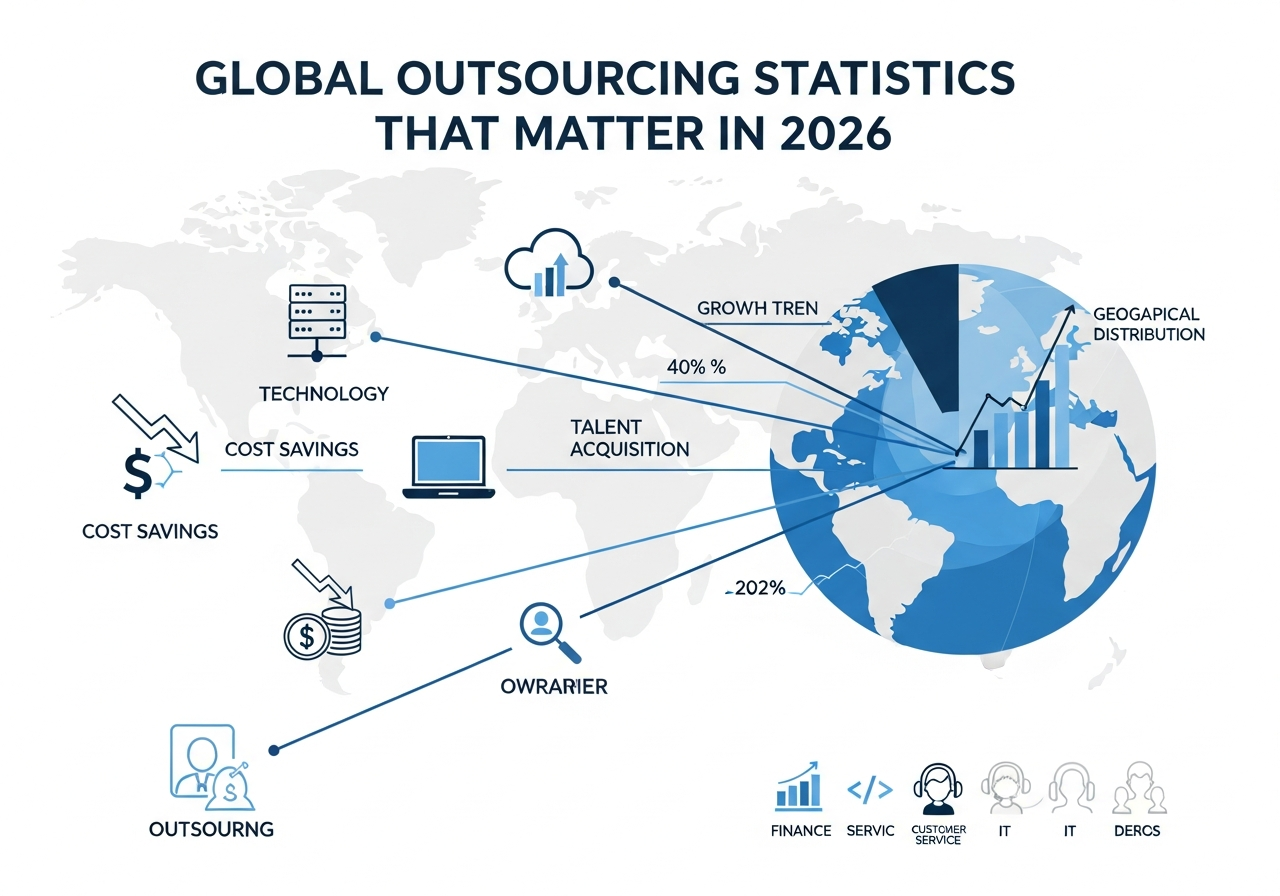
When looking at the data, outsourcing emerges as a direct solution to the challenges of rising costs and talent shortages. The global outsourcing market is valued at over $400 billion in 2025 and is expected to surpass $525 billion by 2030, proving that businesses worldwide are adopting it as a long-term strategy.


Cost savings are the leading driver. Nearly 59% of companies outsource primarily to reduce expenses, with many reporting savings of 30% to 60% depending on the service and region. For small businesses and startups, this reduction in overhead often means the difference between breaking even and scaling profitably.


Efficiency gains are equally powerful. Outsourcing allows companies to launch products up to 25% faster by delegating specialized tasks to skilled providers. Meanwhile, more than 80% of businesses globally report using outsourcing in some capacity, highlighting how widespread and normalized the practice has become.


These statistics show a clear pattern: outsourcing isn’t just about cutting costs. It’s a data-backed solution that helps businesses maintain growth, improve productivity, and gain access to specialized talent that may not be available locally.


Key Outsourcing Benefits Backed By Statistics


Regional Outsourcing Hubs

While outsourcing is a global practice, certain regions have emerged as the most influential players in 2025. Each hub brings unique strengths that make it attractive for businesses around the world.


  • India – India remains the global leader in IT outsourcing, handling more than 50% of the world’s IT services contracts. With a highly skilled workforce and competitive labor costs, the country continues to dominate in software development, cloud services, and cybersecurity. Its vast talent pool and strong English proficiency make India the go-to destination for tech outsourcing.


  • Philippines – The Philippines is a powerhouse in customer support and back-office services, where the BPO sector contributes nearly 9% of the country’s GDP. Over 1.3 million Filipinos are employed in call centers and administrative outsourcing roles. The Philippines is especially favored for its strong cultural alignment with Western clients and its large English-speaking workforce.


  • United States – While a large portion of U.S. companies outsource overseas, the U.S. itself is also a growing hub for nearshore outsourcing. More than half of American companies outsource at least one business function, reflecting how normalized the practice has become. The U.S. leads in outsourcing strategy, often blending offshore and local talent to balance cost and quality.


  • Emerging Regions – Countries in Latin America (such as Mexico, Brazil, and Colombia) and Eastern Europe (like Poland and Ukraine) are rapidly gaining traction. Latin America benefits from time zone alignment with North America, while Eastern Europe is renowned for its technical expertise. These regions are projected to see double-digit growth in outsourcing over the next five years as companies diversify away from traditional hubs.


These regional leaders prove that outsourcing is no longer concentrated in just one part of the world—it’s a global system of specialized talent pools that companies can tap into for growth and efficiency.


Global Outsourcing Market Share By Region (2025)


Stats on AI, Compliance, and Remote Teams

As the outsourcing industry evolves, new technologies and business priorities are shaping its future. The latest statistics reveal how companies are preparing to stay competitive through automation, compliance, and remote collaboration.

  • AI and Automation – Nearly 50% of businesses using outsourcing now integrate AI into their operations, whether through chatbots, automated payroll, or advanced analytics. Instead of replacing outsourcing, AI enhances it by allowing providers to handle higher volumes of work with greater speed and accuracy. This makes outsourcing both smarter and more scalable.


  • Compliance and Security – With data protection regulations like GDPR and HIPAA becoming stricter, compliance has become a key outsourcing driver. More than 60% of companies say data security is their top priority when selecting a provider. Outsourcing partners now invest heavily in encryption, audits, and certifications to meet global compliance standards.


  • Remote Teams – The rise of remote work has further fueled outsourcing adoption. Over 70% of businesses say outsourcing helps them manage distributed teams more effectively, especially when paired with digital collaboration platforms. This shift has blurred the lines between “in-house” and “outsourced,” creating a hybrid model where businesses can scale talent globally without borders.


These trends show that outsourcing is no longer just about saving money—it’s about staying resilient in an unpredictable global economy. Businesses that embrace AI, compliance, and remote-first strategies will be positioned to thrive long after 2025.

Future-Proofing Outsourcing Trends (2020–2025)

Key Takeaways for Businesses

Significant Cost Savings – Companies reduce operating costs by 30% to 60% through outsourcing, freeing resources to reinvest in growth. These savings allow businesses to allocate more budget toward innovation, marketing, or customer service improvements. For smaller firms, the ability to operate lean while competing with larger competitors can be a game-changer.


✔ Faster Time-to-Market – Businesses that outsource achieve up to a 25% quicker product launch, gaining an edge over competitors. By delegating repetitive or technical tasks to external specialists, internal teams can focus on strategy and innovation. This not only speeds up delivery but also improves overall quality by bringing in experienced professionals.


✔  Access to Specialized Talent – Outsourcing opens doors to skills not always available locally, from IT expertise to niche administrative support. Instead of struggling to recruit in tight labor markets, companies can tap into global pools of highly qualified professionals. This ensures they stay competitive with access to the best talent, no matter where it’s located.


✔  Scalability and Flexibility – Firms can scale teams up or down without the heavy costs of recruitment, training, or infrastructure. This flexibility allows businesses to handle seasonal spikes in demand or pivot quickly when priorities change. In today’s uncertain economy, the ability to scale without long-term commitments is a major advantage.


✔  Beyond Cost-Cutting – Modern outsourcing focuses on innovation, compliance, and technology integration, making it a long-term strategy, not a quick fix. Companies are increasingly outsourcing to access AI-driven solutions, maintain global compliance, and future-proof their operations. This shift proves outsourcing is no longer just about saving money—it’s about building resilience and staying ahead of change.


Why Stealth Agents is the Smarter Choice in 2025

With outsourcing demand growing worldwide, the challenge for business owners isn’t deciding whether to outsource, but who to trust. This is where Stealth Agents stands apart. Recognized by Forbes as a Top 2 virtual assistant service, Stealth Agents has become the go-to partner for companies seeking reliable, scalable, and high-quality outsourcing solutions.


Here’s why business owners choose Stealth Agents in 2025:


  • 10–15+ Years of Experience

Our executive assistants bring decades of combined expertise, ensuring that clients work with seasoned professionals who can handle complex tasks with confidence. This deep experience translates into smoother onboarding, fewer mistakes, and consistent quality from day one.


  • Dedicated Account Managers

Every client receives personalized support through an account manager who acts as the main point of contact. This ensures communication is clear, priorities are aligned, and projects stay on track without adding stress to your plate.


  • Top 1% Virtual Assistants

We carefully vet our team so only the most qualified professionals represent your business. By focusing on the top talent pool, we guarantee reliable, high-performance support that drives measurable results.


  • Cloud-Based Platform

Secure, streamlined systems make collaboration easy and efficient, no matter where you are in the world. From file sharing to task management, our platform ensures complete transparency and smooth workflows.


  • Proven Reputation

Backed by top reviews on Google and trusted by companies across multiple industries, Stealth Agents has built a reputation for delivering consistent, high-quality outcomes. Our clients regularly highlight our reliability, professionalism, and ability to scale with their needs.


Whether you need a single assistant to support daily operations or a team of 100+ to manage enterprise-level projects, Stealth Agents has the flexibility and scale to deliver. By combining top-tier talent, personalized management, and secure technology, we turn outsourcing statistics into real results for businesses ready to grow smarter in 2025.


Conclusion

The statistics prove what many business leaders already know—outsourcing has become one of the most powerful strategies in today’s economy. From significant cost savings to faster time-to-market and access to specialized talent, outsourcing is no longer a temporary fix but a core part of building sustainable growth. The global market continues to expand, fueled by innovation, compliance demands, and the rise of remote-first teams.


For business owners, the takeaway is simple: outsourcing is not just about reducing expenses—it’s about building agility, resilience, and long-term competitive advantage. The numbers show that companies embracing outsourcing in 2025 are better positioned to navigate challenges and seize opportunities in an uncertain global market.


If you’re ready to turn these insights into action, partnering with a trusted provider makes all the difference. Stealth Agents delivers the expertise, dedicated support, and scalable solutions that transform outsourcing from a strategy into a growth engine.


Frequently Asked Questions

Which industries benefit most from global outsourcing in 2025?

Industries like healthcare, financial services, manufacturing, and retail benefit the most. Healthcare outsources tasks like medical billing and telemedicine support. Financial services focus on outsourcing compliance and data handling. Manufacturing companies outsource quality checks and supply chain tasks. Retail businesses outsource inventory management and customer data analysis to stay competitive.


What are the biggest risks when outsourcing globally in 2025?

The main risks include data security problems, cultural differences, time zone issues, and relying too much on one vendor. Other risks are intellectual property theft, poor quality control, and communication challenges. Political problems in outsourcing regions and currency changes can also affect costs. To reduce risks, carefully check vendors, use clear contracts, and spread tasks across multiple providers.


How do small businesses start global outsourcing without large budgets?

Small businesses can start by outsourcing one task, like customer service or bookkeeping. They can use freelance platforms first and later switch to dedicated providers. Start small, with 10-20 hours a week, to test how it works. Focus on simple tasks like admin work before moving to more specialized jobs. Many providers offer flexible pricing and trial periods for small businesses.


What global outsourcing trends will dominate beyond 2025?

More companies will use a mix of outsourcing locations. Outsourcing with a focus on eco-friendly practices will grow. Blockchain technology will be used for clear contracts and payments, including cryptocurrency. Companies will also outsource small parts of projects (micro-outsourcing) and use pricing based on results instead of fixed fees.


How does global outsourcing impact local employment statistics?

Outsourcing can create local jobs in areas like management and client relations. While some jobs move overseas, companies often use the money they save to grow and create new jobs at home. The overall effect depends on the industry, with tech and service jobs often changing rather than disappearing.


What legal considerations affect global outsourcing contracts in 2025?

Laws like GDPR, rules about where data is stored, and international tax laws are important. Contracts should cover intellectual property rights, how disputes will be handled, and how to end the agreement. New rules about AI and moving data across borders also need to be included. It’s best to work with lawyers who know international outsourcing laws.


How do companies measure ROI from global outsourcing initiatives?

Companies measure success by looking at costs per task, quality of work, and how much faster things get done. They also track employee happiness, customer loyalty, and revenue growth linked to outsourcing. Other measures include fewer mistakes, better process efficiency, and meeting business goals. Regular reviews help ensure outsourcing is worth it.


What technology infrastructure is needed for successful global outsourcing?

Companies need cloud-based tools for managing projects, secure VPNs, and platforms for team collaboration. Video calls, time trackers, and file-sharing tools are also important. Strong cybersecurity, like multi-factor logins and encrypted communication, keeps data safe. APIs help connect outsourced tasks with a company’s internal systems.


How do cultural differences affect global outsourcing success rates?

Cultural differences can affect how people communicate, work, and meet deadlines. Success depends on training both sides to understand each other’s culture and setting clear communication rules. Planning for time zone differences and holidays is also important. Companies that focus on cultural understanding report better results from outsourcing.


What alternative outsourcing models exist beyond traditional offshore arrangements?

Nearshoring means outsourcing to nearby countries, which helps with time zones and cultural similarities. Onshoring keeps work within the same country but may use cheaper rural areas. Rightshoring uses a mix of locations to balance cost and quality. Crowdsourcing hires global talent for specific tasks. Captive centers are offshore teams that work only for one company.

Summarize This Article With AI :