
Virtual assistants are essential for many businesses today. They provide remote support services and handle sensitive data. They must protect client information security and privacy. These strategies can also further reduce the risks of hiring a virtual assistant.
#
Protecting client information is a top priority for virtual assistants. They take essential measures to safeguard sensitive data and keep it confidential.
Why Client Confidentiality Matters in Professional Settings
Maintaining client confidentiality is at the heart of professional integrity. When businesses—whether law firms, healthcare providers, or financial advisors—safeguard client information, they’re not just checking a box; they’re building and maintaining trust.
If confidential information is mishandled or leaked, the fallout can be severe. Think legal repercussions, lost business opportunities, and damaged reputations that can be difficult, if not impossible, to rebuild. Clients entrust sensitive details to professionals because they expect discretion as a given, not a nice-to-have.
Many professions, from doctors to accountants, are guided by strict ethical codes that prioritize confidentiality for precisely these reasons. Ultimately, protecting private client data doesn’t just uphold ethical standards—it’s a sound business strategy that helps secure long-term client relationships.
What Does Client Confidentiality Mean? #
Client confidentiality means keeping your clients’ private information, well… private. Whether someone’s outsourcing calendar management or trusting you with their latest project, their details shouldn’t wind up as watercooler fodder or, worse, somewhere in a Reddit thread. Think of it like Vegas rules: What happens between you and your client stays right there—unless the law says otherwise.
This isn’t just a good habit; it’s a professional must. From bank statements to medical reports and even the notes from an executive coaching session, these details should never be shared with outside parties without clear permission—or a proper legal request, usually from the likes of law enforcement agencies. So, whether you’re working with confidential contracts, therapy notes, or just someone’s pet’s name, treat that information like top-secret intel. These strategies can also further reduce the risks of hiring a virtual assistant.
Professions That Value Client Confidentiality #
Some industries are known for holding client confidentiality in the highest regard. Think of lawyers carefully guarding legal documents, doctors keeping patient health records private, and financial advisors making sure your account details never fall into the wrong hands. Other examples include therapists, who are bound by strict confidentiality agreements, and accountants, who handle personal and corporate financial information with the utmost discretion.
In each of these roles, confidentiality isn’t just a best practice—it’s the core of their profession and often enforced by laws and professional standards. The trust clients place in these experts relies on their consistent ability to safeguard sensitive information, reinforcing the importance of privacy across these fields.
#
Protecting client information is a top priority for virtual assistants. They take essential measures to safeguard sensitive data and keep it confidential.
Industry Regulations for Data Protection #
Several industry regulations play a crucial role in keeping client information safe. Frameworks like ISO 27001 and SOC-2 set foundational standards for how technology companies manage and secure data, ensuring that information is stored in protected environments and organizational controls are strictly maintained.
When it comes to more specialized fields—such as healthcare, legal, insurance, or accounting—regulations like HIPAA and PIPEDA step in to address specific privacy concerns. HIPAA (Health Insurance Portability and Accountability Act) is vital for anyone handling medical information in the United States. It requires that access to patient data be tightly restricted and mandates policies for safeguarding electronic records. Breaches or careless handling can result in serious consequences.
In Canada, PIPEDA (Personal Information Protection and Electronic Documents Act) sets the standards for how private-sector organizations collect, use, and disclose personal information during business activities. This law ensures that client data is treated according to its sensitivity, requiring proper security measures and clear accountability for protecting private information from unauthorized access.
Ultimately, these regulations help virtual assistants and businesses alike build trustworthy data practices by demanding ongoing evaluation and improvement of security protocols—helping keep confidential client information secure from threats and leaks.
Encryption #
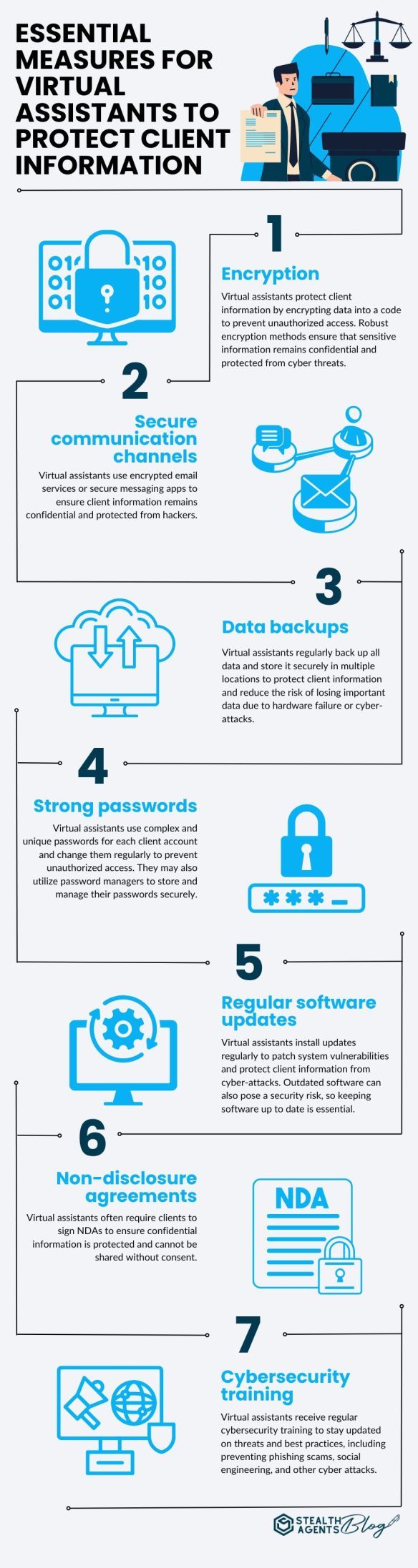
Virtual assistants protect client information by encrypting data into a code to prevent unauthorized access. Robust encryption methods ensure that sensitive information remains confidential and protected from cyber threats.
Secure communication channels #
To maintain the confidentiality of client information, virtual assistants use specific communication channels when exchanging sensitive data with their clients. Virtual assistants may utilize encrypted email services or secure messaging apps to ensure that any information shared remains private and cannot be intercepted by hacker apps.
Data backups #
Virtual assistants regularly back up all data and store it securely in multiple locations to protect client information and reduce the risk of losing important data due to hardware failure or cyber-attacks.
Strong passwords #
Virtual assistants use complex and unique passwords for each client account and change them regularly to prevent unauthorized access. They may also utilize password managers to store and manage their passwords securely.
Regular software updates #
Virtual assistants install updates regularly to patch system vulnerabilities and protect client information from cyber-attacks. Outdated software can also pose a security risk, so keeping software up to date is essential.
Non-disclosure agreements #
Many virtual assistants ask their clients to sign non-disclosure agreements (NDAs) to safeguard handling confidential information actively. These legal contracts guarantee that no third parties can share the client’s information without consent, ensuring data security.
Cybersecurity training #
Virtual assistants undergo regular cybersecurity training to stay updated on security threats and best practices for keeping client information safe. This also includes identifying and preventing phishing scams, social engineering attacks, and other cyber threats.
 #
#
Takeaways #
Virtual assistants play a critical role in keeping client information safe. It is part of their ethical values to ensure confidentiality and respect for intellectual property. They also use various methods such as encryption, secure communication channels, data backups, strong passwords, regular software updates, non-disclosure agreements, and cybersecurity training to ensure the security and privacy of their clients’ sensitive information.