

The outsourcing industry has reached new heights in 2025, with the global market valued at nearly USD 577 billion across IT, customer experience, business process outsourcing (BPO), and virtual assistant services. What was once viewed mainly as a cost-cutting strategy has transformed into a strategic growth driver for companies worldwide.
The statistics tell a clear story: outsourcing is no longer optional — it’s a competitive necessity. With adoption rates surpassing 70% of businesses globally, companies are using outsourced partners to scale faster, reduce overhead, and access specialized talent they can’t always find locally. From startups leveraging virtual assistants to Fortune 500 enterprises expanding IT and customer support operations, outsourcing is proving its potential as a cornerstone of global business.
In this article, we’ll dive into the most important outsourcing stats of 2025 — covering market size, adoption, regional growth hotspots, cost savings, and future forecasts. These numbers show not only the market’s strength today but also the immense potential it holds for the years ahead.
Global Market Size in 2025
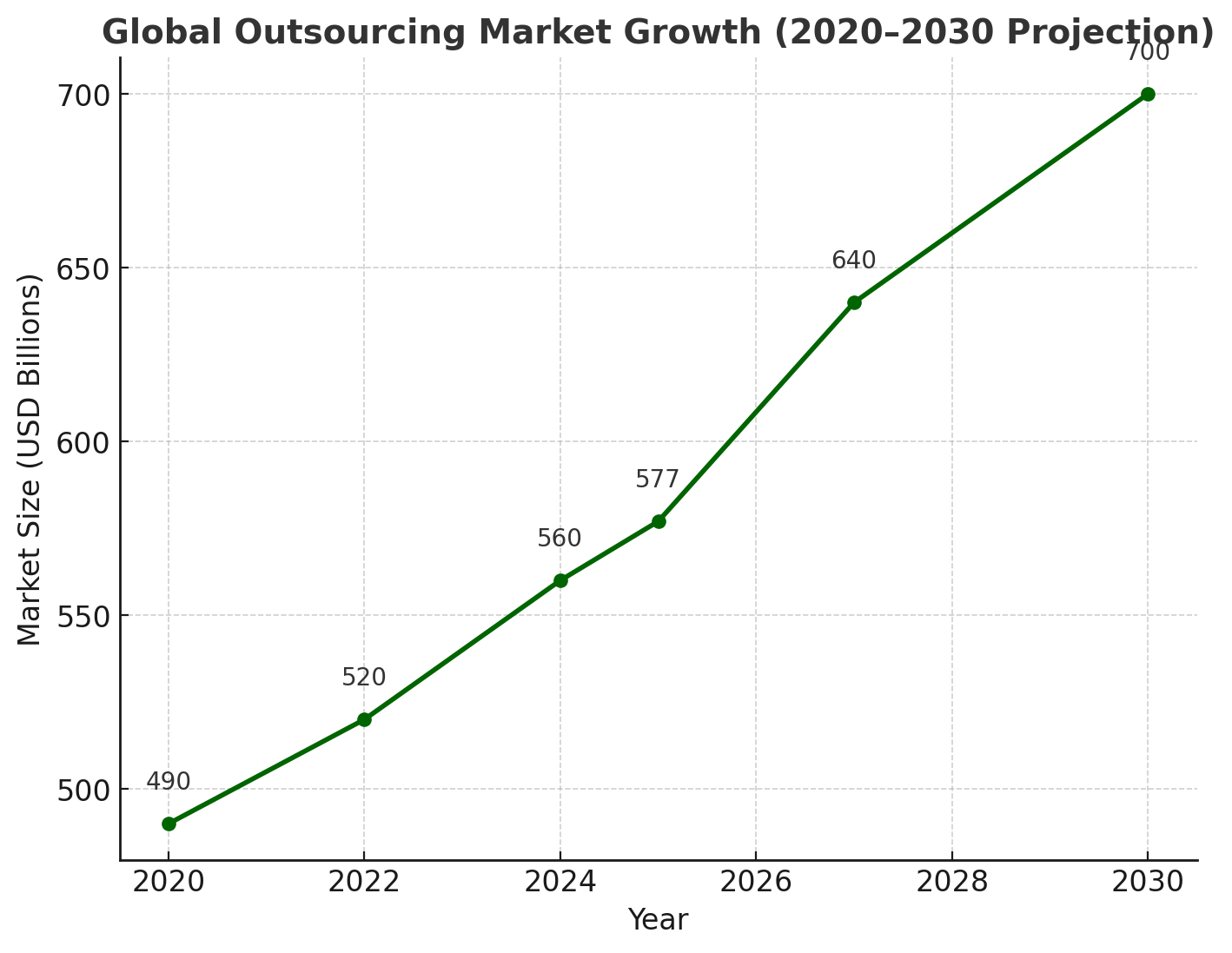
The global outsourcing market in 2025 is valued at an estimated USD 577 billion, reflecting steady growth over the past decade. This represents a rise from around USD 490 billion in 2020, with an average compound annual growth rate (CAGR) of 6–7% across all outsourcing segments.
Looking forward, the market shows even greater potential. Analysts project outsourcing will surpass USD 700 billion by 2030, with IT outsourcing accounting for nearly 60% of total spend, followed by business process outsourcing (BPO) and customer experience (CX) outsourcing. The expansion is driven by companies under pressure to reduce costs, adopt digital-first strategies, and gain access to specialized global talent.
This sustained momentum underscores a key fact: outsourcing is not a short-term solution tied to economic cycles — it is now a structural component of global business strategy, supporting innovation, scalability, and long-term competitiveness.
Outsourcing Adoption Rates
Outsourcing adoption has reached record levels in 2025. Studies show that over 70% of companies worldwide outsource at least one business function, whether IT, customer support, finance, or administrative services. This widespread reliance highlights how outsourcing has shifted from a tactical cost-saving measure to a core operational strategy.
Among small and medium-sized businesses (SMBs), adoption rates are even higher, with nearly 80% of SMBs reporting they use outsourced services. For these companies, outsourcing provides access to specialized skills and scalability that would otherwise be out of reach. Larger enterprises, meanwhile, are increasingly outsourcing not only non-core functions but also advanced services like IT security, analytics, and cloud infrastructure management.
The most commonly outsourced functions in 2025 include:
-
IT outsourcing, which accounts for nearly 60% of all outsourcing spend.
-
Customer experience (CX) outsourcing, valued at around USD 110 billion.
-
HR and payroll outsourcing, adopted by over 40% of enterprises.
-
Virtual assistant outsourcing, used by 65% of SMBs to streamline admin and marketing tasks.
These adoption patterns underscore one fact: outsourcing is no longer a side strategy. It has become a mainstream practice that underpins global competitiveness across industries and business sizes.
Regional Growth Hotspots
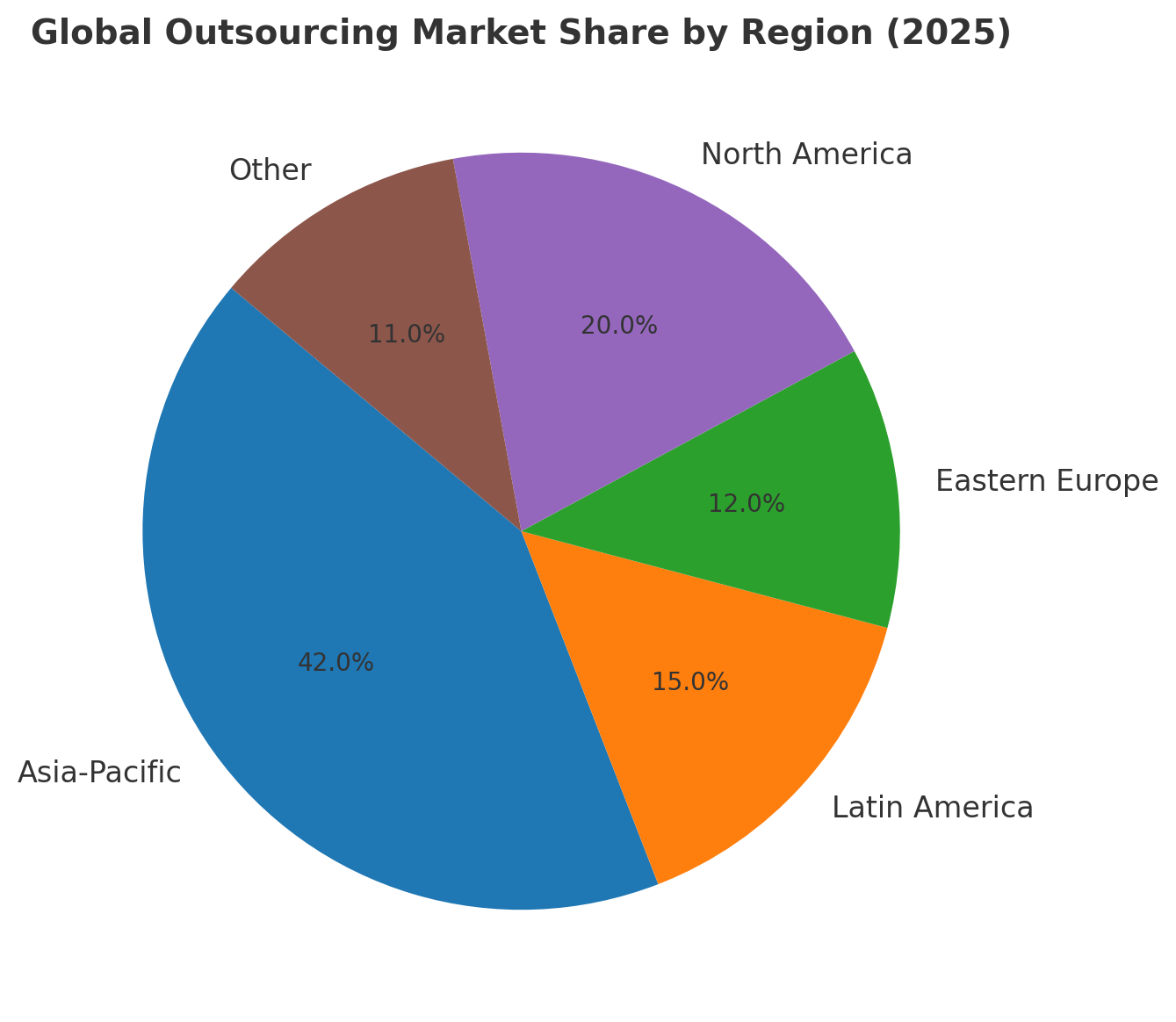
The outsourcing market in 2025 is truly global, but certain regions dominate due to their scale, talent pools, and cost advantages.
-
Asia-Pacific (APAC)
APAC continues to be the largest outsourcing hub, accounting for more than 40% of the global market share. The Philippines leads in customer support and virtual assistant outsourcing, with a workforce of over 1.3 million BPO employees, while India remains dominant in IT outsourcing and technical services. Together, these countries form the backbone of global outsourcing services.
-
Latin America
Nearshore outsourcing in Latin America is growing at a double-digit CAGR, driven by demand from U.S.-based businesses. Countries like Mexico, Colombia, and Costa Rica are top destinations, offering time zone alignment, bilingual (Spanish-English) support, and competitive rates. This makes LATAM especially strong in customer support and e-commerce outsourcing.
-
Eastern Europe
Eastern Europe has become a prime outsourcing hub for Western Europe. Nations like Poland, Romania, and Ukraine are gaining traction thanks to their multilingual talent pools (German, French, Russian, English) and expertise in IT and financial services outsourcing. Growth in this region is projected at 8–10% CAGR through 2030.
-
North America
While North America is primarily an outsourcing buyer, it is also emerging as a nearshore hub, particularly for Canada and U.S.-based providers offering specialized services like high-security IT management and onshore call center support. This trend reflects companies balancing offshore cost savings with domestic compliance needs.
Technology & Automation in Outsourcing
Technology has become the driving force behind outsourcing in 2025. No longer just about cost savings, outsourcing now delivers digital transformation at scale.
One of the most significant shifts is the adoption of AI and automation. Studies show that over 80% of outsourcing providers now use generative AI tools to streamline operations, whether in IT support, customer service, or HR management. AI-powered chatbots handle up to 30% of customer inquiries, reducing response times and cutting service costs by as much as 40%.
Cloud adoption is another critical factor. More than 85% of outsourcing firms rely on cloud-based platforms to manage client operations, ensure data security, and provide real-time reporting. This move to the cloud has enabled outsourcing providers to scale faster and deliver services seamlessly across geographies.
Analytics and big data tools are also central to outsourcing in 2025. Providers use speech analytics, predictive modeling, and sentiment analysis to deliver actionable insights from customer interactions, turning outsourced operations into intelligence centers that guide client strategies.
The takeaway: outsourcing providers that embrace AI, automation, cloud platforms, and analytics are not just delivering tasks — they’re helping clients innovate, stay competitive, and achieve measurable ROI.
Industry-Specific Outsourcing Potential
The outsourcing market in 2025 is increasingly being defined by industry-specific solutions. Rather than offering generic services, providers are tailoring their expertise to the unique needs of different verticals.
✔ Information Technology (IT)
IT outsourcing remains the largest segment, accounting for nearly 60% of global outsourcing spend. Services include software development, cloud management, cybersecurity, and infrastructure support. With businesses under pressure to digitize, IT outsourcing is projected to grow at a CAGR of 8% through 2030, reaching hundreds of billions in value.
✔ Customer Experience (CX)
CX outsourcing is now valued at approximately USD 110 billion in 2025. Companies across e-commerce, telecom, and financial services are increasingly relying on outsourced providers to deliver 24/7, multilingual, omnichannel support. With 60% of firms citing CSAT as their top performance metric, CX outsourcing is becoming a frontline driver of customer loyalty.
✔ Healthcare
The healthcare outsourcing sector is experiencing a 7% CAGR through 2030. Providers manage patient scheduling, insurance claims, and billing, with compliance to HIPAA and GDPR being non-negotiable. With rising patient loads and administrative complexity, healthcare outsourcing has become an essential strategy for hospitals and private practices alike.
✔ E-Commerce
E-commerce outsourcing is booming, with up to 70% of mid-to-large retailers outsourcing at least one function such as product listing, order tracking, refunds, and digital marketing. Seasonal surges, like Black Friday, drive additional demand, making e-commerce one of the most dynamic growth areas in outsourcing.
Key Risks & Challenges
While the 2025 outsourcing stats highlight massive potential, businesses must also weigh the challenges that come with relying on external providers.
🚩 High Turnover & Retention Issues
Call centers and outsourcing firms still face 30–45% annual attrition rates, which can disrupt service quality and increase retraining costs. Although remote and hybrid work models are helping reduce turnover, retention remains a significant industry challenge.
🚩 Data Security & Compliance
With sensitive customer and financial data at stake, 21% of companies report third-party data breaches linked to outsourcing providers. Compliance with global standards like GDPR, HIPAA, and PCI-DSS is now one of the top vendor selection criteria.
🚩 Service Quality & Consistency
A major concern for 40% of outsourcing clients is inconsistent service delivery. Variations in training, cultural alignment, and oversight often lead to fluctuating customer experiences, making strict SLAs (Service Level Agreements) crucial.
🚩 Communication & Time Zone Barriers
Although collaboration tools have improved communication, 29% of businesses still face challenges coordinating with offshore teams due to time zone gaps and cultural differences. This is a key reason why nearshore outsourcing in Latin America and Eastern Europe is seeing double-digit growth.
🚩 Over-Reliance on Vendors
For some SMBs, outsourcing becomes the backbone of operations. However, 15% of businesses report negative impacts when vendors fail to deliver, highlighting the need to diversify providers and build contingency plans.
Stealth Agents: Unlocking Market Potential
Amidst the growth and challenges of the outsourcing industry in 2025, businesses are looking for partners that offer scalability, compliance, and proven expertise. This is where Stealth Agents continues to stand out as one of the most trusted outsourcing providers worldwide.
Ranked by Forbes in 2025 as the #2 outsourcing company, Stealth Agents combines global talent with tailored solutions to help businesses of all sizes capture the true potential of outsourcing.
Why businesses choose Stealth Agents:
-
Experienced Professionals: Stealth Agents’ workforce includes VAs, call center agents, and specialists with 10–15+ years of expertise, ensuring high-quality results.
-
Dedicated Account Managers: Every client is assigned a personal account manager who oversees onboarding, performance, and quality assurance.
-
Scalable Teams: Businesses can start with a single VA and scale to 50–100+ agents quickly, making growth seamless.
-
Proven Results: With a 95% client satisfaction rate and average cost savings of 40–60%, Stealth Agents delivers measurable ROI.
-
Secure & Compliant: Operating on a cloud-based platform aligned with HIPAA, GDPR, and PCI-DSS, Stealth Agents ensures data security and compliance for sensitive industries.
Conclusion
The outsourcing industry in 2025 proves itself to be more than a cost-cutting measure — it is a strategic driver of growth and innovation. With the global market valued at USD 577 billion and projected to surpass USD 700 billion by 2030, the statistics reveal massive potential for businesses that leverage outsourcing effectively.
From IT and CX to healthcare and e-commerce, outsourcing is reshaping how companies operate, providing 40–60% cost savings, faster scalability, and access to world-class talent. At the same time, challenges such as data security, turnover, and quality control remind business leaders to choose providers that prioritize compliance and long-term performance.
For companies ready to unlock this potential, Stealth Agents stands out as a proven partner. With Forbes recognition, experienced professionals, and secure, scalable solutions, Stealth Agents helps businesses harness outsourcing not just for savings, but for sustainable growth and competitive advantage.
The numbers don’t lie — outsourcing in 2025 isn’t just about the present. It’s about the market potential that will define the future of business worldwide.
Frequently Asked Questions
Which countries have the highest outsourcing growth rates in 2025?
Vietnam, Bangladesh, and Ukraine are growing the fastest in outsourcing, with yearly increases of 15-20%. These countries offer low costs and growing numbers of English-speaking workers. India and the Philippines continue steady growth at 8-12%, while African countries like Kenya and Ghana are emerging with over 25% growth rates.
What percentage of Fortune 500 companies use outsourcing services?
In 2025, about 92% of Fortune 500 companies use outsourcing services. These large companies often outsource 3-5 business functions, with IT, cybersecurity, and data analytics being the most common. This shows that outsourcing is a key part of their operations, not just a way to save money.
How much can startups save annually by outsourcing instead of hiring full-time employees?
Startups can save $75,000-$150,000 per year for each role they outsource instead of hiring full-time U.S. employees. These savings come from avoiding costs like salaries, benefits, office space, and training. Outsourcing tasks like customer support, accounting, and marketing helps startups access expert help while keeping costs low.
What are the fastest-growing outsourcing services in 2025?
The fastest-growing services in 2025 include AI-powered customer support, cybersecurity monitoring, and digital marketing automation, growing 20-25% each year. Social media management, content creation, and e-commerce support are also growing quickly as businesses focus on improving their online presence and sales.
Which industries are least likely to use outsourcing?
Government agencies, defense contractors, and highly regulated financial companies are the least likely to outsource, with adoption rates of 35-45%. These industries face strict rules about security and data handling, which limit outsourcing options. However, some are starting to use domestic outsourcing that meets their strict requirements.
What is the average contract length for outsourcing partnerships in 2025?
Most outsourcing contracts last 2-3 years, with options to adjust services or renew based on performance. Short-term contracts (6-12 months) are common for one-time projects, while long-term partnerships can last 5+ years. Contracts are now more flexible, allowing businesses to make changes without major renegotiations.
How has remote work affected global outsourcing demand?
Remote work has increased outsourcing demand by 40% since 2020. Companies are now more comfortable managing teams in different locations and using virtual tools. This has opened up a larger talent pool and made offshore outsourcing more common, even in industries that used to prefer in-house teams.
What qualifications do outsourcing professionals typically have?
Most outsourcing workers have a bachelor’s degree (75%) and certifications in their field. IT workers often have programming certifications, while customer service staff complete specific training programs. High-level professionals usually have 10+ years of experience and advanced degrees. Language skills, cultural knowledge, and industry expertise are also important.
Which outsourcing models deliver the highest ROI for businesses?
Dedicated team models provide the best returns, saving businesses 65-80% compared to in-house teams. This model offers consistent quality and easier communication. Project-based outsourcing is good for quick tasks but offers less long-term value. Hybrid models, which mix onshore and offshore teams, balance cost savings with better communication.
What backup plans do companies use for outsourcing failures?
Companies often work with 2-3 outsourcing providers to reduce risks. Backup plans include training internal staff to handle tasks, keeping relationships with other vendors, and having gradual transitions when switching providers. Contracts usually include penalties for poor service and guarantees for quick replacements to avoid disruptions.