Accounts payable virtual assistant services from Stealth Agents help you manage invoices, vendor payments, and reconciliations effortlessly—saving you time, reducing errors, and ensuring on-time payments. Let Stealth Agents streamline your AP process with expert VAs so you can focus on growing your business, not chasing bills.
By bringing on an accounts payable virtual assistant, businesses can cut operating costs by up to 78% while benefiting from the increased productivity remote workers are known to deliver. Beyond the numbers, hiring virtual assistants enables companies to refocus on their key priorities rather than getting bogged down in administrative tasks.
Stealth Agents, a top choice for outsourcing services, connects businesses with skilled virtual assistants tailored to their specific needs. Whether you’re curious about virtual assistant pricing or ready to hire, we’re here to help. With a free consultation, you’ll gain insight into how a virtual assistant can reshape your day-to-day operations for the better. Schedule your consultation today and discover a more innovative way to manage your accounts payable.
If you’re weighing your options between in-house accounts payable staff and virtual assistants, it’s crucial to consider several factors—supervision, collaboration, flexibility, and cost—that impact day-to-day efficiency as well as your bottom line.
What Is an Accounts Payable Virtual Assistant?
Simply put, an accounts payable virtual assistant is your remote right-hand for everything to do with bills and bookkeeping—minus the caffeine runs or desk clutter.
These detail-savvy professionals work from afar to keep your AP process running smoother than a freshly printed invoice.
With expertise in managing tasks like invoice handling, vendor payments, and financial reconciliations, an accounts payable VA steps in to bring order to the chaos.
They deftly process invoices, answer vendor questions, and keep payment records up to date, all while ensuring no late charges or surprise fees rain on your cash flow parade.
Key things an accounts payable virtual assistant can tackle include:
- Sorting, validating, and processing invoices so nothing falls through the cracks
- Responding to vendor inquiries and maintaining great supplier relationships
- Managing expense reports and reconciling financial records
- Leveraging accounting software (like QuickBooks, Xero, or FreshBooks) to ensure data is accurate and easily accessible
What are the responsibilities of an accounts payable virtual assistant?
Hiring an accounts payable virtual assistant can work wonders for your business by relieving the financial headaches of day-to-day operations. Whether it’s managing invoices or ensuring timely vendor payments, top-notch accounts payable services help keep your business running smoothly without a hitch. Here’s how a finance virtual assistant can support you every step of the way.
1. Processing Invoices
A seamless accounts payable process starts with accurate and organized invoice handling. Your virtual assistant receives invoices, verifies them against purchase orders or delivery receipts, and checks that every detail matches the agreement to avoid costly errors. They guarantee that all invoices are accurately recorded and paid on time by incorporating verified invoices into your bookkeeping system, thereby maintaining the reliability of your records and the stability of your cash flow.
2. Managing Vendor Payments
Paying vendors doesn’t have to be a headache when you have a virtual assistant to handle it. They establish schedules within the accounts payable process to guarantee that payments are made promptly, thereby preserving positive vendor relationships. Beyond scheduling payments, they communicate directly with vendors to address concerns and confirm timelines, helping you maintain trust and avoid disputes. Virtual assistants for vendor management also ensure that all vendor interactions are documented and organized, creating a smoother and more efficient workflow for your business.
3. Reconciling Accounts
Regular reconciliation is essential to avoid discrepancies, and accounts payable support specialists excel in this area. By comparing your accounts payable process records with vendor statements, you can resolve mismatches and ensure that every transaction is logged correctly. These endeavors generate precise accountancy records that offer a comprehensive understanding of your financial situation, thereby preventing costly errors or fraudulent activities.
4. Maintaining Financial Records
Organized financial records are crucial for running your business smoothly, and that’s where a virtual finance assistant excels. They handle your documents, including invoices, receipts, and vendor communications, ensuring everything is easily searchable and secure. With these well-maintained records, audits, financial reporting, and planning, you can take your next steps with confidence.
5. Ensuring Compliance with Policies
A skilled accounts payable virtual assistant ensures your business stays aligned with its financial policies and industry regulations. They handle invoice approvals and payment processes with meticulous attention to detail, minimizing the risk of non-compliance within your accounts payable services. By staying up to date on rules and regulations, you protect yourself from fines, mistakes, or legal issues.
6. Tracking Accounts Receivable
Your hired accounts receivable virtual assistant doesn’t just help with payables; they also keep your income on track. They monitor accounts receivable, ensuring clients make timely payments by sending reminders and follow-ups. This boosts your cash flow and ensures you never miss out on what’s owed to your business.
7. Preparing Financial Reports
Making sense of your numbers can feel overwhelming, but an accounts payable support specialist simplifies it by creating clear, easy-to-understand reports. From cash flow breakdowns to profit-and-loss statements, they transform complicated data into insights you can use to make smarter decisions. Transparency and clarity mean you’ll always know where your business stands.
8. Setting Up Payment Systems
A virtual assistant streamlines your accounts payable process by establishing efficient digital payment systems. They research tools that simplify your workflows, ensuring payments and records are managed securely and effortlessly. With their help, you’ll spend less time processing payments and more time growing your business.
If your business is ready for smoother workflows, better organization, and less financial stress, consider what an accounts payable virtual assistant can do for you. Start taking control of your finances today!
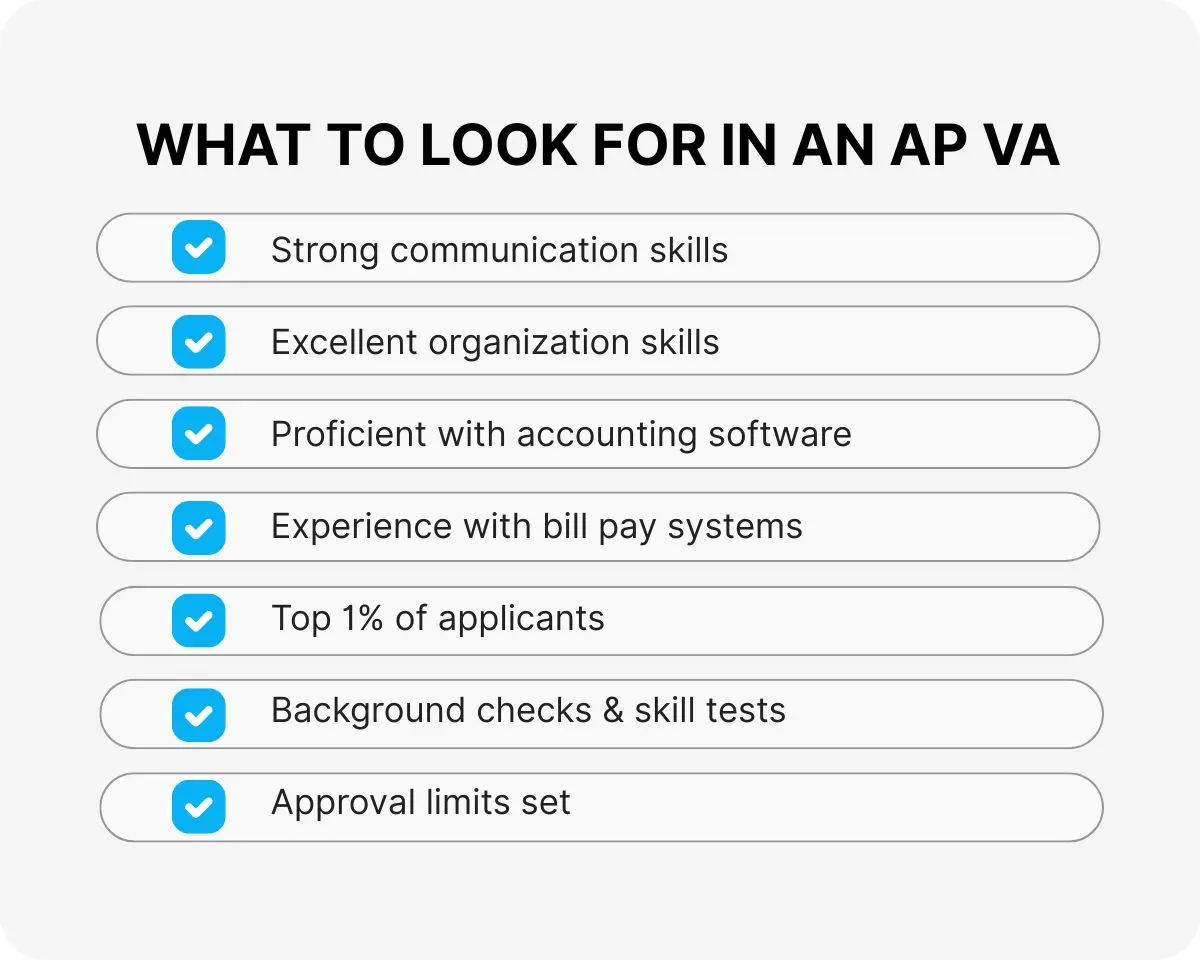
Why Are Communication, Organization, Problem-Solving, Financial Acumen, and Tech Savvy Essential?
When assessing the right accounts payable virtual assistant for your business, it’s not just about technical skill—it’s about mastering the essentials that keep your finances tidy and your team running like a well-oiled machine. Here’s why these qualities matter:
- Clear Communication: Timely, crystal-clear communication is the backbone of great accounts payable support. Whether liaising with vendors about payment status or coordinating internally, a virtual assistant who communicates effectively helps prevent misunderstandings, missed deadlines, and costly errors. You’ll always know where things stand—no decoding required.
- Organizational Wizardry: Handling invoices, receipts, and vendor documentation takes next-level organization. An accounts payable virtual assistant with sharp organizational skills keeps your digital and physical records streamlined. They make sure files are accessible at a moment’s notice, reducing time spent searching for information and helping you breeze through audits or financial reviews.
- Resourceful Problem-Solving: No matter how tight your process is, the occasional hiccup (like a duplicate invoice or a missing receipt) will pop up. A problem-solver doesn’t panic—they roll up their sleeves and hunt down solutions. This means less disruption to your cash flow and the reassurance that any obstacles will be handled quickly and quietly.
- Financial Accuracy: Your business relies on accurate numbers to thrive. A detail-oriented virtual assistant ensures every transaction is precise, catching discrepancies before they balloon into bigger issues. This attention to detail is your safeguard against fraud, overpayments, or costly mistakes that could affect your bottom line.
- Accounting Software Know-How: Today’s financial operations move at the speed of technology. A virtual assistant experienced with tools like QuickBooks, Xero, or SAP can automate recurring payments, reconcile accounts faster, and reduce manual data entry. They’re not just keeping up—they’re actively making your workflow more efficient.
What Experience Should I Look For in an Accounts Payable Virtual Assistant?
Selecting the right accounts payable virtual assistant can have a significant impact on the efficiency and financial organization of your business. A skilled virtual assistant will handle payments, records, and systems with accuracy and care, freeing you to focus on growth. Here are seven key experiences to look for when hiring an expert in accounts payable services.
Why Are Communication, Organization, Problem-Solving, Financial Acumen, and Tech Savvy Essential?
When assessing the right accounts payable virtual assistant for your business, it’s not just about technical skill—it’s about mastering the essentials that keep your finances tidy and your team running like a well-oiled machine.
Here’s why these qualities matter:
- Clear Communication: Timely, crystal-clear communication is the backbone of great accounts payable support. Whether liaising with vendors about payment status or coordinating internally, a virtual assistant who communicates effectively helps prevent misunderstandings, missed deadlines, and costly errors. You’ll always know where things stand—no decoding required.
- Organizational Wizardry: Handling invoices, receipts, and vendor documentation takes next-level organization. An accounts payable virtual assistant with sharp organizational skills keeps your digital and physical records streamlined. They make sure files are accessible at a moment’s notice, reducing time spent searching for information and helping you breeze through audits or financial reviews.
- Resourceful Problem-Solving: No matter how tight your process is, the occasional hiccup (like a duplicate invoice or a missing receipt) will pop up. A problem-solver doesn’t panic—they roll up their sleeves and hunt down solutions. This means less disruption to your cash flow and the reassurance that any obstacles will be handled quickly and quietly.
- Financial Accuracy: Your business relies on accurate numbers to thrive. A detail-oriented virtual assistant ensures every transaction is precise, catching discrepancies before they balloon into bigger issues. This attention to detail is your safeguard against fraud, overpayments, or costly mistakes that could affect your bottom line.
- Accounting Software Know-How: Today’s financial operations move at the speed of technology. A virtual assistant experienced with tools like QuickBooks, Xero, or SAP can automate recurring payments, reconcile accounts faster, and reduce manual data entry. They’re not just keeping up—they’re actively making your workflow more efficient.
1. Strong Understanding of the Accounts Payable Process
Seek an individual who has direct experience overseeing the accounts payable process from inception to completion. They should be skilled at handling invoices, making timely payments, and troubleshooting vendor issues. This ensures everything flows smoothly, preventing late fees and keeping your vendors happy.
2. Expertise in Bookkeeping
Your accounts payable virtual assistant should also be well-versed in bookkeeping to ensure that financial records are accurate and up-to-date. They must accurately track every expense, reconcile bank statements, and ensure that the company’s books are well-organized and precise. This accuracy is critical for making wise financial decisions and preparing for tax season.
3. Experience with Accounts Receivable
Someone who understands both accounts payable and accounts receivable will be a valuable asset. They can help track client payments, send reminders, and manage outstanding balances effectively. Keep your business’s cash flow in a healthy state by maintaining a balance between accounts receivable and accounts payable.
4. Problem-Solving in Vendor Communication
An experienced accounts payable support specialist knows how to resolve disputes with vendors. Whether it’s a missing invoice or an incorrect charge, they’ll communicate clearly and professionally to fix the issue. This experience will save you time and build better vendor relationships.
5. Knowledge of Financial Systems
Your virtual assistant should have experience with popular accounting tools, such as QuickBooks or Xero, as well as systems designed explicitly for the accounts payable process. They will know how to set up and optimize these platforms to make payment tracking and bookkeeping easier. Familiarity with these systems ensures they can get started quickly with minimal training.
6. Accuracy in Financial Reporting
A reliable accounts payable virtual assistant knows how to prepare clear financial reports. They should provide statements that display your expenses, cash flow, and vendor payment history in a way that is easy to understand. These reports help you monitor your financial well-being and track the allocation of your funds.
7. Adherence to Compliance and Policies
Ensuring that financial policies and regulations are adhered to is a crucial aspect of the job. Your accounts payable virtual assistant should have experience adhering to company policies and any industry-specific standards to avoid legal issues. Their attention to compliance protects your business from unnecessary risks.
8. Track Record of Timely Payments
Ultimately, you need someone with a proven track record of meeting payment deadlines accurately and on time. Select a virtual assistant who is adept at adhering to schedules and prioritizing tasks, as late payments can harm your reputation and result in additional fees. Their ability to stay on top of deadlines will ensure that your financial operations remain smooth and stress-free.
By hiring an accounts payable virtual assistant with these experiences, you’ll bring stability and efficiency to your financial operations. If you want to take the hassle out of managing payments and records, start your search today and find the perfect assistant for your needs!
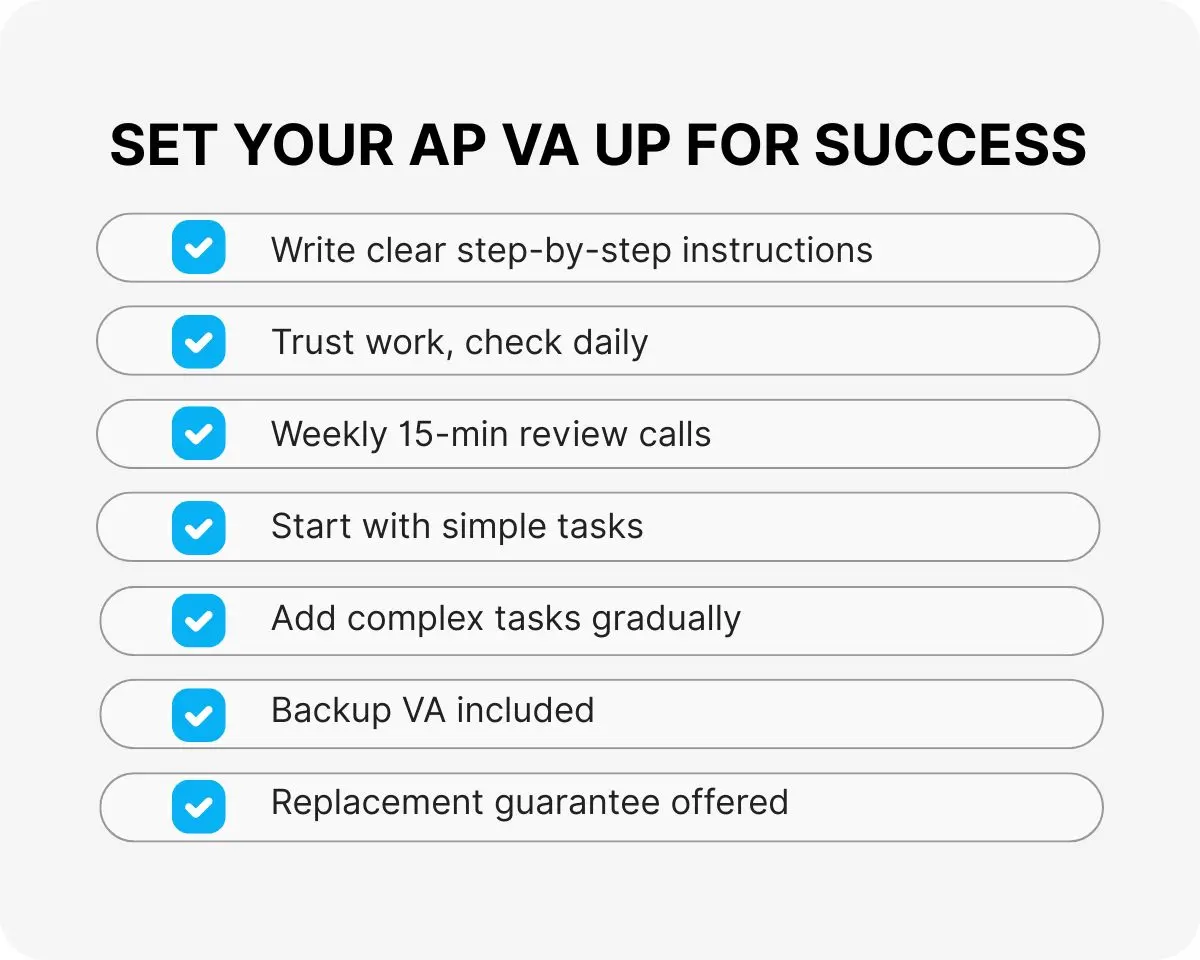
Best Practices for Working with an Accounts Payable Virtual Assistant
Bringing an accounts payable virtual assistant on board is just the beginning—setting them (and your business) up for success requires a thoughtful approach.
Here are some essential best practices to help you make the most of this working relationship:
1. Foster Clear Communication
Kick things off by establishing open and reliable communication with your virtual assistant. Lay out your expectations—from response times to preferred contact methods (Slack, email, smoke signals—okay, maybe not those). This clarity helps keep everyone on the same page and prevents costly misunderstandings down the line.
2. Invest in Thorough Onboarding
Take the time to walk your assistant through your accounting software (think QuickBooks, Xero, or whichever platform you love), introduce them to your team’s workflow, and explain your company’s unique processes. The more context they have upfront, the better equipped they’ll be to represent your business seamlessly.
3. Create Documented Procedures
Draft clear, step-by-step guides for your core accounts payable tasks—like processing vendor invoices, reconciling payments, or sorting out month-end reports. These checklists and written SOPs act as a safety net, ensuring consistency even if your systems or team members change.
4. Prioritize and Organize Tasks
Clearly articulate which tasks need immediate attention and which can wait. Prioritization helps your assistant focus on deadlines, like urgent vendor payments, avoiding late fees and keeping those all-important relationships in good standing.
5. Schedule Regular Check-Ins
Don’t just assign tasks and vanish. Schedule weekly or biweekly check-ins to review progress, discuss any challenges, and share feedback. These meetings are your opportunity to realign goals, fine-tune processes, and celebrate successes (big or small).
6. Track Performance and Results
Set specific benchmarks—such as invoice turnaround times, reconciliation accuracy, or error rates—to measure your assistant’s performance. Tracking these metrics will highlight strengths and spotlight areas for improvement, helping you refine your workflow together.
By implementing these best practices, you’ll empower your accounts payable virtual assistant to deliver maximum value, streamline your payment processes, and maintain top-notch financial hygiene for your business.
How to Maximize the Effectiveness of Your Accounts Payable Virtual Assistant
A great accounts payable virtual assistant comes with a toolkit of impressive skills, but even the most talented professional can only shine with the right structure in place. If you’re looking to make the most of your assistant’s expertise, focus on establishing solid processes and open lines of communication.
Emphasize Clear Communication
Start by fostering transparent and direct communication. Set expectations for response times, preferred communication channels (whether that’s email, Slack, or old-fashioned phone calls), and how updates should be shared. This avoids confusion, ensures everyone stays on the same page, and supports a smooth workflow.
Provide Strong Onboarding
Don’t toss your assistant the keys and hope for the best. Invest time upfront with onboarding: walk them through your accounting software (from QuickBooks to Xero), explain your preferred financial protocols, and share any quirks unique to your business. Think of this as laying groundwork—they’ll work more confidently and independently when they know exactly how things are done.
Create Standard Operating Procedures (SOPs)
Solid Standard Operating Procedures (SOPs) are your safety net. By documenting recurring tasks—think invoice entry, payment approvals, or reconciliations—you make sure everything is done consistently, no matter who’s handling it. SOPs reduce errors, save time, and help your virtual assistant hit the ground running when new tasks arise.
Prioritize and Organize Tasks
Be clear about which tasks should take priority and outline deadlines for each. Distinguishing between “urgent” vendor payments and routine data entry keeps your assistant focused on what really matters—because paying your landlord late is never a laugh.
Regular Check-Ins For Feedback and Alignment
Schedule quick catch-up calls or send weekly roundup emails. These check-ins are an opportunity to review work, address any questions, and course-correct if needed. Regular feedback helps your assistant grow and keeps everyone aligned with your business needs.
Track Performance with the Right Metrics
Put performance metrics in play. Monitor things like invoice processing times, error rates, and vendor satisfaction. Not only do these numbers help you gauge the assistant’s impact, but they also highlight opportunities for further improvement.
Best Practices for Working with an Accounts Payable Virtual Assistant
Bringing an accounts payable virtual assistant on board is just the beginning—setting them (and your business) up for success requires a thoughtful approach. Here are some essential best practices to help you make the most of this working relationship:
1. Foster Clear Communication
Kick things off by establishing open and reliable communication with your virtual assistant. Lay out your expectations—from response times to preferred contact methods (Slack, email, smoke signals—okay, maybe not those). This clarity helps keep everyone on the same page and prevents costly misunderstandings down the line.
2. Invest in Thorough Onboarding
Take the time to walk your assistant through your accounting software (think QuickBooks, Xero, or whichever platform you love), introduce them to your team’s workflow, and explain your company’s unique processes. The more context they have upfront, the better equipped they’ll be to represent your business seamlessly.
3. Create Documented Procedures
Draft clear, step-by-step guides for your core accounts payable tasks—like processing vendor invoices, reconciling payments, or sorting out month-end reports. These checklists and written SOPs act as a safety net, ensuring consistency even if your systems or team members change.
4. Prioritize and Organize Tasks
Clearly articulate which tasks need immediate attention and which can wait. Prioritization helps your assistant focus on deadlines, like urgent vendor payments, avoiding late fees and keeping those all-important relationships in good standing.
5. Schedule Regular Check-Ins
Don’t just assign tasks and vanish. Schedule weekly or biweekly check-ins to review progress, discuss any challenges, and share feedback. These meetings are your opportunity to realign goals, fine-tune processes, and celebrate successes (big or small).
6. Track Performance and Results
Set specific benchmarks—such as invoice turnaround times, reconciliation accuracy, or error rates—to measure your assistant’s performance. Tracking these metrics will highlight strengths and spotlight areas for improvement, helping you refine your workflow together.
By implementing these best practices, you’ll empower your accounts payable virtual assistant to deliver maximum value, streamline your payment processes, and maintain top-notch financial hygiene for your business.
How to Maximize the Effectiveness of Your Accounts Payable Virtual Assistant
A great accounts payable virtual assistant comes with a toolkit of impressive skills, but even the most talented professional can only shine with the right structure in place. If you’re looking to make the most of your assistant’s expertise, focus on establishing solid processes and open lines of communication.
Emphasize Clear Communication
Start by fostering transparent and direct communication. Set expectations for response times, preferred communication channels (whether that’s email, Slack, or old-fashioned phone calls), and how updates should be shared. This avoids confusion, ensures everyone stays on the same page, and supports a smooth workflow.
Provide Strong Onboarding
Don’t toss your assistant the keys and hope for the best. Invest time upfront with onboarding: walk them through your accounting software (from QuickBooks to Xero), explain your preferred financial protocols, and share any quirks unique to your business. Think of this as laying groundwork—they’ll work more confidently and independently when they know exactly how things are done.
Create Standard Operating Procedures (SOPs)
Solid Standard Operating Procedures (SOPs) are your safety net. By documenting recurring tasks—think invoice entry, payment approvals, or reconciliations—you make sure everything is done consistently, no matter who’s handling it. SOPs reduce errors, save time, and help your virtual assistant hit the ground running when new tasks arise.
Prioritize and Organize Tasks
Be clear about which tasks should take priority and outline deadlines for each. Distinguishing between “urgent” vendor payments and routine data entry keeps your assistant focused on what really matters—because paying your landlord late is never a laugh.
Regular Check-Ins For Feedback and Alignment
Schedule quick catch-up calls or send weekly roundup emails. These check-ins are an opportunity to review work, address any questions, and course-correct if needed. Regular feedback helps your assistant grow and keeps everyone aligned with your business needs.
Track Performance with the Right Metrics
Put performance metrics in play. Monitor things like invoice processing times, error rates, and vendor satisfaction. Not only do these numbers help you gauge the assistant’s impact, but they also highlight opportunities for further improvement.
By implementing these foundational elements—clear communication, thorough onboarding, documented SOPs, thoughtful task management, ongoing check-ins, and smart performance tracking—you’ll ensure your accounts payable virtual assistant delivers their best, while minimizing stress and maximizing productivity for yo
What Security Measures Are in Place for My Financial Information?
Protecting financial information is a top priority for businesses relying on accounts payable virtual assistants and online tax planning services. Stringent security protocols, including encryption and multi-factor authentication, are implemented to ensure the confidentiality of sensitive data. Advanced firewalls and secure cloud storage systems are commonly used to prevent unauthorized access and maintain the integrity of accounts receivable and accounts payable services.
Regular backups and real-time monitoring protect against data breaches, ensuring nothing is lost or compromised. Many service providers adhere to global standards, such as GDPR and SOC 2, further strengthening their data protection policies. Studies reveal that 68% of businesses use cloud-based security tools, providing a safer platform for virtual assistant-related tasks. Role-based permissions are frequently implemented to restrict access to sensitive information, making sure that only authorized personnel can view or manage critical financial data.
Frequent audits and employee training programs are conducted to address vulnerabilities, creating a safer environment even for remote work in growing job sectors. Businesses can confidently entrust their accounts payable and financial processes, knowing rigorous safeguards are in place against emerging cyber risks.
What are the tools used by an accounts payable virtual assistant?
An accounts payable virtual assistant utilizes various tools to handle financial tasks efficiently. These tools fall into distinct categories that support specific parts of the accounts payable process. Here are the top tool categories they use, explained in detail:
1. Accounting Software (QuickBooks, Xero)
QuickBooks and Xero are popular accounting software platforms that are packed with features such as expense tracking, invoicing, and payroll management. They deliver real-time financial insights, helping businesses make faster and smarter decisions. The capacity to automate repetitive duties, such as transaction categorization, is a notable feature that reduces errors and saves time. These tools integrate easily with other software, centralizing all financial data in one place. Using a cloud-based framework, both tools enable businesses and virtual assistants to access financial data from anywhere, supporting flexible and remote work arrangements.
Google Ratings: ⭐⭐⭐⭐⭐ 🌟✨
Price: QuickBooks starts at $30 per month, while Xero starts at $13 per month.
Website: https://quickbooks.intuit.com, https://www.xero.com
2. Invoice Processing Tools (Bill.com)
Bill.com streamlines the invoicing and payment process, making it a vital tool for accounts payable virtual assistants. It efficiently manages digital invoices, payment approvals, and vendor interactions within a single platform. Its automation features route invoices to approvers for quick processing and sync seamlessly with accounting software for up-to-date records. By going paperless, clients avoid misplaced invoices and benefit from improved efficiency. With added features like a vendor portal and automatic reminders, businesses maintain a transparent and professional approach to invoice management.
Google Ratings: ⭐⭐⭐⭐⭐ 🌟📋
Price: Starts at $45/month.
Website: https://www.bill.com
3. Communication Platforms (Slack, Zoom)
Slack and Zoom are indispensable for effective communication, both internally and with vendors. Slack organizes discussions into project-specific channels and offers integrations with tools like Google Drive for smooth collaboration. Zoom excels in hosting video meetings, screen sharing, and recording sessions, which is ideal for detailed financial reviews or remote team discussions. Together, these platforms reduce miscommunication by promoting immediate and clear exchanges of information. Their mobile-friendly interfaces ensure teams stay connected on the go. These tools help maintain a collaborative environment, even in remote working conditions.
Google Ratings: Slack ⭐⭐⭐⭐⭐ 🌟✉️, Zoom ⭐⭐⭐⭐ 🌟🎥
Price: Slack offers a free plan with advanced features starting at $7.25 per month; Zoom begins at $14.99 per month.
Website: https://slack.com, https://zoom.us
4. Document Management Systems (Google Drive, Dropbox)
Google Drive and Dropbox are reliable tools for securely storing and organizing financial documents. They offer features like encryption and access controls to safeguard sensitive information. With systematic folder setups, retrieving and sharing documents becomes quick and easy. Both systems also allow multiple users to collaborate on files simultaneously, ensuring smooth teamwork. The cloud-based storage provides easy access from any device, making it convenient for accounts payable virtual assistants to manage documents remotely.
Google Ratings: Google Drive ⭐⭐⭐⭐⭐ 🌟📄, Dropbox ⭐⭐⭐⭐ 🌟📂
Price: Google Drive offers free storage up to 15 GB, with paid plans starting at $1.99 per month. Dropbox starts at $9.99 per month.
Website: https://www.google.com/drive, https://www.dropbox.com
5. Payment Platforms (PayPal, Wise)
PayPal and Wise are trusted platforms for handling online payments and international transactions. They allow accounts payable virtual assistants to facilitate fast and secure payments to vendors or suppliers globally. With competitive fees and transparent exchange rates, Wise is especially popular for cross-border payments. PayPal, on the other hand, supports invoicing and offers a user-friendly dashboard for tracking payment activity. Both platforms give businesses flexibility in managing diverse payment needs while keeping details organized and accurate.
Google Ratings: PayPal ⭐⭐⭐⭐ 🌟💳, Wise ⭐⭐⭐⭐⭐ 🌟🌎
Price: PayPal charges a transaction fee (varies); Wise’s fees start at 0.41%.
Website: https://www.paypal.com, https://wise.com
Where to Hire the Most Reliable Accounts Payable Virtual Assistant?
When it comes to hiring a dependable accounts payable virtual assistant, Stealth Agents stands out as the go-to provider. With a strong track record in matching businesses with top-tier virtual assistants, Stealth Agents ensures that you receive highly skilled professionals tailored to your specific needs.
You can be confident that your financial operations are in the hands of skilled professionals, thanks to their dedication to quality. Stealth Agents distinguish themselves through their seamless process, which commences with a complimentary consultation. This initial conversation enables you to specify your requirements and preferences, thereby guaranteeing that your business is well-suited. Stealth Agents provides personalized solutions that enhance your productivity and efficiency, whether you aim to reduce operational costs or streamline your accounts payable processes.
A Step-by-Step Approach to Finding the Right Fit
To ensure you hire the best accounts payable virtual assistant for your business, it pays to take a thoughtful, methodical approach:
- Define Your Needs: Start by outlining the exact tasks and responsibilities you want your virtual assistant to handle. Think about whether you need support with invoice processing, vendor communication, reconciliations, or all of the above.
- Prioritize Relevant Experience: Look for candidates with a background in accounting or financial management. Familiarity with tools like QuickBooks, Xero, or NetSuite can make onboarding smoother and ensure accuracy from day one.
- Check References and Reviews: Don’t hesitate to ask for references or check client testimonials. A proven track record of reliability and strong work ethic is key when it comes to managing your business’s finances.
- Conduct Interviews: Use the interview process to assess communication skills, attention to detail, and problem-solving abilities. Pose scenario-based questions related to accounts payable to gauge their expertise.
- Provide Training and Support: Once you’ve made your selection, invest some time in onboarding. Share your company’s processes, tools, and expectations to help your new virtual assistant integrate seamlessly and hit the ground running.
Choose Stealth Agents for a hassle-free experience that prioritizes your business success with the right virtual assistant.
What is the Onboarding Process for stealth agents?
For businesses that necessitate competent assistance, the onboarding process of Stealth Agents is intended to be seamless, customizable, and efficient. The process guarantees a seamless match between the virtual assistant’s expertise and your requirements, regardless of whether you are recruiting for positions such as an accounts payable virtual assistant or for other purposes.
- 📞 After the call, we gather all the essential details about your needs and goals.
- 🕒 7 business hours are dedicated to training and finding the VA that perfectly fits your requirements.
- 👤 A dedicated campaign manager will oversee your VA’s performance and provide ongoing support.
- 📊 Monthly VA reviews are conducted to ensure the quality of our services. If changes are needed, please communicate with the campaign manager to request adjustments.
Steps to Ensure the Best Accounts Payable Virtual Assistant Match
To make the most of your onboarding experience, consider these additional steps for a smooth and effective hiring process:
- Define Your Needs: Be clear about the specific accounts payable tasks and responsibilities you want your assistant to handle. This clarity helps us—and you—identify the right skill set and experience.
- Look for Relevant Experience: Opt for candidates with a background in accounting or financial management, ensuring familiarity with industry tools and best practices.
- Check References and Reviews: We recommend reviewing references or feedback from previous employers or clients to gauge reliability and work ethic.
- Conduct Interviews: Take the opportunity to interview potential candidates to assess their communication skills and fit for your business, focusing on accounts payable expertise.
- Provide Training and Support: Once onboard, equip your virtual assistant with comprehensive training and clear guidelines about your processes, so they can hit the ground running.
This structured process helps businesses focus on growth while trusted professionals manage their operational tasks.
Steps to Ensure the Best Accounts Payable Virtual Assistant Match
To make the most of your onboarding experience, consider these additional steps for a smooth and effective hiring process:
- Define Your Needs: Be clear about the specific accounts payable tasks and responsibilities you want your assistant to handle. This clarity helps us—and you—identify the right skill set and experience.
- Look for Relevant Experience: Opt for candidates with a background in accounting or financial management, ensuring familiarity with industry tools and best practices.
- Check References and Reviews: We recommend reviewing references or feedback from previous employers or clients to gauge reliability and work ethic.
- Conduct Interviews: Take the opportunity to interview potential candidates to assess their communication skills and fit for your business, focusing on accounts payable expertise.
- Provide Training and Support: Once onboard, equip your virtual assistant with comprehensive training and clear guidelines about your processes, so they can hit the ground running.
Takeaways
Managing accounts payable doesn’t have to be overwhelming when a skilled accounts payable virtual assistant is ready to help. With their expertise in handling invoices, payments, and financial records, your business can save time and focus on essential priorities. Delegating these tasks ensures accuracy and timeliness, reducing the stress of bill management while promoting efficiency.
Experienced virtual assistants bring immense value, providing reliable support tailored to your unique business needs. By relying on their proven expertise, you gain peace of mind knowing your accounts are managed with care and professionalism.
When Should You Consider an Accounts Payable Virtual Assistant?
It’s not always obvious when to bring in extra support, but there are a few clear signs your business could benefit:
- High Invoice Volumes: If your in-house team is swamped by a mountain of invoices each month, a virtual assistant can step in to handle invoice processing, vendor communications, and other administrative duties—helping your team stay focused and productive.
- Business Expansion: As your operations grow, so does the complexity of your financial processes. A virtual assistant offers the extra set of hands needed to manage increased financial interactions, keeping everything organized as you scale.
- Cost Management: For businesses looking to reduce labor costs without sacrificing quality, virtual assistants offer a budget-friendly solution. You can save on overhead while maintaining high standards in your financial management—only paying for the expertise and support you require.
Whether you’re experiencing rapid growth, an ever-growing stack of invoices, or looking to optimize your operational costs, an accounts payable virtual assistant is a smart, flexible solution to keep your financial workflow running smoothly.
Choose Stealth Agents to simplify your accounts payable tasks, with pricing starting at $18.75 per hour or $3,000 per month for 160 hours of service. We hire virtual assistants with over 10 years of experience and only offer full-time, dedicated support to meet your business needs. Hire Stealth Agents today and experience stress-free bill management.
Frequently Asked Questions
How much does an accounts payable virtual assistant cost per month?
The cost of hiring an accounts payable virtual assistant can vary depending on their level of experience and the specific tasks you need them to handle. Generally, hiring a virtual assistant is a more cost-effective option than employing in-house staff, as it eliminates expenses such as benefits, payroll taxes, and the need for physical office space. Some services offer hourly rates, providing a flexible and affordable way to access highly experienced professionals.
What accounting software do accounts payable virtual assistants typically use?
They are skilled in popular tools like QuickBooks, Xero, FreshBooks, NetSuite, SAP, and Sage. They also use specialized accounts payable tools like Bill.com, AvidXchange, and MineralTree. Many VAs can quickly learn your current software or suggest the best tools for your business.
Can an accounts payable virtual assistant handle multiple currencies and international payments?
Yes, experienced VAs can manage payments in different currencies, calculate exchange rates, and handle international vendor payments. They are familiar with platforms like Wise, Payoneer, and wire transfers, making them a great choice for businesses with global suppliers.
How quickly can I hire an accounts payable virtual assistant?
You can usually hire one within 5-10 days. This includes 1-3 days for an initial consultation, 3-7 days to match you with a pre-vetted candidate, and 1-2 days for final approval. This process is much faster than traditional hiring methods.
What security measures protect my financial data with a virtual assistant?
Trusted services use strong security measures like encrypted communication, secure cloud storage, VPNs, and signed NDAs. Companies like Stealth Agents also offer activity tracking, screenshot monitoring, and restricted access to sensitive data. These steps ensure your financial information stays safe.
Do accounts payable virtual assistants work during my business hours?
Yes, most VAs can adjust their schedules to match your business hours, whether that’s 9-5, extended hours, or specific time zones. This allows for real-time communication with vendors and quick handling of urgent payments.
What happens if my accounts payable virtual assistant makes an error?
If a mistake happens, professional services like Stealth Agents have protocols to fix it quickly. Managers step in to resolve the issue, provide extra training if needed, and ensure it doesn’t happen again. Many services also offer free replacements if the VA doesn’t meet expectations.
Can an accounts payable virtual assistant prepare for tax season?
Yes, they can organize tax documents, categorize expenses, prepare 1099 forms for vendors, and create year-end reports. This helps ensure all payments are properly recorded, making tax filing easier and faster for your accountant.
What’s the difference between a bookkeeper and an accounts payable virtual assistant?
Bookkeepers handle all financial records, including sales, expenses, and general ledgers. Accounts payable VAs focus only on vendor payments, invoice processing, and managing payable workflows. They are ideal for businesses that need help specifically with accounts payable tasks.
How do I transition my current accounts payable process to a virtual assistant?
Start by documenting your current process, gathering vendor details, and organizing invoices. Services like Stealth Agents guide you through onboarding, including setting up system access, training the VA, and gradually handing over tasks. This process usually takes 1-2 weeks and ensures a smooth transition without disrupting payments.